

What Is a Goniometer? A Quick Guide to Measuring Joint Motion
Team Meloq
Author
If you've ever been in physical therapy, sports medicine, or even veterinary care, you've likely seen a goniometer. Think of it as a specialized protractor designed for the human (and animal) body. Its job is to turn a subjective observation like "that shoulder feels stiff" into objective data that clinicians can work with.
This device is a key tool for accurately measuring a joint's range of motion (ROM), providing a clear, numerical picture of exactly how far a joint can—or can't—move. That precision is critical for diagnosing limitations, setting meaningful rehabilitation goals, and showing patients their own progress.
The Foundation of Movement Measurement
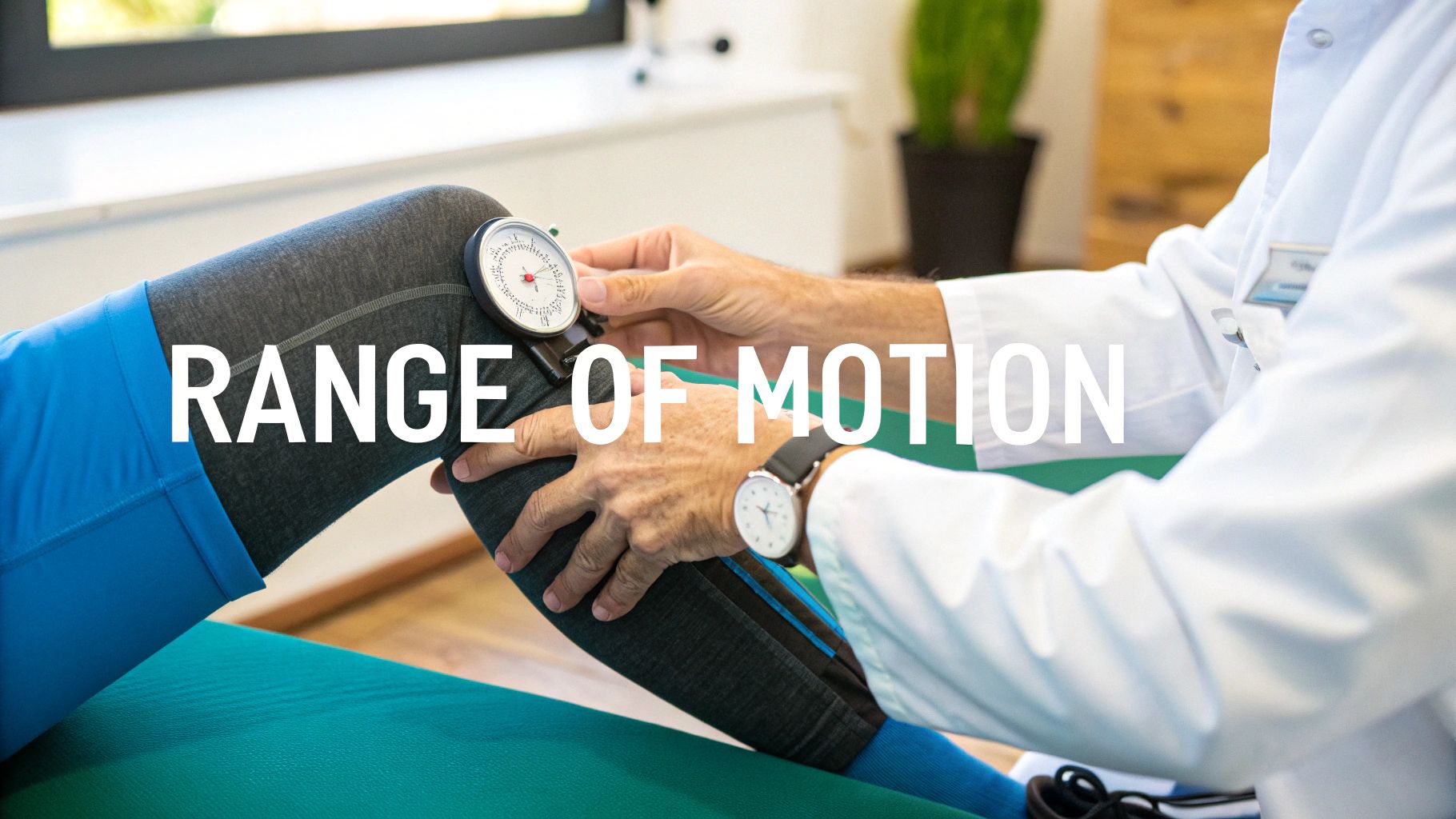
At its core, goniometry is the practice of measuring joint angles. Its impact, however, is significant. A therapist can use a goniometer to record a specific value, like 140 degrees of shoulder flexion, creating an unbiased baseline. This simple act of quantification is a cornerstone of evidence-based practice in fields like physiotherapy and sports medicine.
Take an athlete recovering from an ACL injury. The knee's extension and flexion angles can be measured on day one to establish a starting point. From there, this data becomes indispensable for:
- Diagnosing the severity of a movement limitation from conditions like arthritis or post-surgical stiffness.
- Setting clear, measurable goals that are appropriate for a patient's recovery plan.
- Objectively tracking progress over time, which gives both the clinician and the patient tangible proof of improvement.
For a quick rundown of what makes goniometry so fundamental, here’s a look at its core components.
Goniometry at a Glance
| Aspect | Description |
|---|---|
| Purpose | To objectively measure a joint's range of motion (ROM) in degrees. |
| Key Components | A stationary arm, a moving arm, and a body (fulcrum) with an angle scale. |
| Application | Used in diagnostics, goal-setting, and progress tracking across multiple disciplines. |
| Primary Benefit | Replaces subjective visual estimates with precise, repeatable numerical data. |
Ultimately, these elements combine to form a simple yet powerful system for quantifying human and animal movement.
From Guesswork to Precision
Before the goniometer became a clinical staple, assessments were largely based on visual estimation and a clinician’s personal experience. While that "feel" for movement is still valuable, it was inherently subjective and could vary between practitioners. The goniometer changed that by introducing a standardized approach.
This simple tool marked a shift toward a more scientific methodology, providing the hard data needed to support treatment plans and monitor outcomes effectively.
A goniometer doesn't just measure an angle; it provides a common language for movement professionals. An orthopedic surgeon, a physical therapist, and an athletic trainer can all look at the same number and understand exactly what it means for the patient's or athlete's function.
This is what makes the goniometer so powerful. It helps ensure that treatment decisions are grounded in solid evidence. Understanding the objective of measurement is the first step to appreciating why these tools are so vital in modern healthcare. For any clinician, mastering the goniometer is a fundamental skill for delivering effective care.
Exploring the Different Types of Goniometers
When you hear the word "goniometer," a single image probably comes to mind—that classic plastic protractor tool. In reality, a toolkit of specialized devices exists. Just as a carpenter has different saws for different tasks, a clinician may need various goniometers to accurately measure specific joints and movements.
Figuring out the nuances between these tools, from traditional manual versions to modern digital instruments, is key to capturing data that's not just accurate, but also meaningful for a patient's or athlete's recovery.
The Classic: Universal Goniometers (UG)
The most common and instantly recognizable type is the Universal Goniometer (UG). For decades, this simple, protractor-like device has been a workhorse of physiotherapy clinics. Its design is straightforward, with three core parts that work together to measure a joint's angle.
- Fulcrum: The pivot point in the center that is lined up with the joint's axis of rotation.
- Stationary Arm: This arm is aligned with the part of the body segment that is not moving.
- Moving Arm: This arm follows the body segment as it moves through its range of motion.
Despite its simplicity, a UG is only as reliable as the clinician using it. Achieving correct alignment and stabilization is crucial, making it a tool that blends the art of practice with the science of measurement.
The Modern Standard: Digital Goniometers
Stepping into the present day, digital goniometers offer a high-tech upgrade to their manual counterparts. These devices can reduce guesswork by replacing the visual scale with a clear digital display. This simple change may cut down on the potential for human error when reading the measurement.
Many models are designed for quick, single-handed operation, which can free up the other hand to better stabilize the patient's limb—a small detail that can make a big difference in a busy clinic. This digital advantage can translate into more precise and repeatable measurements. While a UG is generally considered reliable, a quality digital device can measure down to a single degree. That level of precision can be valuable when tracking small but clinically significant gains, especially with elite athletes or post-operative patients where every degree may count.
By potentially reducing subjective interpretation, digital goniometers can deliver more objective and consistent data. This boost in reliability is important for evidence-based practice, helping ensure treatment decisions are built on accurate information.
On top of that, many digital goniometers have built-in features like memory storage for previous readings, which can make documentation and progress tracking easier. To get a better sense of how these modern tools fit into the bigger picture, you can learn more about the complete suite of range of motion measurement tools available today.
Specialized Tools for Complex Joints
Beyond the universal and digital types, a family of specialized devices exists for measuring areas that are notoriously tricky to assess with a standard goniometer, like the spine and neck.
An inclinometer, for instance, is a gravity-based device. Instead of using arms that must be aligned with body parts, it measures an angle relative to the pull of gravity. This makes it suitable for assessing spinal flexion, extension, and lateral bending, as the broad curves of the back often lack the distinct bony landmarks needed for a reliable UG reading.
For the complex movements of the neck, specialized devices like Cervical Range of Motion (CROM) instruments may provide a more comprehensive assessment. These are frame-like devices worn on the patient’s head that can use multiple inclinometers and a magnetic compass to measure movement in all three planes: flexion/extension, lateral flexion, and rotation. The CROM offers a standardized way to quantify the intricate kinematics of the cervical spine.
Each of these tools has a specific job, and the choice depends on the joint being measured, the clinical setting, and the level of precision required.
Comparison of Goniometer Types
To help you decide which tool might be right for the job, here's a quick comparative overview of the most common goniometer types.
| Goniometer Type | Primary Use Case | Key Advantage | Potential Limitation |
|---|---|---|---|
| Universal Goniometer | General joint measurements (e.g., knee, elbow, shoulder). | Low cost, simple to use, widely available. | Relies heavily on clinician skill; may be less precise for small changes. |
| Digital Goniometer | High-precision tracking of any joint; clinical research. | Potentially high accuracy, reduces reading error, one-handed use. | Higher cost, requires batteries. |
| Inclinometer | Spinal range of motion (thoracic and lumbar spine). | Excellent for measuring curved surfaces without clear landmarks. | Primarily measures against gravity; may be less intuitive initially. |
| CROM/BROM Devices | Comprehensive cervical spine and back assessments. | Measures complex, multi-planar movements with high reliability. | More expensive and can be more cumbersome to set up than a simple goniometer. |
Ultimately, choosing the right goniometer is about matching the tool to the task. Whether you’re grabbing a trusted plastic UG for a quick field-side check or a precise digital device for post-surgical tracking, understanding the strengths of each one helps ensure you're gathering the best possible data to guide your care.
How to Measure Joint Angles Correctly
Getting a solid goniometer reading is much more than just lining up the arms and noting a number. It's a hands-on skill that requires a consistent, precise process. When the technique is mastered, the data becomes more reliable and repeatable—the kind of objective evidence a treatment plan can be built upon.
The process boils down to a few key principles: isolate the joint you're measuring, use the same bony landmarks every time, and ensure the patient isn't compensating with other movements. Let's walk through a classic example—measuring knee flexion—to see how it all works in practice.
Preparing for an Accurate Measurement
Before you even pick up the goniometer, the first step is positioning the patient. This isn't just about comfort; it's about isolating the joint so you're only measuring what you intend to measure. For knee flexion, this usually means having the patient lie on their back (supine).
This position helps lock the hip and pelvis in place, stopping them from tilting or rotating. That way, you know the movement is coming purely from the knee joint. A quick, clear explanation of what you're about to do also helps the patient relax and move more naturally.
The Three Pillars of Alignment
Once your patient is set, it's time to find your bony landmarks. Think of these as anatomical anchors. Using the same distinct points on the skeleton ensures your goniometer placement is consistent from one session to the next, which is critical for tracking progress.
For measuring knee flexion, you have three key points to line up:
- Fulcrum: The goniometer's pivot point goes right over the joint's axis of rotation. For the knee, that’s the lateral epicondyle of the femur—a bony bump on the outer side of the thigh bone.
- Stationary Arm: This arm stays put, aligned with the part of the body that isn't moving. You'll aim it toward the greater trochanter, the prominent bony knob on the outside of the hip.
- Moving Arm: This arm follows the motion. As the patient bends their knee, you keep this arm aligned with the lateral malleolus, which is the bony bump on the outside of their ankle.
This visual shows how the different types of goniometers—from the classic universal tool to more advanced options—are used in the clinic.
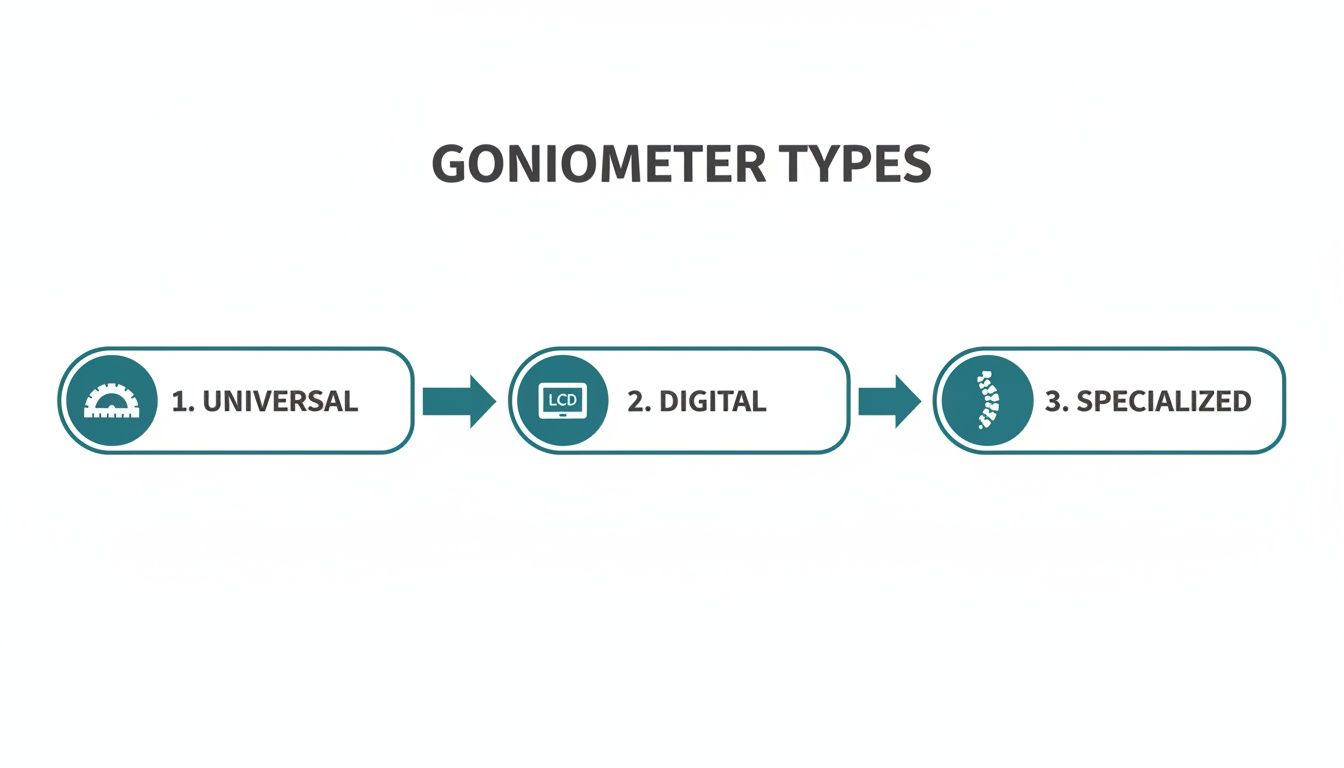
It’s a good reminder that we select our tools based on the job at hand, whether it's a quick screen with a universal goniometer or an assessment that calls for digital precision.
Taking the Final Reading
With the goniometer aligned, you’ll ask the patient to move their joint through its full available range—in this case, bending their knee as far as is comfortable. Your job is to keep the fulcrum and stationary arm perfectly still while smoothly tracking the limb's movement with the moving arm.
The final number on the goniometer is more than just a measurement; it’s a piece of objective data that forms the baseline for tracking progress. A landmark paper in Physical Therapy emphasizes that while goniometry is reliable, its validity hinges on consistent procedures, from patient positioning to landmark palpation (1).
Once you have the reading, documenting it accurately is just as important as getting it right in the first place. Good notes allow you to track changes with confidence over weeks and months. To sharpen your documentation skills, our guide on how to document range of motion offers some practical tips for clinical record-keeping. By mastering this systematic approach, you turn a simple protractor into a powerful tool for making informed clinical decisions.
Understanding Measurement Reliability and Validity
In the world of clinical data, getting a number is only the first step. For that number to be meaningful, it has to be both reliable and valid. These two concepts are the bedrock of trustworthy measurement. They ensure that when you use a goniometer, the data you're collecting is both consistent and accurate.
Reliability refers to consistency. If you measure an athlete's shoulder rotation three times in a row, do you get nearly the same number each time? If so, your method is reliable.
Validity, on the other hand, is about accuracy. Does your measurement truly represent the joint’s actual range of motion? You can have a measurement that's reliable but not valid—imagine your goniometer is misaligned the same way every time. You'll get consistent readings, but they'll all be inaccurate. The goal is to achieve both.
Intra-Rater vs. Inter-Rater Reliability
When we discuss reliability in goniometry, it splits into two main types. Understanding the difference is crucial for any clinic or team that wants to standardize assessments.
- Intra-Rater Reliability: This refers to the consistency of measurements taken by a single clinician. If you measure a patient's knee flexion today and then again tomorrow, how close are your results? High intra-rater reliability is the hallmark of a skilled, systematic practitioner.
- Inter-Rater Reliability: This examines the consistency of results between different clinicians. If you and a colleague both measure the same patient's shoulder, do you arrive at the same number? High inter-rater reliability is important for ensuring continuity of care.
To achieve high reliability, standardized procedures are essential for everything: patient positioning, finding bony landmarks, and aligning the goniometer (1).
The Impact of Technique and Tool Choice
The quality of your data comes down to two things: your technique and your tool. A classic universal goniometer is a clinical staple, but its accuracy is dependent on your skill. Small variations in where you place the fulcrum or how you align the arms can affect the reading.
Research suggests that while a trained clinician can achieve good reliability with a manual goniometer, there can be an error margin of approximately 5 degrees. That amount may be enough to miss small yet clinically significant changes in a patient's range of motion (1).
This is where modern tools may offer an advantage. Digital goniometers can eliminate one of the biggest sources of human error: reading the small hash marks on a plastic scale. By providing a clear digital readout, they take some of the guesswork out of the equation.
This simple change can often give both intra-rater and inter-rater reliability a boost. With less room for human error, high-quality digital devices may shrink that margin of error. That's a level of precision that allows for finer tracking of a patient's progress.
Interpreting the Numbers with Caution
Even with the best tools and technique, ROM data must be interpreted with a critical, experienced eye. A five-degree improvement in knee flexion might not seem like much on paper, but for a post-operative patient, it could represent a significant leap in their ability to function.
Context is everything. To make smart judgments, clinicians compare a patient's data against established benchmarks. You can learn more about how this works by exploring the definition of normative data and seeing how it guides clinical decisions. This context helps you determine if a change is just a number or a truly meaningful improvement for that individual.
Ultimately, understanding what a goniometer is goes beyond learning how to use it. It means deeply understanding the principles that make its measurements trustworthy. By staying focused on reliability and validity, you ensure every assessment you make is built on a foundation of solid, actionable data.
Goniometry Applications Across Disciplines

While the goniometer is a classic tool in human physical therapy, its real power lies in its adaptability. It provides objective data that shapes decisions in a wide range of professional fields.
Whether you're in a rehab clinic, an athletic training room, or a veterinary office, the fundamental principles of measuring a joint’s range of motion are the same. This shared language of degrees and angles empowers experts to pinpoint limitations and track progress.
Physical Therapy After ACL Surgery
In a post-operative setting, a goniometer is a roadmap to recovery. Let’s consider an athlete rehabbing from an Anterior Cruciate Ligament (ACL) reconstruction.
One of the first major hurdles is achieving full knee extension. Falling short by even a few degrees, an issue known as an extension deficit, can lead to numerous problems, from an altered gait to a higher risk of long-term osteoarthritis (1).
A physical therapist will use a goniometer at each session to track this with precision. Documenting a change from -5 degrees of extension to a perfect 0 degrees isn't just a number; it's objective proof that the rehab plan is on track. This data gives a clinician the confidence to progress their patient to the next phase of recovery.
Athletic Training for Injury Prevention
For athletic trainers, goniometry is a valuable tool for injury prevention. It allows them to build movement profiles for each athlete, establishing a baseline for their range of motion (ROM) before the season starts.
A classic example is screening baseball pitchers. The repetitive motion of throwing puts incredible stress on the shoulder joint. Over time, many pitchers develop a decrease in shoulder internal rotation on their throwing arm, a condition called Glenohumeral Internal Rotation Deficit (GIRD).
Research suggests that when this loss of internal rotation significantly outpaces the gain in external rotation, it has been linked to a higher risk of shoulder and elbow injuries (1). An athletic trainer can use a goniometer to screen the entire pitching staff for this imbalance, flagging at-risk athletes for targeted mobility work before they experience pain.
This kind of proactive screening shifts the focus from reactive treatment to smart prevention, helping keep athletes on the field.
A Role in Veterinary Medicine
The goniometer's usefulness extends to veterinary medicine, where practitioners apply the same principles to assess the joint health of animals.
A common application is managing canine hip dysplasia. A veterinarian can use a goniometer to measure a dog’s hip extension angle. A noticeable loss of extension can be an early warning sign of the arthritic changes associated with dysplasia. This allows for early intervention, such as starting joint supplements or beginning physical therapy. As veterinary professionals integrate these tools, understanding how to streamline their practice with resources like veterinary practice management software can be key to adding new assessment protocols into their workflow.
- Canine Rehabilitation: Tracking knee flexion to ensure a dog is recovering well after cruciate ligament surgery.
- Equine Sports Medicine: Measuring the range of motion in a horse's hock joint to evaluate its recovery from an injury.
These examples make one thing clear: knowing what a goniometer is and how to use it is a fundamental skill. Whether the patient is a star athlete or a beloved pet, objective ROM data provides the unbiased information needed to deliver effective care.
References
- Gajdosik RL, Bohannon RW. Clinical measurement of range of motion. Review of goniometry emphasizing reliability and validity. Phys Ther. 1987 Dec;67(12):1867-72.
Choosing the Right Goniometer for Your Practice
Picking the right goniometer is a strategic decision that should fit your clinical environment, workflow, and standard of care. With options ranging from the classic universal goniometer to high-precision digital devices, the "best" choice depends on your specific situation.
Ultimately, you're weighing the simplicity and low cost of a manual tool against the potential for enhanced accuracy and efficiency of a digital one. This choice will directly shape how you collect, interpret, and use range of motion data.
Evaluating Your Clinical Needs
First, consider what your day-to-day looks like. Are you performing quick assessments on the sidelines, or are you in a busy outpatient clinic where documenting progress for insurance is essential?
- Fast-Paced, High-Volume Clinics: In settings where every minute counts, digital goniometers can be a game-changer. They provide quick, easy-to-read measurements, and many can be used with one hand, freeing the other to stabilize the patient.
- Field-Side or Mobile Assessments: For an athletic trainer or a therapist who makes house calls, a sturdy plastic universal goniometer is a reliable choice. It’s inexpensive, durable, and doesn’t need batteries.
- Research or Precision-Focused Practice: When you're tracking small but clinically meaningful changes—think post-op recovery or neurological rehab—the superior accuracy of a digital device may be preferable. Reducing a potential margin of error can make a significant difference in how you guide treatment.
The choice between manual and digital often involves a trade-off between cost and data quality. While a universal goniometer is a budget-friendly staple, a digital device can be an investment in higher precision and potentially cleaner documentation.
The Role of Budget and Data Integration
Of course, budget is always a factor. A universal goniometer has no ongoing costs, but a digital device may offer returns in time saved on charting and the value of higher-quality data.
You should also consider how your clinic handles health records. Some digital goniometers can store past measurements or even sync with Electronic Health Record (EHR) systems. This can help eliminate manual entry errors and build a seamless, objective timeline of patient progress. For help outfitting your entire workspace, some resources specialize in finding the right lab equipment and furniture.
At the end of the day, it's all about finding the right balance for your practice. By taking a hard look at your workflow and clinical demands, you can invest in a goniometer that doesn’t just do the job—it actively enhances the quality of care you deliver.
Your Goniometry Questions Answered
Even when you are familiar with a goniometer, practical questions often arise. Here are some quick answers to common questions, helping you use your goniometer with more confidence.
How Often Should I Use a Goniometer in My Practice?
You will almost always use it during the initial assessment to get a solid baseline. From there, it's essential for regular check-ins to track progress objectively and at discharge to document the final outcome. For athletes, it's also a valuable tool for pre-season screenings and post-injury return-to-sport decisions.
Can I Use a Smartphone App Instead of a Goniometer?
It's a common question, and while many apps are available, their accuracy can be variable. It depends on the phone's sensors and the app's calibration.
Peer-reviewed studies have shown inconsistent results. For clinical decision-making and official documentation, a dedicated, medical-grade device—whether it’s a universal goniometer or a digital one—is still considered the gold standard for reliable and valid measurements (1).
If there's one key takeaway from the research, it's this: consistency is king. Whichever tool you choose, stick with that exact same device for all follow-up measurements to ensure your data is comparable and trustworthy (1).
What Is an Acceptable Margin of Error?
With a standard universal goniometer, the generally accepted margin of error is about 5 degrees. This can vary depending on the joint being measured and the experience level of the clinician (1). This 5-degree window can make it challenging to spot smaller, yet significant, changes.
This is where digital tools may offer an advantage. A high-quality digital goniometer might reduce that error, giving you the precision to detect subtle improvements that are clinically meaningful for your patient's progress.
The future of precise and efficient measurement is here. Meloq provides a suite of digital tools, including the EasyAngle digital goniometer, designed to give clinicians the objective data they need to elevate patient care. Discover how you can replace subjective assessments with medical-grade accuracy by visiting the Meloq Devices website.

Featured Product
EasyAngle Digital Goniometer
Measure range of motion with clinical precision. CE certified, Bluetooth connected.
Learn More