

What Is a Goniometer and How Does It Measure Human Movement
Team Meloq
Author
Ever wondered how a physical therapist can tell exactly how much your knee can bend after surgery? Or how a sports scientist tracks an athlete's shoulder mobility down to the degree?
The answer isn't guesswork. It's a surprisingly straightforward—yet essential—tool. At its heart, a goniometer is a specialized protractor built for the human body. It allows clinicians to measure joint angles and track range of motion (ROM) with objective, reliable data.
Your Guide to Measuring Human Movement
This guide will walk you through what a goniometer is, why it’s become a cornerstone of modern physiotherapy and sports medicine, and how it translates subjective feelings like "stiffness" into hard numbers. This isn't just about measurement; it's about creating a clear path for diagnosis, treatment planning, and tracking the entire recovery journey.
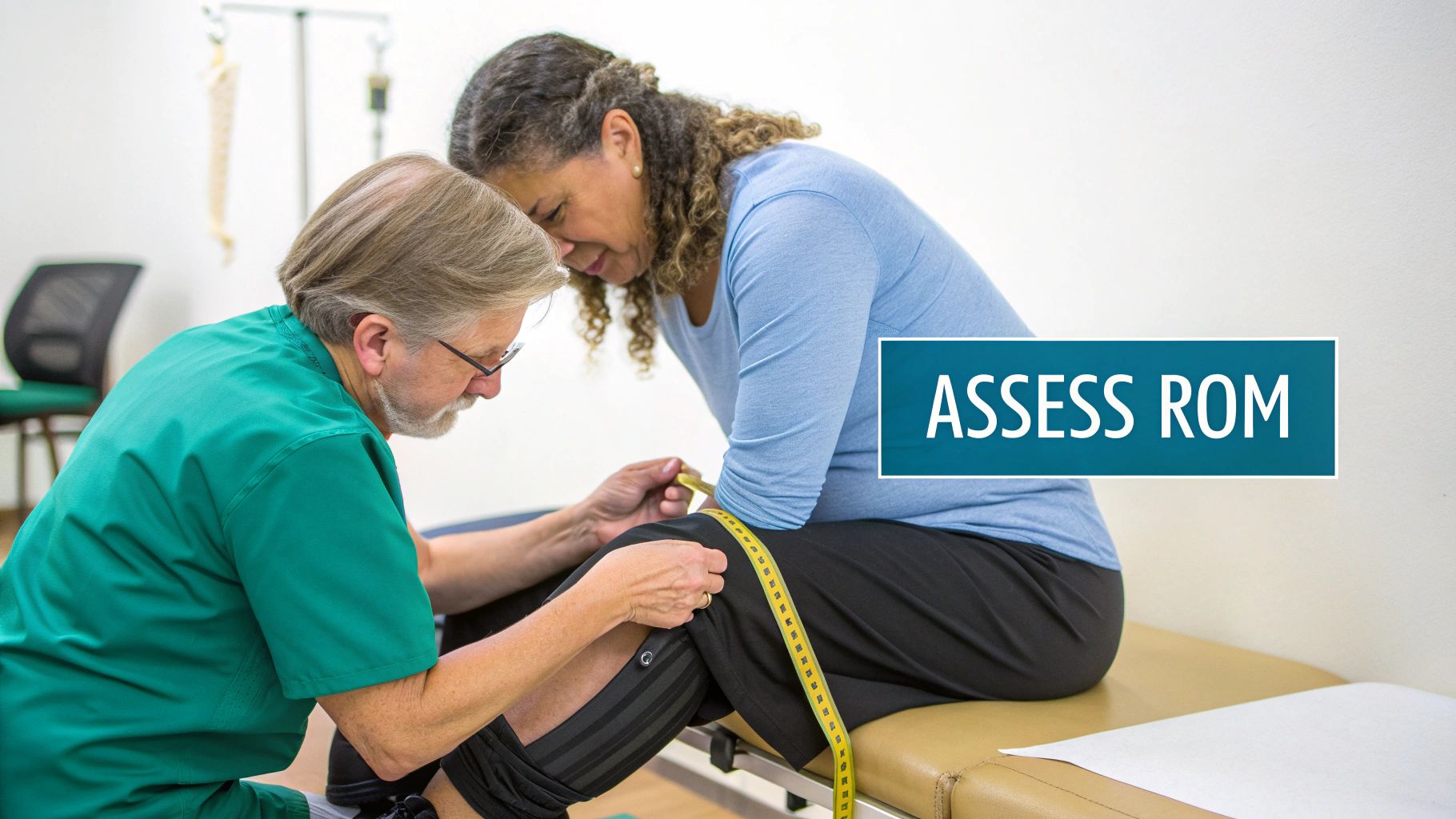
For well over a century, the goniometer has been a standard tool, allowing practitioners to move beyond vague descriptions and into the world of precise, actionable data. It provides a universal language for understanding and improving how we move.
The Core Components of a Goniometer
To understand what a goniometer does, it helps to know its three key parts. Think of them as the three points needed to define any angle.
Let's break them down in this quick table.
Goniometer At a Glance
| Component | Function |
|---|---|
| Axis (or Fulcrum) | The central pivot point. This is placed directly over the joint's axis of rotation, like the bony landmark on the side of the knee or elbow. |
| Stationary Arm | The fixed reference point. This arm is aligned with the part of the body that isn't moving (e.g., the thigh when measuring knee flexion). |
| Moving Arm | The indicator. This arm follows the limb as it moves, pointing to the final angle measurement on the circular scale. |
By carefully lining up these three components with specific bony landmarks, a clinician can obtain a consistent, repeatable measurement. It's a simple, elegant design that's fundamental to the entire analysis of movement and forms the bedrock of countless treatment plans.
A goniometer’s real power is its ability to turn physical motion into objective data. This shift from observing a movement to accurately measuring it is a core principle of evidence-based practice in rehabilitation and sports science.
This data-driven approach allows therapists to set clear recovery goals, show patients tangible proof of their progress, and justify treatment plans. It makes the invisible—improvement in joint function—visible.
The Surprising History of Measuring Angles
The goniometer's journey from mapping the stars to measuring human joints is a story of scientific evolution. Clinicians rely on it every day for physical assessments, but its principles were born from a completely different world. Long before it ever touched a patient's knee or shoulder, its earliest form was pointed toward the sky.
This leap from astronomy to anatomy was driven by a fundamental shift in medicine toward objective, quantifiable data. As healthcare evolved beyond purely descriptive observations, practitioners needed tools that could deliver precise, repeatable measurements. The goniometer, with its brilliantly simple design for measuring angles, was a perfect fit for this new, evidence-based approach.
From Celestial Bodies to Human Joints
The instrument’s roots go back centuries. The name ‘goniometer’ itself comes from the Greek words ‘gonia,’ meaning angle, and ‘metron,’ meaning to measure—a perfect description of its core job.
A primitive version first appeared back in 1538, developed by the Dutch physician and mathematician Gemma Frisius. He based his design on the astrolabe and used it to calculate the position of stars and planets relative to Earth. It's this early astronomical use that set the stage for its eventual clinical career. You can discover more about this instrumental revolution in physiotherapy and see how deep these roots really go.
This history isn't just trivia; it highlights the scientific heritage behind the tools we use in modern physiotherapy and sports rehabilitation.
Standardizing Clinical Measurement
Adopting the goniometer in orthopedics and physical therapy was a turning point for the profession. It allowed for the standardization of joint motion assessment, creating a common language for clinicians everywhere. Instead of using subjective terms like "limited" or "stiff," a therapist could now document a specific degree of movement.
This ability to capture objective data empowered clinicians to set clear baselines, track patient progress with undeniable evidence, and refine treatment protocols based on measurable outcomes.
It’s important to remember this context. The goniometer isn't just a piece of plastic or metal. It represents a foundational shift toward the scientific, data-driven practice that defines modern healthcare, ensuring every measurement taken has a legacy of precision behind it.
Exploring the Modern Goniometer Toolkit
Not all goniometers are the same. A modern clinician's toolkit includes a collection of devices, each suited for a different job. There are tools for quick bedside checks and others for high-stakes research. Knowing the difference is key to picking the right instrument for the right patient.
The most recognized is the universal goniometer, usually a classic clear plastic protractor. It’s the workhorse of most physical therapy clinics because it's inexpensive, portable, and straightforward. It requires a skilled hand to align its axis and arms perfectly with anatomical landmarks, but for a trained professional, it delivers reliable data for everyday practice.
Still, the classic design isn’t without its challenges. Achieving consistent measurements between different therapists (inter-rater reliability) can be difficult. Even a small shift in alignment can affect the reading, which is why more advanced tools have been developed to improve precision.
The Rise of Digital Precision
This is where digital goniometers and inclinometers have made a significant difference. These devices replace the manual scale with an electronic sensor and a digital display, providing an instant, clear reading. This simple change helps eliminate the guesswork of trying to read a tiny hash mark from an awkward angle, which naturally makes measurements more consistent.
Studies comparing digital tools to traditional ones often find that the digital versions demonstrate better reliability. Some research suggests that digital inclinometers can achieve higher intraclass correlation coefficients (ICCs)—a key statistical measure of reliability—than a standard goniometer, meaning results are more consistent from one session to the next (1). This is particularly important when tracking small, hard-won improvements in a patient's recovery. You can find a great breakdown of the different options in this guide to range of motion measurement tools.
You can trace the goniometer's journey from astronomy to medicine in the graphic below.
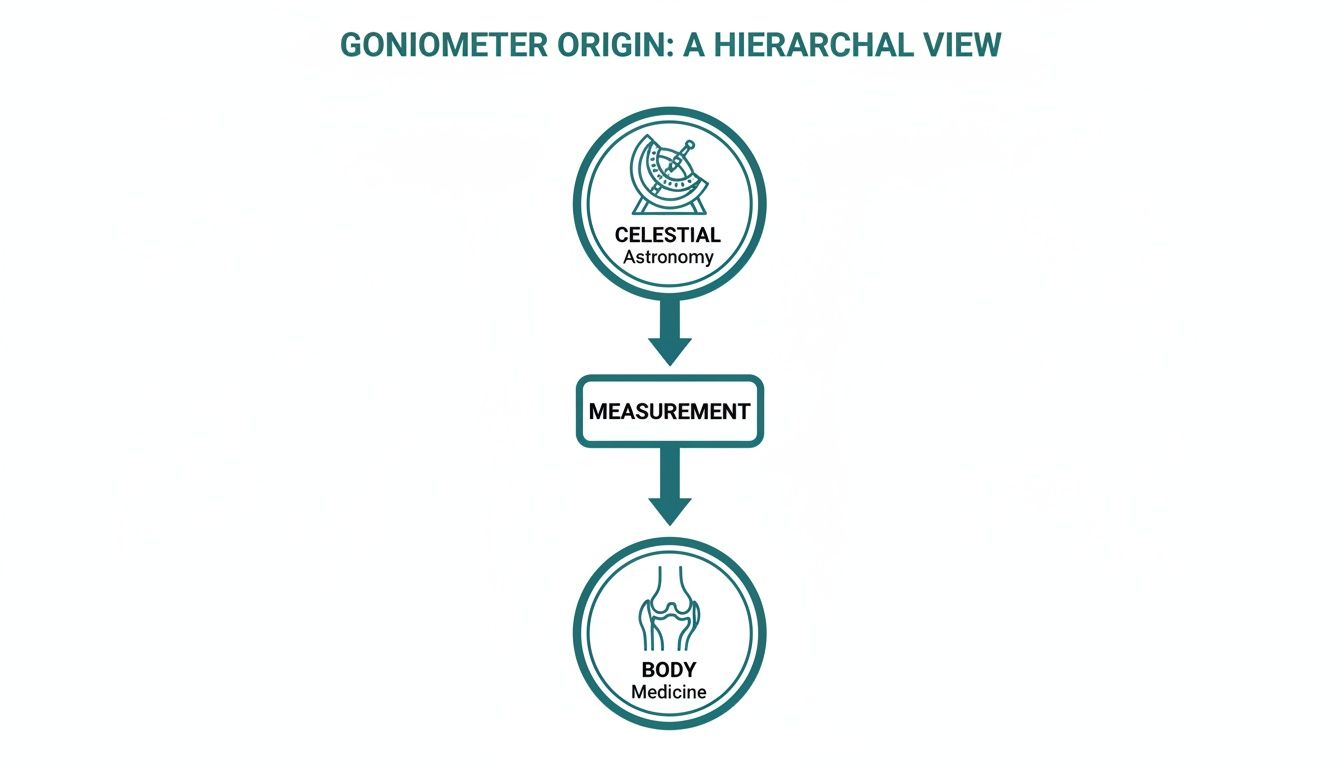
It’s fascinating to see how the core idea of measuring angles, first used to map the stars, was eventually adapted to map the mechanics of the human body.
Specialized Tools for Specific Needs
Beyond general-purpose goniometers, there is a whole family of specialized instruments designed for unique situations. These are built to capture data that a universal goniometer may not be suited for.
- Electrogoniometers: These are commonly used in biomechanics research. Sensors are strapped to a joint, and they continuously record angles during movement, which is ideal for getting dynamic, real-time data for gait analysis or studying complex athletic motions.
- Specialized Joint Goniometers: Some joints are anatomically complex to measure. For these, there are tools like the finger goniometer or the scoliometer for the spine. They are shaped to fit the unique contours of the body part, which can improve the accuracy of the assessment.
- Smartphone Apps: By using the accelerometers and gyroscopes in phones, many apps now function as goniometers. Research indicates many of them can provide valid and reliable measurements, making them a convenient option in certain contexts (2).
Comparison of Common Goniometer Types
To help visualize the options, this table breaks down the most common goniometer types you'll encounter in clinical practice. It’s a quick-reference guide highlighting where each tool shines and what its limitations are.
| Goniometer Type | Primary Use | Pros | Cons |
|---|---|---|---|
| Manual (Universal) | General ROM assessment in most clinical settings. | Low cost, portable, widely available, no batteries needed. | Requires significant skill; prone to inter-rater variability. |
| Digital/Inclinometer | General ROM, spinal measurements, situations needing higher precision. | Easy-to-read display, improved reliability, reduces human error. | More expensive, requires batteries, can be slightly bulkier. |
| Electrogoniometer | Biomechanics research, dynamic motion analysis (e.g., gait labs). | Provides continuous, real-time data during movement. | Very expensive, complex setup, not practical for routine clinical use. |
| Scoliometer | Screening and measuring trunk rotation in cases of scoliosis. | Specifically designed for spinal assessment, non-invasive. | Highly specialized; limited to one specific measurement. |
| BROM/CROM | Measuring cervical spine range of motion. | Designed to isolate neck movements accurately. | Specialized and more costly than a universal goniometer. |
Ultimately, choosing the right goniometer depends on the clinical question you’re trying to answer. A simple plastic goniometer is often sufficient for a routine knee check-up. But if you’re analyzing a sprinter's stride, you might require the capabilities of an electrogoniometer.
By understanding this diverse toolkit, you can move past a one-size-fits-all mindset. Picking the right device ensures the data you collect is not only accurate but also perfectly suited to guide your patient’s diagnosis, treatment plan, and recovery.
Mastering Goniometry for Reliable Results
Getting a precise measurement with a goniometer is more than just lining up its arms and reading a number. True accuracy comes from a disciplined, standardized approach that turns a simple tool into a powerful diagnostic instrument. This mastery separates a rough estimate from a clinically valid data point.
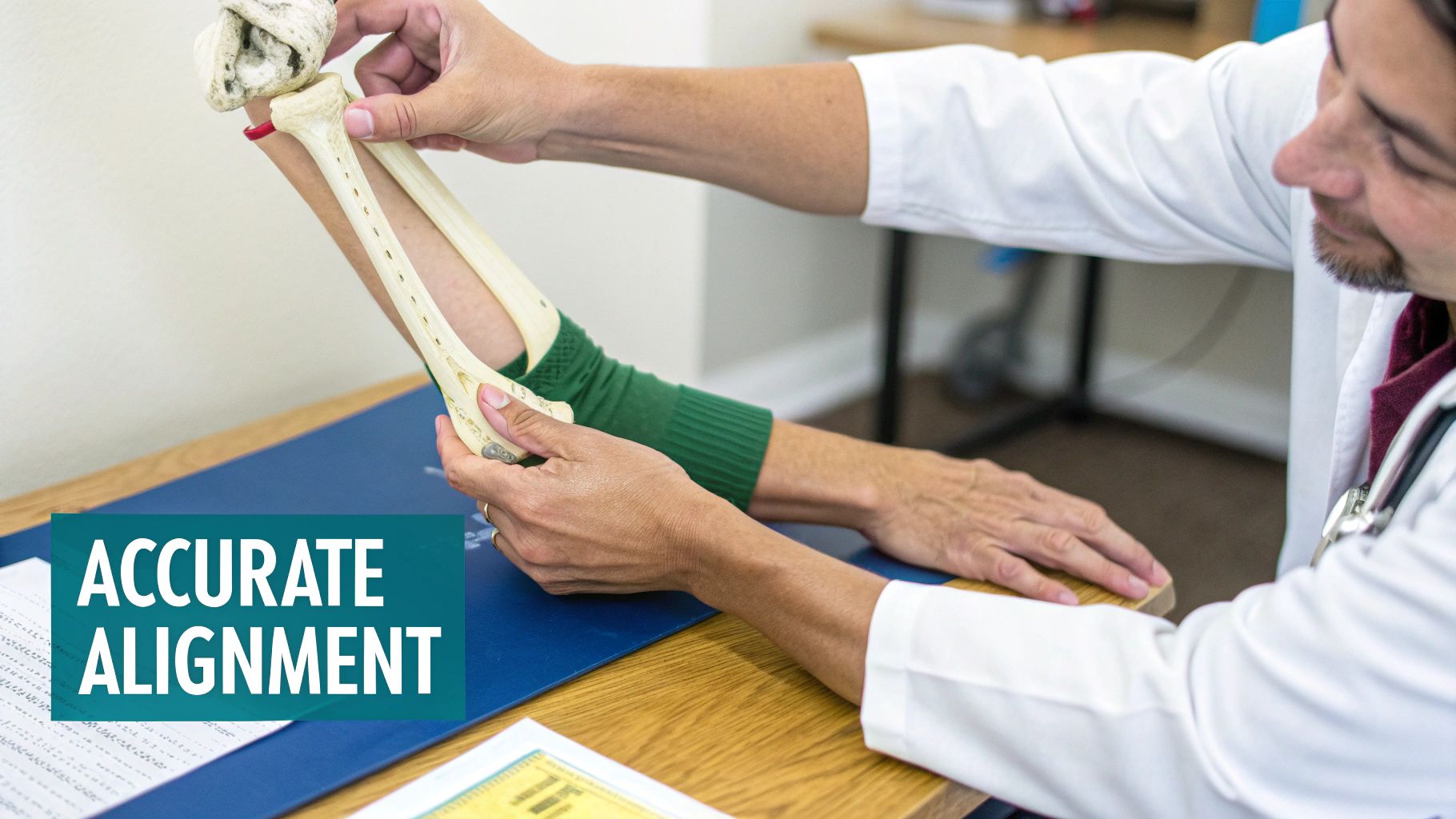
The entire process hinges on one thing: consistency. Whether you're tracking a single patient's progress over several weeks or ensuring your entire clinical team measures the same way, standardized procedures are non-negotiable. This commitment to a repeatable method is what builds trust in your data.
The Foundation of an Accurate Measurement
Every solid reading starts long before the goniometer even touches the patient. The first step, proper patient positioning, is critical for isolating the joint you intend to measure. For instance, when measuring shoulder abduction, the patient must be positioned to prevent trunk or scapular movement from artificially inflating the number.
Once they're positioned, the next job is to correctly identify bony landmarks. These palpable points on the skeleton serve as consistent anchors for the goniometer. Failing to locate these landmarks is a common source of error.
Finally, the goniometer itself must be aligned with care:
- Axis Alignment: The goniometer's axis (the pivot point) must be placed over the joint's estimated center of rotation.
- Stationary Arm: This arm lines up with the proximal, non-moving part of the body, creating a stable baseline to measure from.
- Moving Arm: This arm follows the distal segment as it moves through its range, ultimately pointing to the final measurement.
Avoiding Common Measurement Pitfalls
Even with a perfect setup, subtle mistakes can compromise your data. Being aware of these common errors is half the battle in ensuring your measurements are trustworthy.
One frequent mistake is parallax error. This happens when you read the measurement scale from an angle instead of looking at it straight-on, at eye level. This can easily skew the reading by several degrees—a significant amount when tracking incremental progress.
Another critical error is missing patient compensation. A patient might unconsciously tilt their pelvis to achieve more hip flexion or hike their shoulder during an arm movement. As a clinician, you must observe the entire body, not just the joint, to catch these compensatory movements before they distort your results.
"To ensure inter-rater reliability—consistency between different clinicians—and intra-rater reliability—consistency for a single clinician over time—adherence to a strict, documented protocol is essential. Without it, measurements lose their clinical value for tracking outcomes." (1)
Documenting these precise measurements is just as important as taking them. For a deeper dive into best practices, check out our guide on how to document range of motion.
Mastering goniometry takes dedication and hands-on practice. If you're looking to broaden your clinical toolkit, you can explore a wide range of other practical skills development resources. By adhering to these fundamental principles and steering clear of common mistakes, you can be confident that your goniometric data is a true and reliable reflection of your patient's function.
How ROM Data Shapes Patient Outcomes
Goniometry is more than just collecting numbers. It's about turning that data into smarter clinical decisions and, ultimately, better real-world results for patients.
Think of objective Range of Motion (ROM) data as a clear, unbiased language. It helps shape a patient's entire journey, from the initial diagnosis all the way to a full recovery.
This data-driven approach cuts through the ambiguity of subjective assessments. Instead of relying on vague descriptions like "stiff" or "limited," you can document a precise measurement. This provides an indisputable baseline of your patient's condition.
Guiding Treatment and Setting Realistic Goals
With a clear baseline, therapists can set specific, achievable goals. This is where goniometry truly shines—it transforms a vague hope for improvement into a structured, measurable plan.
For example, a patient recovering from ACL reconstruction can have their knee flexion progress tracked week by week with a goniometer. This data gives immediate feedback on whether the rehabilitation protocol is effective or if it needs modification, keeping the patient on an efficient path to recovery.
In sports, a performance coach might assess a pitcher's shoulder rotation to help determine their readiness to return to play. If the ROM data does not meet pre-injury levels or established benchmarks, it provides clear evidence that they may not be ready. This simple check can be a key factor in preventing re-injury.
Documenting Progress and Proving Efficacy
Objective ROM data is also a powerful communication tool. It provides tangible proof of progress that can help keep patients motivated when they can see their hard work paying off in the numbers.
This evidence is just as crucial on the administrative side. Clear documentation of improving ROM provides the justification needed when communicating treatment plans to insurance providers. It demonstrates the medical necessity and effectiveness of interventions.
A goniometer reading acts as a universal translator. It communicates a patient's functional status to the patient, to other members of the healthcare team, and to insurers, ensuring everyone is working from the same objective evidence.
At the end of the day, goniometry is a cornerstone of patient-centered care. Whether it’s an occupational therapist measuring wrist extension to design an ergonomic solution or a physical therapist guiding post-operative rehabilitation, the goal is always the same. Understanding the objective of measurement is key to using this data effectively to tailor treatments, validate progress, and empower patients with confidence in their recovery.
The Shift to Digital Measurement Tools
The manual goniometer is still a cornerstone of physiotherapy and sports medicine, but the move to digital is changing the game. This is not just about adopting new technology; it’s a practical evolution that addresses some of the real-world limitations of traditional tools, pushing us toward better precision and a smoother clinical workflow. For a growing number of clinicians, upgrading isn't a question of if, but when.
The biggest driver here is the potential for improved accuracy and reliability. Digital goniometers and inclinometers can take the guesswork out of reading a manual scale, especially in awkward positions. This may reduce the variability between different therapists assessing the same patient, leading to more consistent data the whole team can trust.
A Better Workflow for You, a Better Experience for Your Patient
One of the most profound benefits is also one of the simplest: many digital devices allow for measurement with just one hand. This might sound like a small detail, but in practice, it’s a significant advantage. It frees up the other hand to properly support the patient's limb, ensuring you isolate the joint correctly and guide them through a controlled, safe movement.
Not only can this stability lead to a more precise reading, but it also creates a much more comfortable and secure experience for the patient. It makes the whole process more efficient, allowing for faster assessments without compromising on quality.
With an instant digital readout, you can sidestep the risk of parallax error—the classic mistake of misreading the scale from an angle. Plus, data can often be saved directly to a patient's digital file, which means fewer transcription errors and a cleaner data trail of their progress over time.
This move toward objective data is part of a much larger trend across the wellness industry. We're seeing a similar push for hard numbers everywhere; for instance, it's worth checking out how technology in gyms is transforming fitness, including smart equipment, which reflects the same demand for objectivity that we see in the clinic. The shift from analog to digital isn't just about convenience—it's about raising the standard of care by making every measurement as reliable as possible.
Common Questions About Goniometers
Even after you understand what a goniometer is, practical questions often arise. Let's tackle some of the most common ones with clear, evidence-based answers.
How Do You Ensure Measurement Reliability?
In other words, how do you make sure your goniometer measurements are consistent between different therapists?
Achieving good inter-rater reliability is crucial, and it comes down to strictly following standardized protocols (1). This is a professional necessity. It means everyone on the team uses the same patient positioning, palpates and marks the exact same anatomical landmarks, and uses the same type of goniometer for every assessment.
Regular team training is important for reducing small differences between therapists. Digital tools can also be beneficial in this area, as they can reduce subjective reading errors.
Can I Just Use a Smartphone App Instead of a Clinical Goniometer?
This question comes up frequently. There are many apps available, and while convenient, their clinical validity requires careful consideration.
Some studies show that certain apps can provide reliable measurements, but their accuracy depends on the phone's internal sensors and the app's software (2). For formal documentation or making critical clinical decisions, the evidence generally supports using a dedicated, validated medical device to meet professional standards of care.
A key takeaway from research is to be consistent. Whether you use a universal goniometer or an app, sticking to the same instrument for follow-up measurements is the only way to reliably track a patient's progress, as readings can differ between devices (3).
What’s the Difference Between Active vs. Passive Range of Motion?
This is a fundamental concept, and clarifying it is important because each measurement tells you something different about the joint.
- Active Range of Motion (AROM) is how far a patient can move a joint using their own muscles. It's a measure of their functional ability—what they can actually do.
- Passive Range of Motion (PROM) is the measurement you get when the clinician moves the joint for the patient. This assesses the joint's inert structures, like the capsule and ligaments, and is typically slightly greater than AROM.
References
- Gajdosik RL, Bohannon RW. Clinical measurement of range of motion. Review of goniometry emphasizing reliability and validity. Phys Ther. 1987 Dec;67(12):1867-72.
- Mourcou Q, Fleury A, Diot B, Franco C, Vuillerme N. Mobile and wearable technology for the measurement of joint range of motion: a systematic review and meta-analysis. J Biomech. 2015;48(11):2760-70.
- Kolber MJ, Pizzini M, Robinson A, Yanez D, Hanney WJ. The reliability and concurrent validity of a digital inclinometer and universal goniometer in assessing passive hip range of motion in healthy subjects. Int J Sports Phys Ther. 2013 Jun;8(3):324-32.
Ready to take your assessments to the next level? The Meloq ecosystem, featuring the EasyAngle digital goniometer, delivers objective, one-handed measurements that fit right into your workflow and elevate patient care. Find out how precise data can make all the difference at https://www.meloqdevices.com.

Featured Product
EasyAngle Digital Goniometer
Measure range of motion with clinical precision. CE certified, Bluetooth connected.
Learn More