

Range of motion testing: A Practical Guide to Assessments
Team Meloq
Author
Assessing movement is fundamental to physiotherapy and rehabilitation, and range of motion testing is the bedrock of this process. It is the clinical practice of measuring the extent of movement a person has around a specific joint. This provides a crucial piece of the puzzle, helping clinicians to identify movement limitations, track recovery progress, and build effective rehabilitation plans.
This is achieved by quantifying how far a person can move a joint independently (active range of motion) or how far a clinician can move it for them (passive range of motion).
Understanding the Fundamentals of Movement Assessment
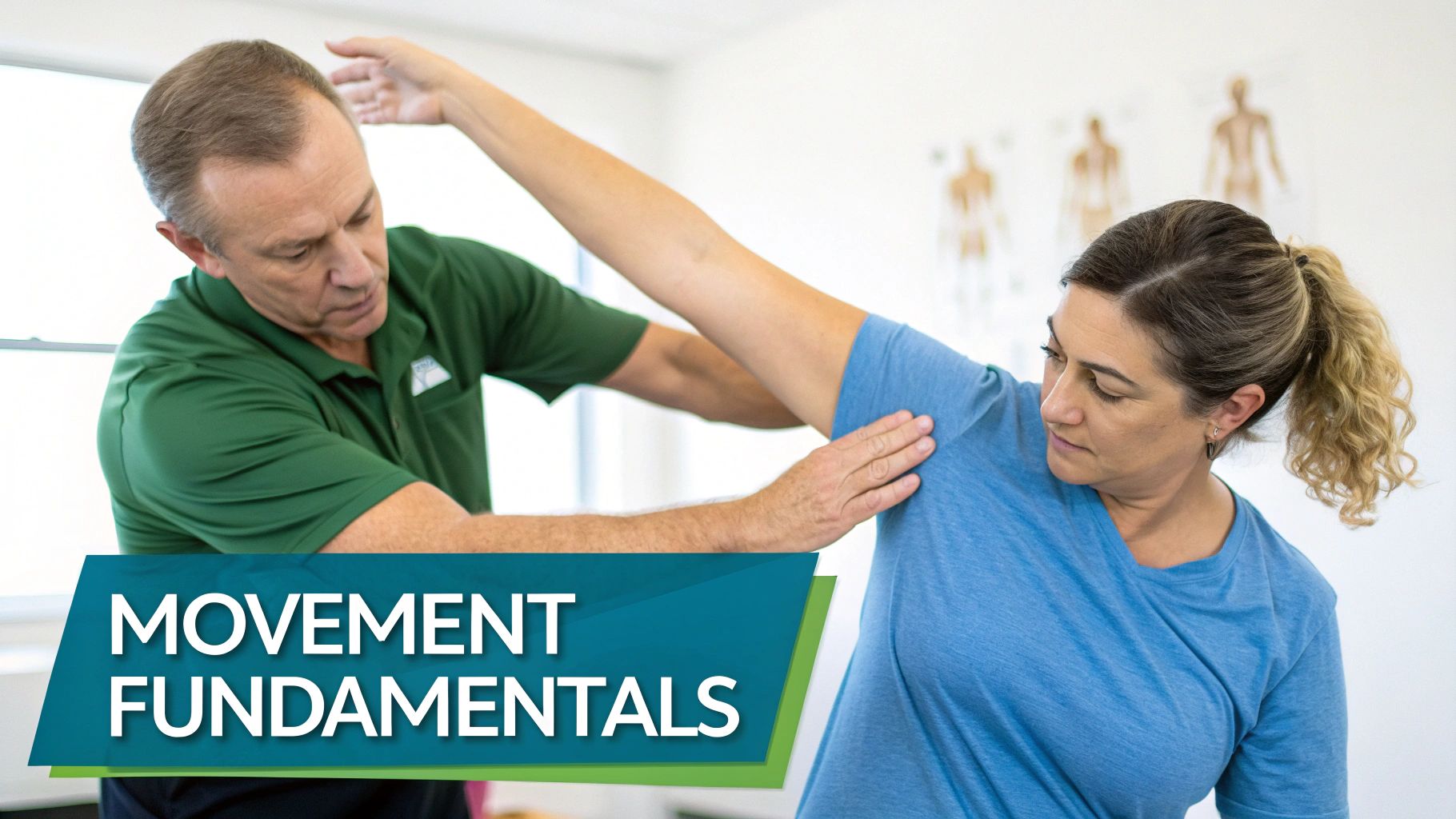
Range of motion (ROM) can be considered a vital sign for the body's movement system, much like blood pressure is for cardiovascular health. It is a foundational metric that provides information about the health of a joint, the flexibility of surrounding muscles, and a person's functional capabilities. Without this objective data, creating an effective recovery roadmap becomes speculative.
However, this assessment is not a uniform process. The first critical distinction is between active and passive movements, which offer different but equally important clinical insights.
Active vs Passive Range of Motion
Active Range of Motion (AROM) is straightforward: it is the extent to which a person can move their own joint without external assistance. For example, a person lifting their arm as high as possible. This simple test reveals information about their willingness to move, muscle strength, and motor control.
Conversely, Passive Range of Motion (PROM) occurs when a therapist moves the joint for the person. This eliminates the contribution of the person's own muscle strength and isolates the joint's true mechanical capacity. PROM is key for identifying issues with non-contractile tissues such as the joint capsule, ligaments, or cartilage (1).
A simple analogy is opening a door. AROM is you pushing the door open yourself—it depends on your own strength. PROM is someone else pushing the door for you—it shows how freely the hinges can move, regardless of your effort.
A significant difference between AROM and PROM can provide valuable diagnostic clues. For instance, if passive motion is much greater than active motion, it may suggest muscle weakness or a neurological issue that prevents the person from reaching their full potential (1).
The Importance of End-Feel
As a therapist gently moves a joint to its passive limit, a distinct sensation is felt at the end of the movement. This is called the end-feel, and this tactile feedback provides valuable information about the cause of the limitation.
Different tissues produce different sensations:
- Firm: A springy, leather-like sensation. This often indicates muscular or capsular tightness.
- Hard: An abrupt, bony block. This is expected when bone meets bone, such as when fully straightening the elbow.
- Soft: A cushioned feeling, usually when soft tissue (like the biceps muscle) is compressed. This is also considered normal.
- Empty: This occurs when the patient stops the movement due to significant pain, long before any real mechanical limit is reached.
Understanding these fundamentals is the first step toward performing a skillful range of motion testing assessment. These concepts, often combined with tools like goniometers, are used to gather objective, reliable data. You can learn more about what a goniometer is used for in a detailed guide. This foundational knowledge is essential for setting realistic goals and objectively tracking a patient's entire recovery journey.
From Guesswork to Precision in ROM Testing
Effective range of motion testing depends on consistency. Without it, tracking a patient's progress is a subjective exercise, with results varying from one clinician to another. For a long time, clinicians often relied on visual estimations to judge joint movement. This approach, while well-intentioned, created a significant problem for patient care due to its lack of reliability.
An assessment of a patient's shoulder flexion could yield wildly different numbers depending on which therapist was conducting the test. This lack of a universal standard made it nearly impossible to reliably document improvement, share data between providers, or conduct meaningful research. The fields of physical therapy and rehabilitation needed a common language for movement.
The Dawn of Standardization
The turning point occurred around the mid-20th century, a landmark period for rehabilitation medicine. Before the 1960s, visual approximation was the primary method for ROM assessment, a technique that was neither consistent nor reproducible. Recognizing this critical gap, organizations like the American Academy of Orthopaedic Surgeons (AAOS) initiated the process of creating universal, standardized measurement techniques.
After multiple revisions based on extensive clinical feedback and research, the AAOS published its foundational techniques in a booklet in 1965. This guide was adopted by orthopaedic societies worldwide, establishing the first true gold standard for range of motion testing. You can explore more about this pivotal history of measurement to understand its impact.
This was not just a minor procedural update; it represented a fundamental shift in clinical philosophy. It established the principle that for a measurement to be clinically useful, it must be both reproducible and reliable.
Why Rigorous Protocols Still Matter Today
The legacy of that standardization effort is evident in every modern physiotherapy clinic. The protocols established by the AAOS and other organizations ensure that a 140-degree knee flexion measurement in one clinic means the same thing in another, anywhere in the world. This consistency is the bedrock of evidence-based practice.
Today's rigorous protocols are vital because they allow clinicians to confidently determine if a treatment is effective. They transform patient assessment from an art based on intuition into a science grounded in objective data.
This precision has profound implications for individual patient care and the field as a whole.
- For Patients: Standardized testing means their progress is real and measurable. Seeing their numbers improve on a chart can be a powerful motivator during a long rehabilitation journey.
- For Clinicians: It provides a clear, objective foundation for making decisions. If a patient's shoulder abduction has not improved after two weeks of a specific intervention, the data provides a solid reason to adjust the treatment plan.
- For Research: Universal protocols allow scientists to pool data from multiple studies, leading to more powerful conclusions about which rehabilitation techniques are most effective.
Ultimately, the transition from estimation to precise, standardized range of motion testing laid the groundwork for the modern tools and technologies we use today. It underscored the non-negotiable value of accuracy and set the stage for the next evolution in measurement—the leap from manual tools to more reliable digital solutions.
Choosing Your Tools for Accurate ROM Measurement
Transitioning from subjective "eyeballing" to objective data in range of motion testing requires the right tools. These instruments act as specialized lenses that bring joint movement into sharp focus, allowing for precise, repeatable measurements. The choice of tool often depends on the specific joint, clinical needs, and the desired level of precision.
The most recognized and widely used tool is the goniometer. Its design is simple: a protractor with two movable arms. One arm remains stationary against a body part, while the other follows the limb through its arc of motion, providing a direct angular measurement. It is the dependable workhorse for most major joints like the knee, elbow, and shoulder.
For areas like the spine, where identifying distinct bony landmarks can be challenging, clinicians often use an inclinometer. This tool measures a body part's angle relative to gravity, making it ideal for assessing spinal flexion and extension with confidence.
The Rise of Digital Measurement
While manual tools have been the standard for decades, digital technology represents a significant advancement in both accuracy and efficiency. Digital goniometers and inclinometers provide an instant, clear readout, removing the guesswork associated with reading small markings on a traditional goniometer.
Some studies suggest these digital devices show higher inter-rater reliability, meaning two different clinicians are more likely to obtain the same measurement on the same patient (1). This consistency is critical for tracking progress accurately over time and ensuring all members of the care team are aligned.
Digital tools help standardize the process of range of motion testing. They minimize the variability that can arise from slightly different alignments or visual interpretations, effectively translating a skilled clinical assessment into a hard, objective number that is easy to record and trust.
This improvement in reliability and ease of use simplifies the entire workflow. Instead of squinting at a dial and manually recording a number, a clinician gets a precise reading with the push of a button, often with the data syncing directly to the patient's electronic health record.
Comparing Manual and Digital Tools
Deciding between traditional and modern tools involves weighing factors like cost, training, and a clinic's daily needs. Each approach has distinct advantages and potential drawbacks. A side-by-side comparison can highlight where each tool excels. For help in choosing the best fit for your practice, you can explore a detailed breakdown of various range of motion measurement tools and their applications.
Here is an example of a modern, single-handed digital goniometer and inclinometer.
This image shows how easily a digital device can be aligned with the joint axis, providing a clear, immediate readout for greater precision.
To help guide your decision, here is a direct comparison of the two approaches.
Manual vs Digital ROM Measurement Tools A Comparative Overview
| Feature | Manual Goniometer | Digital Goniometer |
|---|---|---|
| Accuracy | Good, but dependent on user skill and visual interpretation. | Excellent, with measurements often precise to 1°. |
| Reliability | Can have moderate inter-rater reliability due to user variability. | High inter-rater reliability, ensuring consistent data. |
| Ease of Use | Requires practice to align correctly and read accurately. | Intuitive, with clear digital displays and often one-handed operation. |
| Data Recording | Fully manual process; requires writing down each measurement. | Automated; many devices can store or sync data to apps. |
| Cost | Very low initial cost, making it highly accessible. | Higher initial investment, but offers long-term efficiency gains. |
Ultimately, the goal of any range of motion testing is to gather data that is both valid and reliable. While manual goniometers will always have a place in education and practice, the advantages offered by digital devices in accuracy, reliability, and workflow are becoming increasingly compelling for modern clinics focused on evidence-based care. Adopting these tools can lead to more objective assessments and, ultimately, more effective patient outcomes.
A Practical Guide to Standardized Joint Measurement Protocols
Reliable range of motion testing is not just about having the right tools; it is about using them with consistent, standardized techniques. Following established protocols is the only way to ensure that the data you collect is accurate, repeatable, and clinically meaningful. Let's walk through a practical guide for measuring key movements in the body's major joints.
Think of these protocols as a recipe for measurement. A chef follows precise steps to make a dish taste the same every time; similarly, a clinician follows standardized procedures to ensure a measurement is consistent every time. This consistency is the bedrock of high-quality patient care and effective progress tracking.
This visual flow shows how the tools we use for ROM testing have evolved, moving from the classic goniometer to more advanced digital methods.
The trend is clearly toward digital solutions, which are effective for minimizing user error and simplifying data capture.
Mastering Shoulder Measurement
The shoulder is an incredibly mobile ball-and-socket joint, which makes precise measurement critical. Proper patient positioning and stabilization are essential; otherwise, compensatory movements from the trunk or scapula may be measured instead.
For shoulder flexion and extension, the patient should lie on their back (supine) with their arm neutral at their side.
- Axis of Rotation: Place the goniometer's fulcrum over the center of the humeral head, just below the acromion process.
- Stationary Arm: Align this arm with the mid-axillary line of the trunk.
- Moving Arm: This arm follows the humerus, pointing toward the lateral epicondyle of the elbow.
For abduction, the patient remains supine but with their palm facing forward. The goniometer placement is similar, but the movement occurs in the frontal plane as the arm moves away from the body.
Assessing the Elbow and Forearm
The elbow is a simpler hinge joint, but accurate measurement still requires attention to detail. The main movements are flexion, extension, and forearm supination/pronation.
For flexion and extension, the patient can be seated or supine, but the upper arm must be stabilized, either against their side or on a supportive surface.
Proper stabilization is key. If the patient’s trunk or pelvis moves during the measurement, the recorded number will reflect that compensation, not the true joint motion. This creates flawed data that can lead to incorrect clinical decisions.
To take the measurement:
- Axis of Rotation: Position the fulcrum over the lateral epicondyle of the humerus.
- Stationary Arm: Align it with the midline of the humerus, pointing toward the acromion.
- Moving Arm: Align it with the midline of the radius, pointing toward the styloid process.
Evaluating Hip Mobility
Hip range of motion testing is crucial for assessing everything from gait and functional mobility to lower back health. The primary movements are flexion, extension, abduction, adduction, and internal/external rotation.
For hip flexion, the patient should lie supine. The key is to bring the knee toward the chest while keeping the opposite leg flat to prevent the pelvis from tilting.
- Axis of Rotation: Place the fulcrum over the greater trochanter of the femur.
- Stationary Arm: Align this arm with the midline of the pelvis.
- Moving Arm: This arm follows the femur, using the lateral femoral condyle as a reference.
Knee Flexion and Extension Protocols
After injuries or major surgeries like an ACL reconstruction, restoring knee motion is a primary goal. A healthy knee should achieve 0 degrees of extension (perfectly straight) and at least 125-135 degrees of flexion to handle daily activities.
To measure knee flexion, have the patient lie supine.
- Axis of Rotation: The fulcrum goes over the lateral condyle of the femur.
- Stationary Arm: Line it up with the greater trochanter of the femur.
- Moving Arm: This is aligned with the lateral malleolus of the fibula.
The patient then bends their knee as far as possible, and the measurement is recorded. Consistent documentation is as important as the measurement itself.
Ankle Dorsiflexion and Plantarflexion
Ankle mobility is vital for basic movements like walking, running, and squatting. The two main movements are dorsiflexion (foot moving up toward the shin) and plantarflexion (foot pointing down).
Have the patient sit or lie supine with their knee bent to isolate the ankle joint.
- Axis of Rotation: Place the fulcrum over the lateral malleolus.
- Stationary Arm: Align it with the fibular head.
- Moving Arm: Line this up parallel to the fifth metatarsal on the outside of the foot.
By mastering these standardized protocols, you can ensure your range of motion testing is reliable and provides a solid foundation for your clinical reasoning. For those looking to broaden their skill set, resources on other practical skills can offer complementary knowledge.
How to Interpret ROM Data for Better Clinical Insights
Collecting precise numbers with your range of motion testing is only the first step. The real clinical skill lies in interpreting that data—turning a degree measurement into an insight that guides your treatment strategy. This is how we move from simply recording numbers to understanding the story a joint is telling.
The first step is to compare the measurements against a reliable baseline. Clinicians often rely on normative data, which provides a snapshot of what is considered a "normal" range for a specific joint in a healthy population. These established values serve as an essential reference point, helping to quickly identify if a patient’s mobility is significantly outside the expected range.
Establishing a Baseline with Normative Data
This data comes from large-scale studies. A landmark example is the research conducted by the Centers for Disease Control and Prevention (CDC) between 2003 and 2006. This study collected comprehensive ROM measurements from over 600 individuals without known joint mobility issues, covering the elbow, shoulder, hip, knee, and ankle. These CDC measurements became instrumental for clinical decision-making and are still referenced today. You can explore the complete CDC joint range of motion study here.
However, while these population-wide norms are invaluable, they are not a universal rule. Several factors create individual variations that must be considered.
- Age: Joint mobility naturally changes throughout life, often decreasing with age.
- Sex: Research consistently shows slight but consistent differences in joint laxity and ROM between males and females (2).
- Activity Level: A gymnast will have a vastly different "normal" hip ROM compared to a powerlifter or a sedentary office worker. Their baseline is unique to their sport and lifestyle.
The most powerful baseline is often the patient's own body. Comparing the affected joint to the contralateral (unaffected) side provides a personalized, highly relevant benchmark that accounts for all their individual factors. A 10-15% difference between sides is often considered clinically significant.
From Numbers to Clinical Significance
Once you have your measurements and a solid baseline, the next step is to determine what the numbers mean for the patient's function. A 5-degree deficit in knee extension might seem small, but for a patient, it can significantly impact their gait, stability, and ability to descend stairs safely (3). You can learn more by reading about normative data in a clinical context.
Identifying clinically significant findings involves looking for key patterns:
- Limitation (Hypomobility): This is when a joint has less motion than expected. It could indicate issues like muscle tightness, scar tissue adhesion after surgery, or joint capsule stiffness.
- Excessive Motion (Hypermobility): This suggests joint instability, which might stem from ligamentous laxity or a past injury. While more motion might seem beneficial, it can increase the risk of dislocations and other injuries.
Ultimately, interpreting range of motion data is about connecting the dots. A measurement of reduced shoulder external rotation is not just a number; it is a clue that helps explain why a patient cannot reach into a high cabinet. By combining objective data with a deep understanding of the individual, you can make more confident, evidence-based decisions that lead to effective rehabilitation.
References
- Clarkson HM. Musculoskeletal assessment: Joint range of motion and manual muscle strength. 3rd ed. Philadelphia: Lippincott Williams & Wilkins; 2013.
- Soucie JM, Wang C, Forsyth A, et al. Range of motion measurements: reference values and a database for comparison studies. Haemophilia. 2011;17(3):500-507.
- Logerstedt D, Lynch A, Axe MJ, Snyder-Mackler L. Pre-operative quadriceps strength predicts IKDC2000 scores 6 months after anterior cruciate ligament reconstruction. Knee. 2013;20(3):208-212.
The Role of ROM Improvement in Therapeutic Outcomes
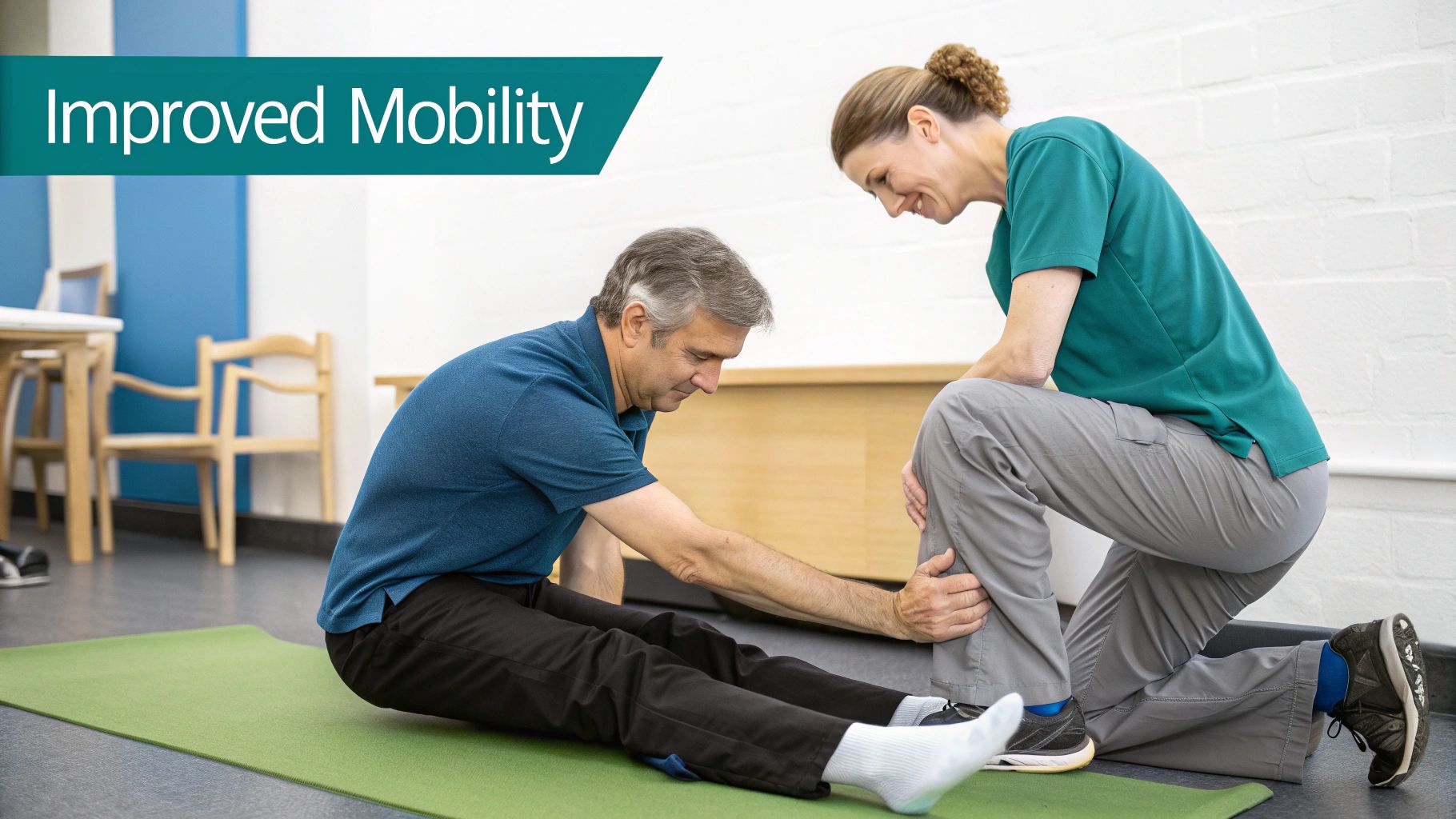
Precise assessment is the starting point, but the ultimate goal of range of motion testing is to drive effective therapeutic outcomes. The data gathered becomes the blueprint for a rehabilitation program designed to restore, maintain, or enhance a person's joint mobility. It bridges the gap between measurement and meaningful results, turning objective numbers into real-world function.
A structured plan is essential because movement limitations rarely resolve on their own. After an injury or surgery, factors like scar tissue, inflammation, and muscle imbalances can restrict a joint's freedom. A detailed assessment pinpoints which movements are limited, allowing for the prescription of specific exercises and manual therapies that address the root cause of the problem.
From Assessment to Application
The connection between testing and treatment is a continuous feedback loop. Initial measurements establish a baseline. Subsequent tests track progress and indicate whether the interventions are effective. This data-driven approach keeps the rehabilitation plan on target, allowing for adjustments as the patient's mobility improves.
Consider a total knee replacement. A primary goal is restoring full extension (0 degrees) and sufficient flexion for function (at least 120 degrees). Consistent range of motion testing quantifies every degree of progress toward these benchmarks. This not only motivates patients but also guides clinical decisions on when to advance exercises or modify manual techniques to overcome stiffness.
This systematic approach is effective. One prospective study showed that consistent, structured exercise protocols not only prevent age-related decline but can also actively improve joint mobility. Researchers observed significant increases in shoulder extension, shoulder transverse extension, hip flexion, and hip rotation among participants. You can read the full study on systematic exercise and ROM improvements for more details.
The Foundation for Functional Health
Ultimately, meticulous range of motion testing is the foundation for improving a person's ability to live their life, whether that means walking without a limp or reaching for a cup on a high shelf. By translating assessment data into targeted action, we can deliver tangible results that enhance quality of life and promote long-term musculoskeletal health.
Frequently Asked Questions About Range of Motion Testing
Whether you are a student learning to use a goniometer or an experienced clinician, questions about range of motion testing often arise. Let's address some of the most common ones, moving beyond how to measure to why certain methods are used.
The goal is to ensure that every measurement taken is not only accurate but also provides the clinical insight needed to make informed decisions for your patients.
What Is the Difference Between Intra-rater and Inter-rater Reliability
This is a key concept related to data trustworthiness.
-
Intra-rater reliability refers to an individual's own consistency. If you measure a patient's knee flexion today and again tomorrow, how close are the two measurements? High intra-rater reliability means your technique is solid and repeatable.
-
Inter-rater reliability refers to consistency between clinicians. If you and a colleague both measure the same patient's shoulder abduction, do you get the same result?
When both are high, you can confidently track progress over time, regardless of who is taking the measurement. This is where standardized protocols and precise digital tools are particularly valuable, as they reduce the variables and human error that can affect the numbers (1).
When Should I Prioritize PROM Testing Over AROM Testing
The choice between Passive Range of Motion (PROM) and Active Range of Motion (AROM) depends on the clinical question you are trying to answer.
Prioritize PROM when you need to determine the joint's true, unrestricted potential. By removing the patient's own muscle power from the equation, you can assess the non-contractile tissues—like the joint capsule or ligaments—and get a clear sense of the end-feel and any mechanical blocks.
On the other hand, AROM is the preferred method for assessing a patient's functional ability. It is a real-world test that shows how their muscle strength, motor control, and willingness to move combine to create movement, providing a snapshot of their current functional capacity.
Can I Trust ROM Norms for Every Patient
Normative data is a useful starting point, but it should not be the final word. Every patient is different.
Normative values are a starting point, not the final destination. The most clinically relevant comparison is often the patient's own contralateral (unaffected) side, which serves as their unique, personalized 'normal' baseline.
Always relate the results to the individual. Factors like their age, activity level, and specific goals will heavily influence what is considered "normal" for them. A significant difference between their affected and unaffected sides is often a more powerful indicator of a true limitation than a comparison to population averages.
Reference
- Gajdosik RL, Bohannon RW. Clinical measurement of range of motion. Review of goniometry emphasizing reliability and validity. Phys Ther. 1987;67(12):1867-1872.
At Meloq, we believe that replacing subjective assessments with objective, quantified data is the key to better outcomes. Our ecosystem of digital measurement tools, including the EasyAngle digital goniometer, empowers clinicians with medical-grade accuracy and streamlined workflows. Standardize your results, clearly document progress, and elevate your practice with tools designed for the modern movement professional. Discover how our devices can integrate into your work at https://www.meloqdevices.com.

Featured Product
EasyAngle Digital Goniometer
Measure range of motion with clinical precision. CE certified, Bluetooth connected.
Learn More