

Isometric Mid Thigh Pull: The Complete Guide to Testing & Data
Team Meloq
Author
The isometric mid-thigh pull, often abbreviated as IMTP, is a static strength test designed to provide an incredibly revealing look at an individual's neuromuscular capabilities. The setup involves an athlete pulling with maximal intent against a fixed, immovable bar for a few seconds.
The objective extends beyond simply measuring peak force production. The primary value of the IMTP lies in its ability to capture the speed at which force is generated. This provides a powerful and reliable snapshot of an athlete's explosive potential, a critical component in most sports.
Why the Mid Thigh Pull Is a Key Assessment for Athletes
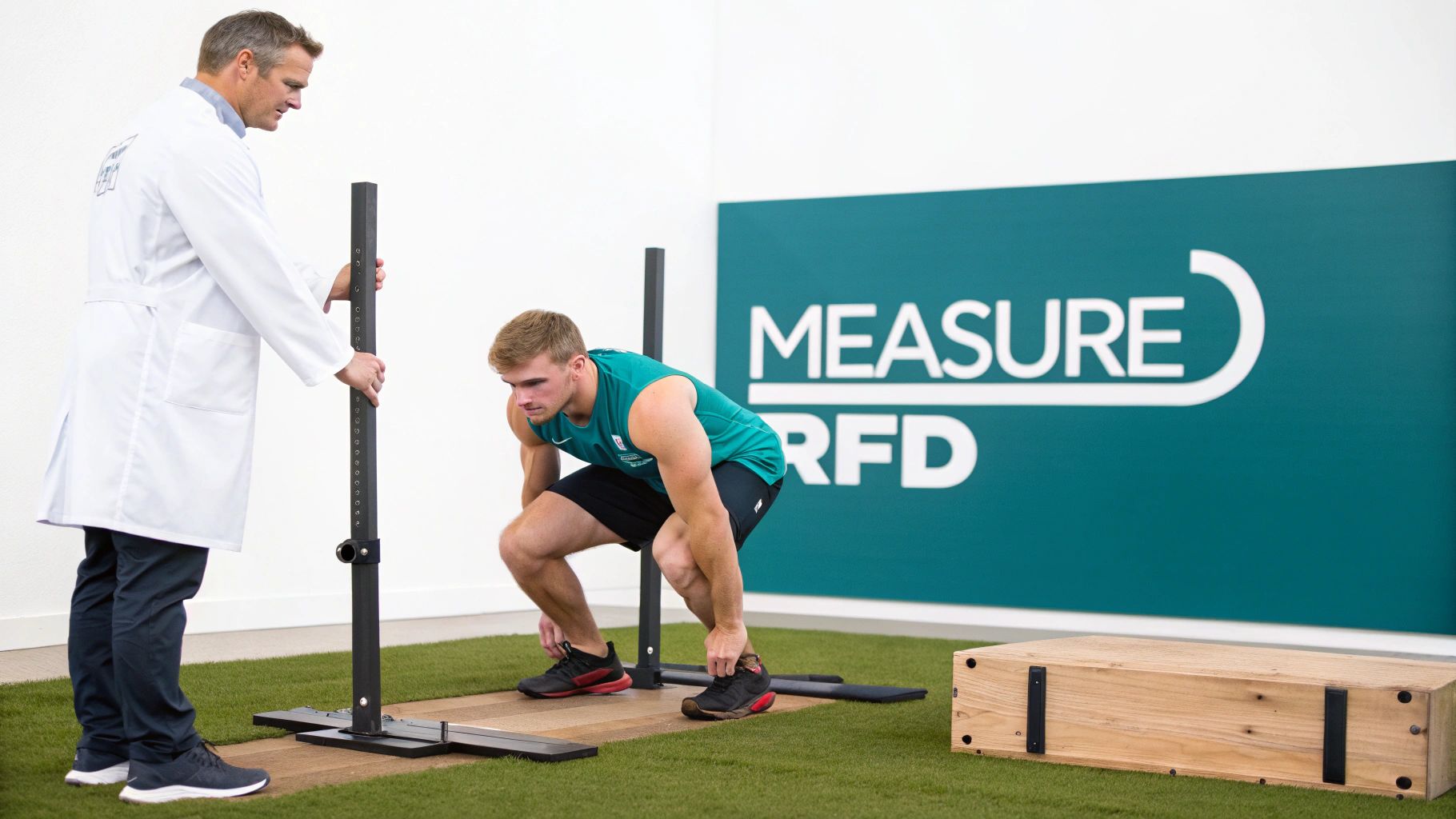
In the field of sports science, it is understood that not all strength tests provide the same information. A one-repetition maximum (1RM) in a dynamic lift like the squat or deadlift is an excellent measure of an athlete's maximal strength, but it offers limited insight into how quickly that force can be applied. The IMTP is designed to fill this critical information gap.
This test provides a clear window into an athlete's neuromuscular system by measuring two key components fundamental to almost every sport:
- Maximal Strength: The highest absolute force an athlete can exert isometrically.
- Rate of Force Development (RFD): How rapidly an athlete can generate force from a resting state.
Consider the neuromuscular differences between a powerlifter and a sprinter. While the powerlifter is a specialist in producing massive force over a longer duration, the sprinter excels at producing immense force within milliseconds. The IMTP allows practitioners to quantify both of these crucial abilities in one controlled assessment. By measuring these force characteristics precisely, the IMTP delivers insights vital for improving overall athletic performance.
A Deeper Look at the Science
Because the IMTP is an isometric test—meaning the muscles contract without a significant change in length—it isolates the measurement of force generation from the complexities of movement skill. This provides a pure measurement of an athlete's ability to produce tension. The specific multi-joint posture it uses is also highly relevant to foundational athletic movements like jumping, sprinting, and the second pull phase of weightlifting movements.
The diagnostic power of the IMTP is one of its most valuable attributes. For instance, an athlete may present with impressive peak force but a slow RFD. This profile suggests that training should focus on ballistic or plyometric exercises to enhance explosiveness. Conversely, low peak force typically indicates a need to build a stronger absolute strength foundation.
The IMTP has become a widely used test in sport and clinical science. While traditional protocols last around 3 to 5 seconds, recent research has validated that a shortened 1-second protocol can yield comparable peak force data (1). This has improved efficiency, allowing practitioners to gather necessary information without inducing excessive fatigue.
Practical Applications in Sport
The data gathered from an IMTP is more than just numbers on a screen. For coaches and physiotherapists, IMTP results inform evidence-based decisions daily.
It serves as an objective tool for a range of applications, from identifying talent in developing athletes to guiding a professional's return-to-play protocol after an injury like an ACL tear. The results help build highly specific training programs, monitor fatigue levels, and track an athlete's progress throughout a season. Ultimately, it provides the "why" behind their performance, connecting raw strength to on-field explosiveness.
Getting Your Equipment and Setup Right
Clean, reliable data from a mid-thigh pull starts long before the athlete steps onto the force plates. The testing setup is the foundation of the entire assessment, as minor inconsistencies can lead to significant inaccuracies in results. This is not just about having the right equipment; it’s about arranging it with precision and purpose.
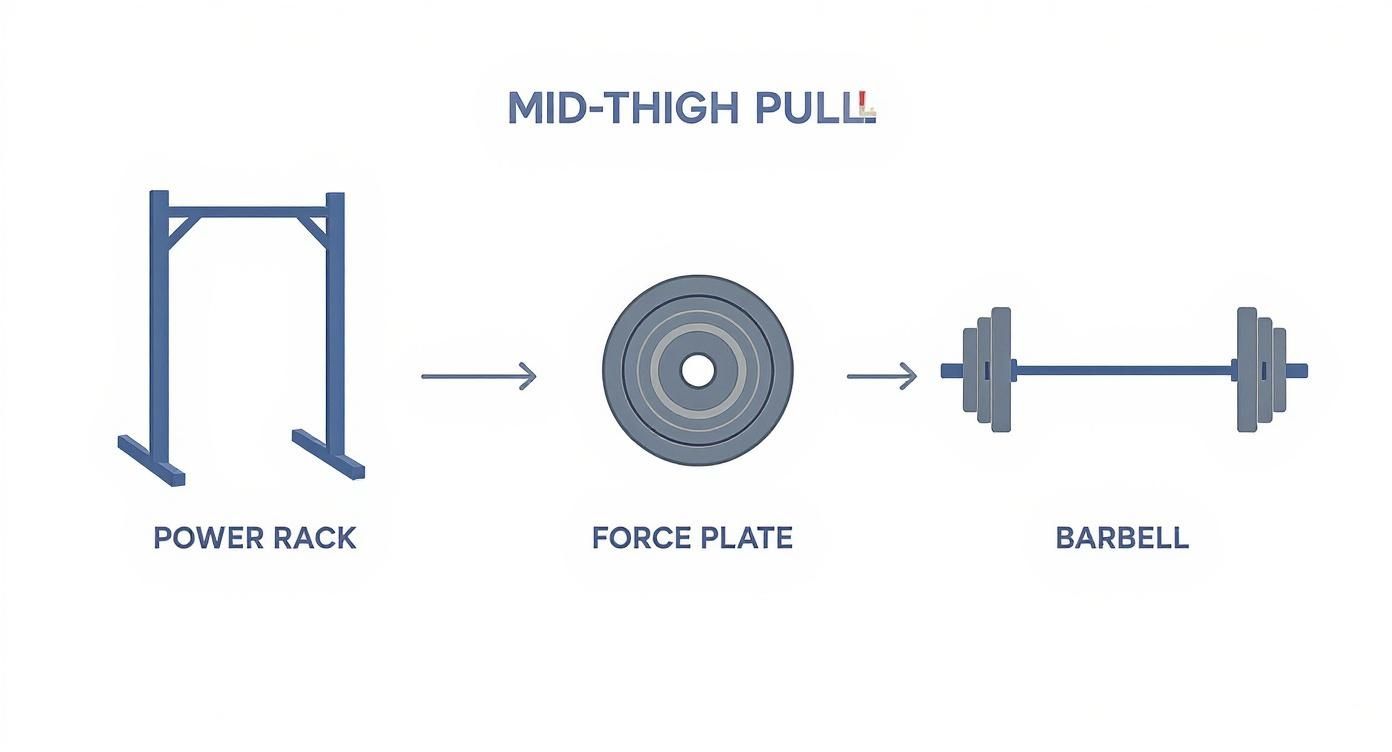
The first element to secure is the anchor point. A heavy-duty, securely bolted power rack or a dedicated IMTP testing rig is required. The structure must be completely immovable. Any give or shift means the force generated by the athlete is not being directed vertically into the measurement device—it is being dissipated by moving the equipment.
Selecting Your Core Components
The choice of measurement tool is critical. While both force plates and dynamometers can be used, they capture data differently. Force plates are widely considered the gold standard for IMTP testing because they measure ground reaction forces directly, providing a complete and unfiltered view of the force-time curve. For those wanting to delve deeper into the mechanics, there is a helpful guide to force platforms in biomechanics.
Next, a stiff, non-elastic bar (often a power bar) is non-negotiable. Using a standard weightlifting or "whippy" bar will cause it to bend and store elastic energy during the pull. This introduces oscillations into the data, corrupting the force curve and making it nearly impossible to accurately determine peak force or the rate of force development.
Finally, the testing space must be organized for efficiency and safety. A cluttered or poorly planned area increases risk and can compromise data quality. Excellent resources for planning and setting up lab workstations and tables can help create a professional and repeatable environment.
Achieving Consistency Through Preparation
Repeatability is paramount for effective monitoring over time. When testing an athlete at different time points, one must have total confidence that any change in data reflects a real change in the athlete, not a variation in the setup. This is where meticulous preparation is essential.
A small but critical detail is to mark everything. Use tape or chalk to outline the athlete's foot position on the force plates and the position of the plates relative to the rack. This simple step eliminates a significant variable between testing sessions.
Before any testing session, equipment calibration is mandatory. Force plates and dynamometers must be zeroed to account for the weight of the bar and any attachments. This ensures the only force being measured is what the athlete produces.
- Bar Height: This is a key variable. The bar should be set so the athlete is in the desired mid-thigh position, achieving specific knee and hip angles. Once this position is determined for an athlete, the exact height—measured from the platform surface—must be recorded and used for all future tests with that individual.
- Chain or Strap Length: The bar should be connected to the rack using high-tensile, non-stretch chains or straps. Any elasticity in the connection will absorb force and compromise the data. The exact number of chain links or the specific strap length used for each individual should be measured and recorded.
By standardizing these environmental and equipment factors, you create a controlled testing environment. This disciplined approach means every IMTP is built on a foundation of precision, yielding data you can trust to make informed clinical or performance decisions.
Executing the IMTP Protocol Like a Pro
With the equipment dialed in and the station prepared, the next step is executing the mid-thigh pull test. A consistent, scientifically-backed protocol is not merely a suggestion; it is the only way to obtain data that is valid, reliable, and comparable over time. Every detail, from the warm-up to the final verbal cue, has an impact.
The process begins with preparing the athlete. A standardized warm-up is essential for priming the neuromuscular system for a maximal effort pull. This should not be a long or fatiguing session. The goal is potentiation—activating the muscles and nervous system so they are ready to perform optimally.
A simple yet effective warm-up might include:
- General Movement: 5-10 minutes of low-intensity activity, such as on an exercise bike, followed by dynamic stretches to increase blood flow.
- Specific Activation: Have the athlete perform two submaximal, isometric "familiarization" pulls. The first should be at approximately 50% of perceived effort, followed by another at 75%. This helps them acclimate to the movement and find a comfortable, powerful position without inducing fatigue.
This sequence ensures the athlete is both physically and mentally prepared for the all-out effort required, setting the stage for them to produce their true maximal force.
Nailing the Athlete's Position
Body positioning is arguably the most critical variable affecting test-retest reliability in a mid-thigh pull. Even minor shifts in joint angles can alter muscle recruitment and force output, rendering session-to-session comparisons invalid. Fortunately, scientific literature provides a clear blueprint for standardizing this position.
The target posture is specific:
- A knee angle between 120° to 145°.
- A hip angle between 140° to 150°.
This setup creates a powerful stance that mirrors the "second pull" phase of an Olympic clean, a position where athletes are known to generate massive force. A goniometer should be used to measure these angles precisely during an athlete's initial setup, and these values should be recorded. Subsequently, the bar height and foot position must remain identical for every test they perform.
IMTP Protocol Checklist
A simple checklist is an invaluable tool for maintaining consistency. It removes guesswork and ensures all critical points of the protocol are addressed every time.
| Phase | Action Item | Key Consideration |
|---|---|---|
| Preparation | Conduct Standardized Warm-Up | 5-10 min general activity, then 2 submax pulls (50%, 75%). |
| Setup | Set Athlete Position | Use a goniometer for knee (120°-145°) & hip (140°-150°) angles. Record for consistency. |
| Execution | Provide Clear Verbal Cues | Use consistent phrases like "Pull as hard and as fast as you can!" or "Push the ground away!" |
| Testing | Perform 2-3 Max Trials | Allow 2-3 minutes of rest between each attempt for full recovery. |
| Quality Control | Monitor for Errors | Watch for any pre-tensioning or countermovement before the pull. Invalidate trials with visible errors. |
Following these steps methodically transforms a potentially chaotic process into a smooth, repeatable system for gathering high-quality data.
Cues, Trials, and Capturing Clean Data
With the athlete in position, your role is to elicit a true maximal effort. Your verbal cues are more powerful than you may realize. They should be simple and direct.
A cue like, "pull as hard and as fast as you can," is effective because it is a dual-purpose command, encouraging both peak force and a high rate of force development. Another effective external cue is to instruct them to "push the ground away." Focusing on an external outcome rather than an internal feeling can often help athletes produce more force. For a more detailed look at the setup process, consult our guide on force plate testing.
The number of trials and rest periods are equally important.
To obtain reliable data, aim for 2-3 maximal trials per session. Research suggests that providing at least 2-3 minutes of rest between pulls is sufficient for neuromuscular recovery, ensuring fatigue does not compromise subsequent efforts. This rest period is crucial for data quality.
During each pull, careful observation is required. Watch for any "pre-tensioning" or countermovement. The athlete must initiate the pull from a dead stop with slack in their arms. Any dip, rock, or bounce before the pull constitutes a foul. This action introduces the stretch-shortening cycle, which will artificially inflate force numbers and invalidate the isometric nature of the test.
Adapting the Protocol for Different Scenarios
A key strength of the IMTP is its adaptability. While the core protocol provides a solid foundation, its logistics can be adjusted to fit different contexts.
When testing a large team, efficiency is key. You might set up multiple stations or use a "round-robin" approach. In group settings, displaying a live data feed can be a powerful motivator, as friendly competition often encourages athletes to achieve higher outputs.
In a rehabilitation setting, the focus shifts from raw output to meticulous detail. You might perform more submaximal repetitions to assess force control or monitor for pain and compensatory patterns. Here, the data serves as a diagnostic tool, guiding the recovery process and informing objective return-to-play decisions.
Turning Mid Thigh Pull Data Into Actionable Insights
Executing a clean isometric mid thigh pull protocol is only half the task. The real value is realized when you translate the raw data from the force plate into a clear, compelling story about your athlete. Collecting data is relatively straightforward; the true skill lies in interpretation—turning a force-time curve into a roadmap for enhanced performance and resilience.
The test provides a wealth of information, but we can begin by focusing on a few key metrics. These data points offer a powerful window into an athlete's neuromuscular signature, revealing not just how strong they are, but how they produce that strength.
Understanding Peak Force
The most direct metric from any mid thigh pull is Peak Force (PF). Measured in Newtons (N), this represents the absolute maximum force an athlete generates during the pull. It is a pure measure of their maximal isometric strength capacity.
Think of PF as the size of an engine. A larger engine has greater potential for power. Similarly, an athlete with a high PF has a greater strength foundation to draw upon for explosive movements.
However, absolute numbers can be misleading. A 100 kg linebacker will naturally produce more raw force than a 55 kg gymnast. This is why we also analyze Relative Peak Force, calculated by dividing peak force by the athlete’s body mass (N/kg). This provides a more meaningful pound-for-pound strength comparison and allows for benchmarking athletes of different sizes.
In a clinical or team setting, tracking relative peak force over a season is highly insightful. A steady increase indicates the athlete is getting stronger for their size. A sudden decrease could be an early warning sign of fatigue or overtraining.
The Critical Role of Rate of Force Development
While Peak Force reflects the engine's size, Rate of Force Development (RFD) tells us how quickly that engine can accelerate. RFD measures how rapidly an athlete can generate force, typically calculated in Newtons per second (N/s). For most sports, this is arguably the more critical metric.
Most decisive athletic actions—a sprint start, a jump, a change of direction—occur in fractions of a second (often under 250 milliseconds). An athlete may possess a high peak force, but if it takes too long to access it, that strength is of limited use on the field. You can gain a deeper understanding of this crucial metric in our article on the Rate of Force Development.
To illustrate, consider two athlete profiles:
- Athlete A (High Force): Exhibits a very high Peak Force but a slow RFD. Their force-time curve shows a gradual, steady climb.
- Athlete B (High Power): Has a slightly lower Peak Force but an extremely high RFD. Their curve shows a near-vertical spike in the first 200 milliseconds.
In a sport demanding rapid power output, Athlete B holds a significant advantage. The IMTP allows us to visualize this difference clearly, enabling us to program accordingly.
Using Normative Data for Context
Your data becomes exponentially more powerful when compared to established benchmarks. A growing body of peer-reviewed research provides normative values for the mid thigh pull across various sports, ages, and skill levels. This context helps you understand where your athlete truly stands.
For example, knowing a collegiate soccer player’s relative peak force is 40 N/kg is a good starting point. But knowing that elite players in their position average 50 N/kg provides a specific, measurable goal to build a training program around (2).
This type of benchmarking is vital not only for performance but also for rehabilitation. By comparing an injured limb's output to the uninjured side—or to pre-injury baseline data—you can make objective, data-driven decisions about their readiness to return to play.
The IMTP has been shown to have strong correlations with key athletic performance measures. This provides objective data linking maximal isometric force to dynamic abilities. For instance, a study on English professional soccer players found a significant link between both absolute and relative peak force in the IMTP and their max sprint velocity and countermovement jump height (3). This indicates that athletes who can generate greater peak isometric force tend to be more explosive. You can read the full research on this topic to understand the connections.
Common Testing Mistakes and How to Fix Them
Even with the best intentions and a controlled setup, small errors during an isometric mid-thigh pull can compromise data integrity. What should be valuable insight can quickly become misleading noise. Correcting these issues is a fundamental skill for any practitioner, as the validity of the entire assessment process depends on this attention to detail.
One of the most common errors is allowing the athlete to create pre-tension on the bar. This occurs when they pull the slack out of the system—flexing their arms and engaging their lats—before the command to pull. This low-level force is not captured as part of their actual explosive effort, leading to an underestimation of their true peak force and rate of force development.
The Problem with Countermovements
The single most damaging mistake is the countermovement, or the "dip and pull." This is when an athlete performs a quick dip, flexing their knees and hips, immediately before pulling upwards. This is a natural instinct to utilize the stretch-shortening cycle to generate more power, similar to preparing for a jump.
While it may feel more powerful to the athlete, it completely invalidates the test. An isometric test is designed to measure pure concentric force from a static start. A countermovement introduces eccentric loading and elastic energy, which can falsely inflate peak force numbers and create an artificial spike early in the force-time curve (4).
To address this, provide crystal-clear instructions. A helpful cue is to instruct athletes to "take the slack out of their body, not the bar" and to wait for the command before applying any significant force. A simple quality check is to ensure the force reading is at zero immediately before giving the cue to pull. If you see any downward movement before the pull, stop the trial, and re-instruct the athlete.
Ensuring Positional Consistency
Another source of error is inconsistent body positioning. This is not just about getting it right on a single day, but maintaining it across every trial and every testing session over months or years. Even minor shifts in knee angle, hip height, or foot placement can alter muscle lever arms and recruitment patterns. This variability makes it impossible to determine if a change in numbers is due to genuine progress or an inconsistent setup.
Meticulous documentation is non-negotiable for a reliable mid thigh pull assessment. To ensure consistency, follow a strict protocol:
- Mark Everything: Use tape to outline the athlete's foot placement on the force plates.
- Record Bar Height: Measure and log the exact bar height from the force plate surface for every athlete.
- Use a Goniometer: During the initial session, measure and record their specific knee and hip angles to replicate them perfectly in future sessions.
Standardizing these details creates a robust, repeatable testing environment. This discipline is what separates high-quality data from unreliable noise. It ensures that observed changes are a true reflection of the athlete's neuromuscular status, not a product of procedural drift.
Using IMTP Results to Guide Training and Rehab
Collecting precise data with a mid thigh pull is one thing; using it to inform practice is where its true value lies. The goal is to close the loop between testing and training, turning force-time curves into smarter programming that delivers tangible results. This provides an objective basis for choosing one training modality over another for a specific athlete.
Consider an athlete who presents with impressive peak force but a sluggish rate of force development (RFD). Their strength foundation is solid, but they cannot express it quickly. This profile is a clear indication to shift their training focus toward more ballistic and plyometric work to enhance explosive power.
Tailoring Programs to Individual Profiles
Conversely, you may have an athlete who is already both strong and explosive. For them, the IMTP serves as an excellent tool for monitoring fatigue and readiness. A sudden drop in RFD can be one of the earliest indicators of neuromuscular fatigue. This allows you to proactively adjust their training load, helping to prevent overtraining and reduce injury risk.
This objective feedback loop enables a shift away from generic, one-size-fits-all programming toward a highly individualized approach based on what an athlete's physiology indicates. It also provides a method to verify that training interventions are effective by tracking their adaptations over time.
Real-World Rehab and Return-to-Play Decisions
In a clinical setting, the IMTP is an incredibly powerful tool. For an athlete recovering from an ACL reconstruction, the test provides clear, objective milestones for their return-to-play journey. Clinicians can assess limb symmetry with precision by comparing the force output of the injured leg to the uninjured one.
A common benchmark for clearing an athlete to return to sport is achieving 90% or greater limb symmetry in both peak force and RFD (5). This data-driven standard removes subjectivity and provides confidence that the athlete is physically prepared for the demands of their sport.
Beyond limb symmetry, the IMTP is used in tactical populations to stratify physical performance and identify injury risk. In a study on United States Marine Corps recruits, IMTP and jump data were used to cluster individuals into performance groups. The highest-performing group demonstrated a significant reduction in musculoskeletal injury risk, particularly ankle injuries, compared to their lower-performing peers (6). These results highlight the test's value as a predictive tool. You can discover more insights about these injury risk findings.
Another advanced metric that can be derived is the Dynamic Strength Index, which combines peak force from the IMTP with data from a dynamic movement like a jump. This ratio helps pinpoint whether an athlete needs to focus on maximal strength or speed-strength training. You can learn more about using the Dynamic Strength Index in our detailed guide. By layering these metrics, the mid thigh pull evolves from a simple strength test into a comprehensive diagnostic and programming tool.
References
- De Witt JK, English KL, Crowell JB, et al. Isometric mid-thigh pull reliability and validity are only minimally affected by variations in knee and trunk angle. J Strength Cond Res. 2018;32(11):3030-3038.
- Comfort P, Thomas C, Dos'Santos T, et al. Changes in peak force and rate of force development during a professional soccer season. Int J Sports Physiol Perform. 2018;13(9):1154-1160.
- West DJ, Owen NJ, Jones MR, et al. Relationships between force-time characteristics of the isometric midthigh pull and dynamic performance in professional rugby league players. J Strength Cond Res. 2011;25(11):3070-3075.
- Haff GG, Ruben RP, Lider J, et al. A comparison of methods for determining the rate of force development during the isometric midthigh pull. J Strength Cond Res. 2015;29(12):3365-3375.
- Grindem H, Snyder-Mackler L, Moksnes H, et al. Simple decision rules can reduce reinjury risk by 84% after ACL reconstruction: the Delaware-Oslo ACL cohort study. Br J Sports Med. 2016;50(13):804-808.
- de la Motte SJ, Gribbin TC, Lisman P, et al. The association of a concussion history and baseline neurocognitive performance with musculoskeletal injury risk in a cohort of US service academy cadets. Mil Med. 2019;184(5-6):e295-e301.
At Meloq, we provide professionals with accurate, portable measurement tools to replace subjective assessments with objective data. Our ecosystem of digital dynamometers, goniometers, and force plates helps you make confident, data-driven decisions for your athletes and patients. https://www.meloqdevices.com

Featured Product
EasyForce Digital Dynamometer
Handheld muscle strength testing with 99% accuracy. Used in 40+ peer-reviewed studies.
Learn More