

How to Calculate Force Applied: A Clinician's Guide
Team Meloq
Author
In clinical practice, understanding applied force often begins with a foundational principle from physics: Force = Mass × Acceleration (F = ma). This equation, central to Newton's Second Law of Motion, posits that the force exerted on an object is the product of its mass and its acceleration. For clinicians in physiotherapy and sports rehabilitation, this means the force produced during a given movement can be determined by knowing the mass of the limb or object being moved and the rate at which its velocity changes.
Why Force Calculation Is a Game-Changer for Clinicians
Understanding how to calculate applied force is more than an academic exercise; it is a cornerstone of modern, evidence-based practice. It allows clinicians to transition from subjective assessments like "that feels strong" to objective, quantifiable data, such as a "peak force of 400 Newtons." This shift fundamentally enhances clinical decision-making.
Quantifying force is critical in physiotherapy, sports rehabilitation, and performance conditioning. By measuring force output, practitioners can establish clear baseline data, track progress with precision, and identify subtle weaknesses or asymmetries that might otherwise be missed.
From Subjective Guesswork to Objective Measurement
This data-driven approach enables the development of highly specific and effective programs. Instead of estimating appropriate loads or readiness for return to sport, clinicians can make informed decisions backed by robust data. This is particularly advantageous for:
- Return-to-play protocols where objective strength criteria can significantly reduce the risk of re-injury (2).
- Strength and conditioning programs where precise load management is key to optimizing adaptation.
- Rehabilitation plans that require careful and consistent monitoring of a patient’s recovery trajectory.
The necessity for accurate force calculation is even more pronounced in specialized fields like neurorehabilitation practices, where a detailed understanding of neuromuscular function is essential for restoring movement.
To apply these concepts in a clinical context, it is helpful to clearly define the key variables involved.
Key Variables in Force Calculation
| Concept | Definition | Standard Unit (SI) | Clinical Relevance |
|---|---|---|---|
| Force (F) | An interaction that, when unopposed, changes the motion of an object. | Newton (N) | The direct measure of strength or effort exerted by a patient. |
| Mass (m) | A measure of the amount of matter in an object. | Kilogram (kg) | Represents the limb, body segment, or external resistance being moved. |
| Acceleration (a) | The rate of change of velocity per unit of time. | Meters per second squared (m/s²) | How quickly a patient can change the velocity of a limb or object; crucial for power. |
This table translates fundamental physics into the practical language used in daily clinical assessment and training.
A Practical Lens for Analyzing Movement
Newton's F = ma formula provides a powerful and practical lens for analyzing patient movement. While the concept of force has a long history, with Aristotelian physics dominating scientific thought for centuries, the mathematical framework established in the 17th century provides us with a clear, usable equation.
For a significant period, the concept of force was largely philosophical. The work of Isaac Newton provided the mathematical foundation for its calculation, which now underpins the field of biomechanics.
Ultimately, learning how to calculate and measure force unlocks a deeper, more precise understanding of human performance and recovery. For those ready to implement these principles, our guide on what is force measurement offers a great starting point.
Applying Foundational Physics in Your Practice
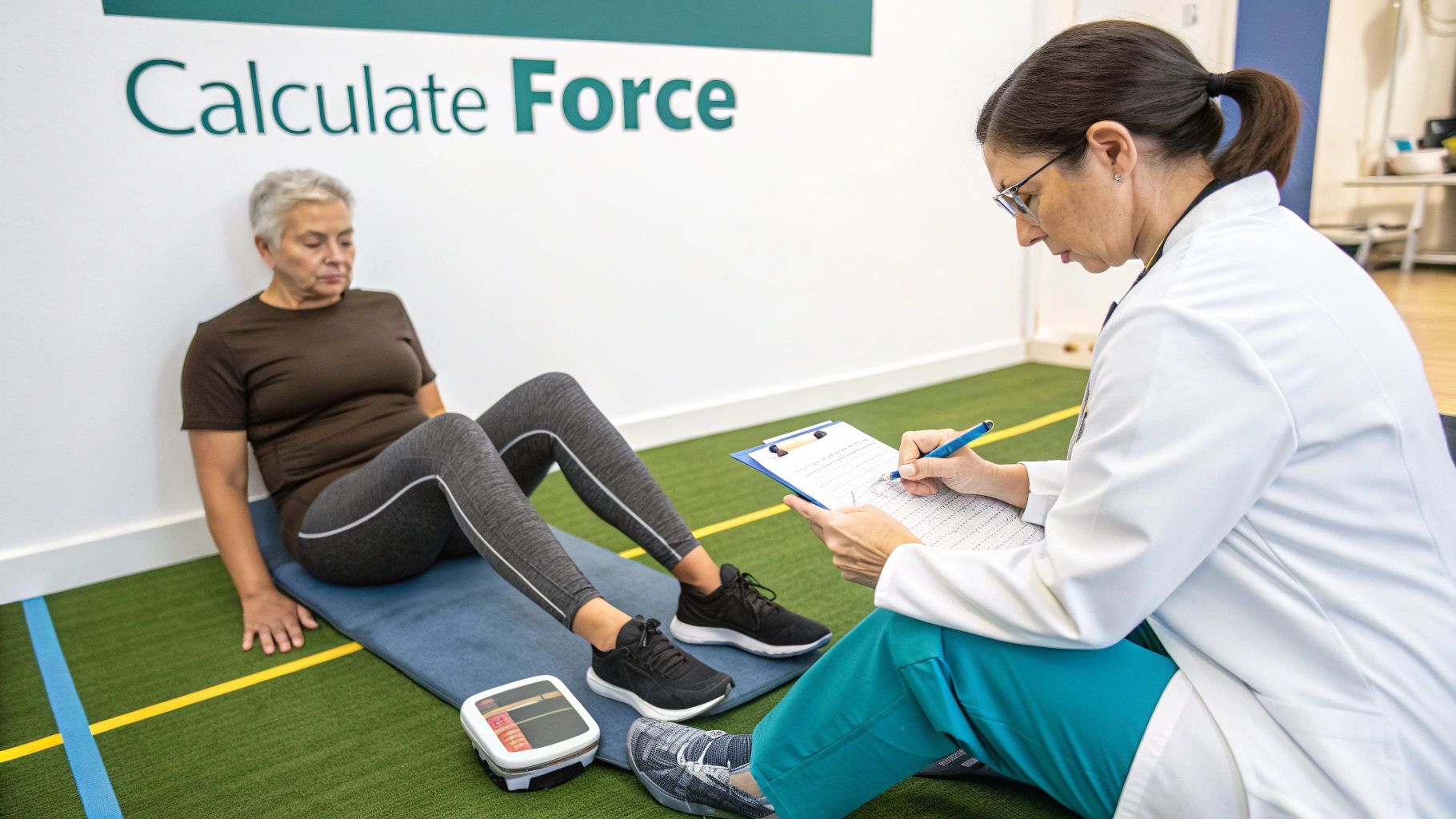
To accurately analyze the forces at play in clinical settings, we must return to the foundational principle of mechanics laid out by Isaac Newton in 1687: his Second Law of Motion.
The law is expressed through the formula F = ma, where force equals mass multiplied by acceleration. This is not merely an abstract concept for a physics lecture; it is the core equation governing every movement a patient makes.
Consider a standard seated leg extension. To determine the force generated by the quadriceps, two key pieces of information are needed: the mass of the patient's lower leg and foot, and the acceleration of that segment during the extension movement.
From Formula to Function
Let's continue with the leg extension example. To apply F = ma, one must first determine the mass (m) of the limb segment. This can be estimated using anthropometric tables, which provide data on limb mass as a percentage of total body mass.
Next, one needs the acceleration (a), which is the rate of change in the leg's velocity. While measuring acceleration directly without specialized technology can be challenging in a typical clinical setting, understanding the relationship is what is most important. For a deeper look into a related metric, our guide on how to measure velocity can be a useful resource.
The objective is not always to obtain a laboratory-grade calculation during a session. Rather, it is to develop a deeper appreciation for the physics at work. A heavier limb or a faster movement requires the client to produce greater force.
Calculating Weight as a Force
Another critical force calculation we use constantly is determining weight. It is important to distinguish that weight is not the same as mass—it is the force exerted on an object by gravity.
This is a specific application of F = ma:
Weight (W) = Mass (m) × Gravitational Acceleration (g)
On Earth, the acceleration due to gravity (g) is a constant, approximately 9.81 m/s². This formula is indispensable for everything from load management in strength training to understanding the baseline forces a patient must overcome post-surgery. An essential physics formulas cheat sheet can be a practical tool for quick reference.
The Critical Importance of Unit Conversion
A common source of error in calculation is inconsistent units. Physics formulas demand consistency, which means adhering to the International System of Units (SI).
Key Takeaway: Before performing any calculation, ensure all values are in standard SI units. Force should be in Newtons (N), mass in kilograms (kg), and acceleration in meters per second squared (m/s²).
Mixing imperial units (like pounds) with metric units (like meters) will lead to inaccurate results.
The most frequent conversion in clinical practice is from pounds to kilograms:
- Pounds (lbs) to Kilograms (kg): Divide the mass in pounds by 2.205.
- For example: A 180 lb individual has a mass of 180 / 2.205 = 81.6 kg.
By standardizing units before calculation, you ensure that your results are accurate and clinically meaningful. This is how abstract physics becomes a precise tool for improving patient outcomes.
Using Modern Tools to Measure Force Directly
While foundational formulas provide a solid framework for understanding force, direct measurement offers superior accuracy for clinical decision-making. Obtaining objective, quantifiable data directly from the patient is the gold standard, allowing practitioners to move beyond estimation.
For clinicians and performance coaches, two tools have become essential for direct force measurement: the handheld dynamometer and the force plate. Each serves a specific purpose, but both provide the objective data needed to elevate the standard of care.
Handheld Dynamometers for Isolated Strength
A handheld dynamometer is a portable device used to measure the force produced by a muscle or muscle group during an isometric (static) contraction. It represents a significant advancement over manual muscle testing, replacing subjective 0-5 grading scales with a precise value in Newtons or pounds-force.
This is highly effective for targeting specific muscle groups to identify weaknesses or asymmetries that might be masked during larger, compound movements.
A common application is testing the isometric strength of the quadriceps in a patient following ACL reconstruction. The dynamometer provides clear, objective data on their recovery, removing guesswork from clinical progression. To learn about the practical application of this tool, please refer to our guide on how to use a dynamometer.
Acquiring reliable data with a dynamometer depends on a rigorous, standardized protocol. Best practices include:
- Consistent Patient Positioning: The patient must be placed in the exact same position for every test to ensure valid comparisons over time. This is non-negotiable for accurately isolating the target musculature.
- Standardized Verbal Cues: Using a consistent script, such as, “Build your force over three seconds… push, push, push!” helps elicit a true maximal effort repeatedly.
- Proper Stabilization: The clinician must stabilize both the limb and the device to ensure the measurement reflects the patient's output, not compensatory movements.
Force Plates for Dynamic Movement Analysis
While dynamometers excel at measuring isolated, static strength, force plates are designed to analyze the dynamic forces produced during complex movements. A force plate is a platform that measures ground reaction forces—the forces exerted by the ground on a body in contact with it.
When an individual performs movements like jumping or squatting on the plate, it measures the forces they generate in multiple directions. This allows for the calculation of metrics that are invisible to the naked eye.
These metrics include:
- Peak Landing Force: Crucial for assessing injury risk and an athlete's ability to attenuate impact forces.
- Rate of Force Development (RFD): Measures how quickly an individual can generate force, a key indicator of explosive power.
- Left/Right Asymmetries: Quantifies imbalances during bilateral movements like a squat or a bilateral jump.
For example, a basketball player returning from an ankle injury might exhibit symmetrical strength in an isolated dynamometer test. However, a jump analysis on a force plate could reveal a persistent offloading of the previously injured limb—a critical insight for mitigating re-injury risk.
Comparing Common Force Measurement Tools
The choice of tool depends on the clinical question being asked. A handheld dynamometer is ideal for assessing specific muscle deficits, whereas a force plate provides a comprehensive view of how an individual produces and absorbs force during dynamic activity.
Here is a brief comparison to guide your selection.
| Feature | Handheld Dynamometer | Force Plate |
|---|---|---|
| Primary Use | Isometric strength of isolated muscle groups. | Ground reaction forces during dynamic movements. |
| Key Metrics | Peak Force, Average Force | Peak Force, RFD, Impulse, Asymmetries |
| Portability | Highly portable, suitable for various clinical settings. | Typically stationary, requiring a dedicated space. |
| Clinical Focus | Rehabilitation, strength deficits, muscle function testing. | Performance analysis, biomechanics, return-to-sport testing. |
Ultimately, both devices offer a powerful means to integrate objectivity into clinical practice. Selecting the appropriate tool—or using both in conjunction—enables the creation of more targeted, effective, and data-driven programs.
Looking Beyond the Numbers in Your Force Data
Collecting force data is merely the first step; the true clinical value lies in interpreting what these numbers reveal about function. A single metric rarely provides a complete picture of an individual's capacity. Therefore, moving beyond a simple peak force reading is crucial for developing specific and effective client programs.
A jump analysis on a force plate, for instance, yields a rich dataset that extends far beyond jump height. While peak force is an excellent indicator of an athlete’s maximum strength, it does not reveal how quickly they can produce that strength—a factor of paramount importance in most athletic endeavors.
Peak Force vs Rate of Force Development
Peak Force is the single highest point of force recorded during a movement. It is a valid indicator of an individual's maximal strength under specific test conditions. However, many athletic movements occur too rapidly for an athlete to achieve their true peak force.
This is where the Rate of Force Development (RFD) becomes a more functionally relevant metric. RFD measures how quickly an individual can generate force. An athlete with a high RFD is explosive and can apply their strength almost instantaneously, which is critical for actions like sprinting, changing direction, or throwing. Two athletes may have identical peak force values, but the one with the higher RFD will almost always be the more powerful and effective performer in a dynamic context (3).
A common clinical scenario involves a post-rehabilitation athlete who has regained their peak strength on paper but still reports feeling slow or lacking power. Often, the underlying issue is a diminished RFD. This insight provides a clear target for the subsequent phase of their training.
Adding Time to the Equation with Impulse
Another key variable is impulse, calculated as Force × Time. Impulse describes the overall effect of a force applied over a period. In biomechanics, a greater impulse results in a greater change in momentum.
Consider a vertical jump. A longer duration of pushing against the force plate can generate a higher impulse, leading to a greater jump height, even if the peak force produced is not maximal. This illustrates why movement technique and timing are as important as raw strength.
The infographic below illustrates how different tools, like a handheld dynamometer and a force plate, are specialized for capturing distinct aspects of force production.
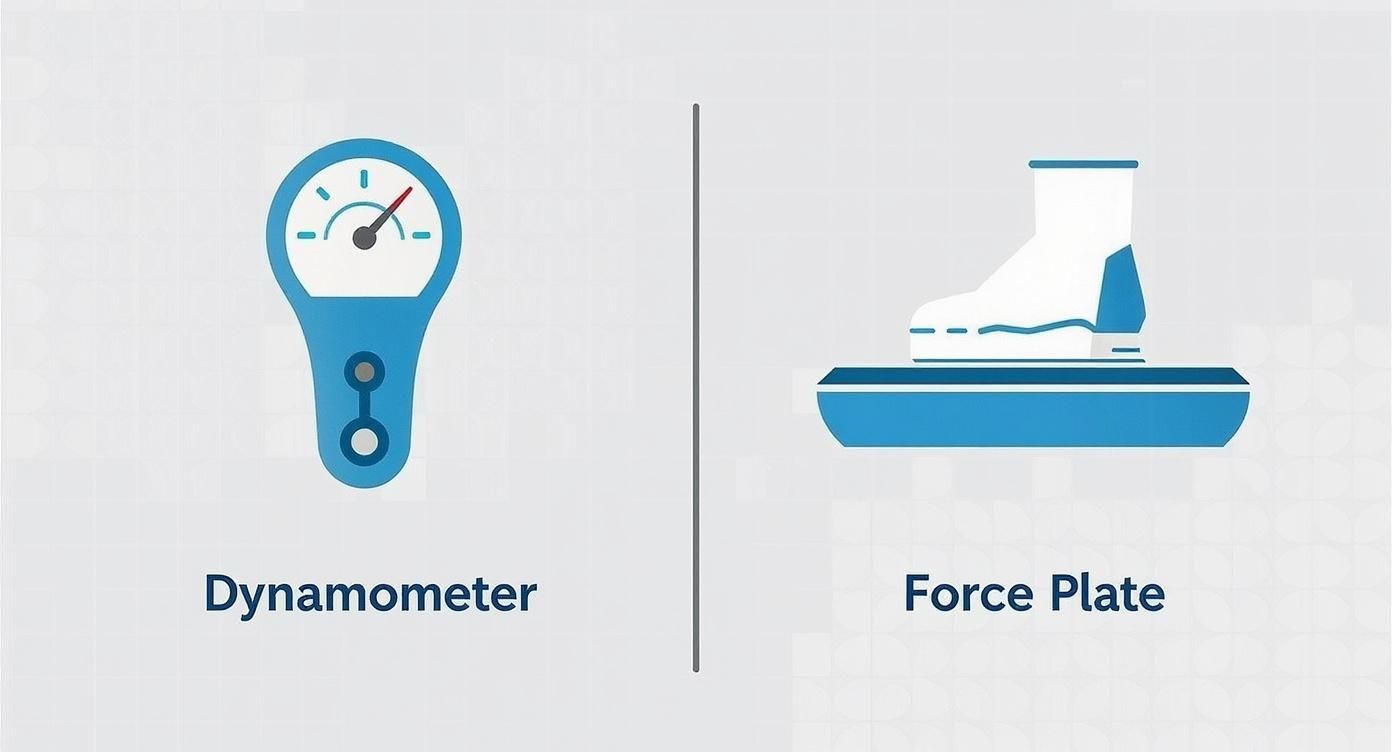
This graphic highlights that while dynamometers are well-suited for measuring isolated peak force, force plates provide dynamic, real-world data such as RFD and impulse. The mathematical principles underlying these analyses have evolved significantly since Newton's time. You can discover more insights about the history of force calculation on Wikipedia for further reading.
Understanding Torque and Levers in Biomechanics
Human movement rarely occurs in a simple, straight line. It is characterized by rotation around joints, meaning that a linear force calculation alone does not capture the full picture. To accurately analyze how we move, we must discuss torque—the rotational equivalent of force.
The human body functions as a complex system of levers. Bones act as rigid lever arms, and joints serve as the pivot points, or fulcrums. Muscles generate force by pulling on bones, creating torque that rotates a limb around a joint.
The Bicep Curl: A Practical Example
Let's analyze a bicep curl. The biceps brachii muscle does not push the forearm upward. Instead, it pulls on the radius, creating torque at the elbow joint and causing the arm to flex.
This rotational force is calculated using the formula:
Torque = Force × Lever Arm
The lever arm (or moment arm) is the perpendicular distance from the joint's axis of rotation to the line of action of the applied force. In the bicep curl example, this is the distance from the elbow joint to the insertion point of the bicep tendon on the forearm.
This relationship is critically important for both performance and injury prevention. A small change in technique or body position can significantly alter the lever arm, which in turn changes the amount of torque a muscle must produce or that a joint must withstand.
Why Torque Is Critical for Clinicians
An understanding of torque is essential for analyzing everything from resistance training exercises to the mechanisms of complex injuries, such as the rotational forces involved in a non-contact ACL tear.
In a clinical setting, appreciating the role of levers can reframe exercise prescription. Moving a handheld weight just a few centimeters can significantly increase or decrease the torque experienced at a joint, thereby modifying the challenge to the target muscle without changing the weight itself.
This principle allows for more intelligent and precise exercise design. Clinicians can manipulate joint angles and body positioning to better isolate a specific muscle or to reduce stress on a vulnerable joint during rehabilitation.
By analyzing movement through the lens of torque and levers, one moves from simple force measurement to a more sophisticated biomechanical analysis. This perspective is vital for designing effective training programs and understanding the root causes of musculoskeletal injuries. For more on how technology aids in these analyses, consider our guide on how force platforms are used in biomechanics.
Your Top Force Measurement Questions, Answered
As clinicians and coaches integrate objective force measurement into their practice, several common questions arise. Addressing these can help build confidence in applying these principles.
What's the Simplest Way to Start Measuring Force in a Clinic?
For those new to quantitative measurement, a handheld dynamometer (HHD) is an excellent starting point. It offers a combination of affordability, portability, and reliable data for measuring isometric strength of specific muscle groups.
It is advisable not to attempt to measure everything at once. Select a few key assessments that are already part of your routine, such as a quadriceps strength test or shoulder external rotation test, and develop a rigorous, standardized protocol for them. Consistency is paramount. Mastering the process on these core tests will build a foundation of trustworthy data before expanding to other assessments.
Why Isn't F = ma Good Enough for Human Movement?
While F = ma is the foundational equation for linear motion, human movement is predominantly rotational. Joints like the knee, hip, and shoulder rotate. This is where torque, calculated as Force × Lever Arm, becomes the relevant concept.
A muscle can generate significant internal force, but if its attachment point is very close to the joint (a short lever arm), the resulting torque might be relatively small. To truly understand joint loading and movement efficiency, one must think in terms of torque rather than just linear force.
How Can I Avoid Errors When Using a Handheld Dynamometer?
The reliability of HHD data is directly dependent on the consistency of the testing process. A strict protocol is the best defense against measurement error.
The following are non-negotiable elements of a reliable protocol:
- Standardize Positioning: Document and use the exact same patient position for every test and re-test.
- Use Anatomical Landmarks: Always place the dynamometer on the same specific, documented anatomical landmark.
- Give Consistent Cues: Use the same verbal script for every trial to ensure consistent effort.
- Stabilize Thoroughly: The tested limb must be well-braced to prevent compensatory movements that could inflate the force reading.
Adhering to these steps and taking the average of three valid trials is a widely accepted best practice for enhancing the reliability of HHD measurements (1).
What's the Real Difference Between Force and Pressure?
This is a frequent point of confusion, but the distinction is critical. Force is the total push or pull on an object, measured in Newtons. Pressure is that same force distributed over a specific area (Pressure = Force / Area).
For example, the total force on the foot during standing is equal to body weight. However, the pressure under the heel is significantly higher than the pressure under the arch because the same force is concentrated on a much smaller surface area. Understanding this concept is vital when considering tissue stress, injury risk, and the etiology of pressure-related injuries.
References
- Stark T, Walker B, Phillips JK, Fejer R, Beck R. Hand-held dynamometry correlation with the gold standard isokinetic dynamometry: a systematic review. PM R. 2011 May;3(5):472-9.
- Grindem H, Snyder-Mackler L, Moksnes H, Engebretsen L, Risberg MA. Simple decision rules can reduce reinjury risk by 84% after ACL reconstruction: the Delaware-Oslo ACL cohort study. Br J Sports Med. 2016 Jul;50(13):804-8.
- Maffiuletti NA, Aagaard P, Blazevich AJ, Folland J, Tillin N, Duchateau J. Rate of force development: physiological and methodological considerations. Eur J Appl Physiol. 2016 May;116(6):1091-116.
At Meloq, we build precise, portable measurement tools designed to replace subjective guesswork with objective data. Our ecosystem of digital dynamometers, goniometers, and force plates empowers you to quantify movement, track progress, and make more confident clinical decisions. See how we can elevate your practice at https://www.meloqdevices.com.

Featured Product
EasyForce Digital Dynamometer
Handheld muscle strength testing with 99% accuracy. Used in 40+ peer-reviewed studies.
Learn More