

Functional Physical Therapy Exercises for Lasting Recovery
Team Meloq
Author
When you hear "physical therapy," you might picture someone lying on a table while a therapist moves their leg, or perhaps doing isolated bicep curls. Functional physical therapy reshapes that image. It’s not about training individual muscles in isolation; it's about retraining your entire body for the specific demands of your life.
It’s a therapeutic approach centered on practicing real-world movements to build strength and coordination that directly translates to daily activities.
Rebuilding Movement for Real-World Demands
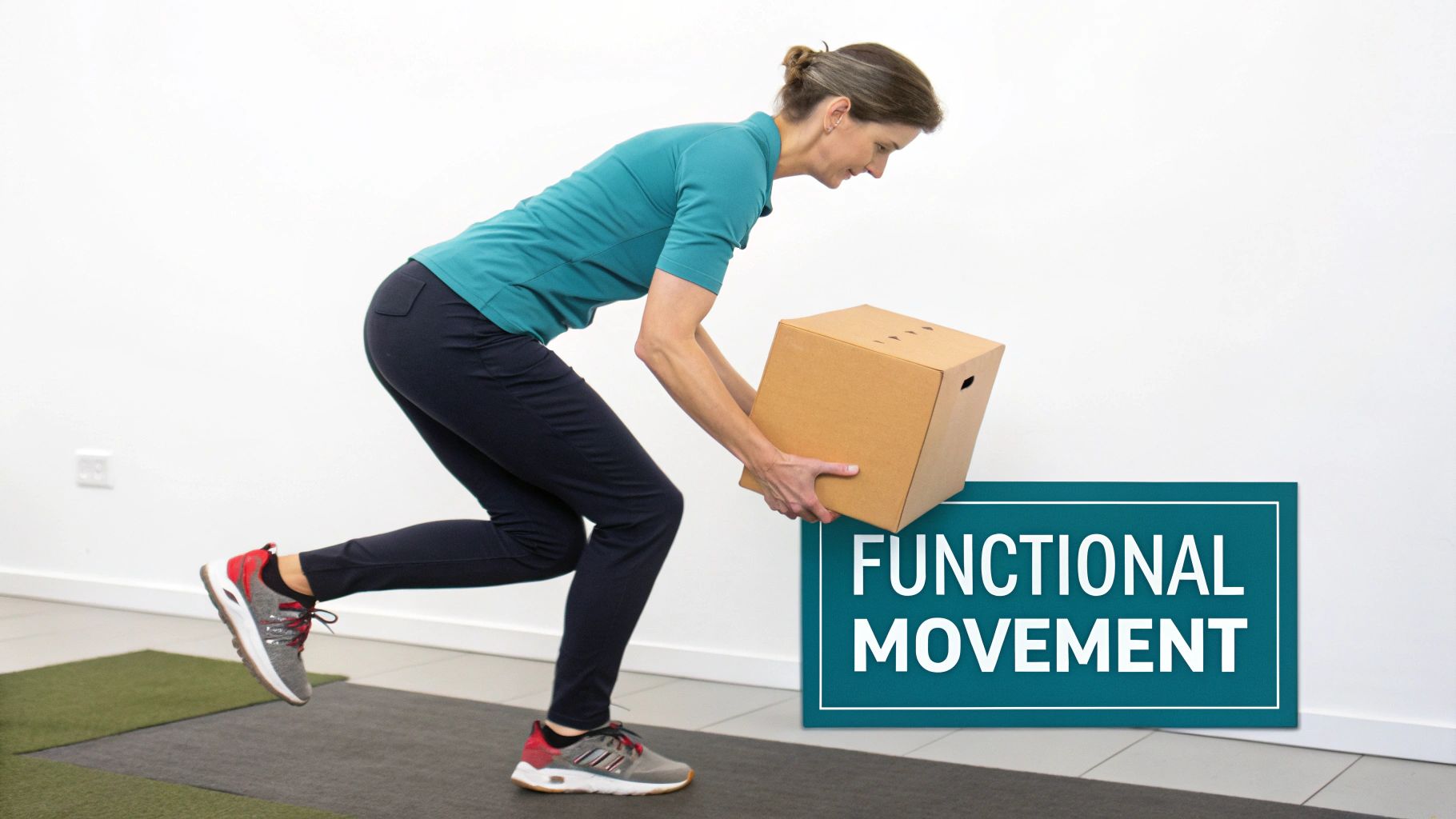
The best way to think about this approach is as a dress rehearsal for life. Instead of just doing a bicep curl to strengthen one muscle, functional physical therapy exercises get groups of muscles to activate together in patterns that look and feel like things you do every day—lifting a child, reaching for something on a high shelf, or getting out of a chair.
We focus on multi-joint, multi-planar movements that build practical strength, robust stability, and seamless coordination. The goal is to get you back to doing what matters to you, making the rehab process feel less like a chore and more connected to your personal goals.
The core idea is brilliantly simple: restore function by practicing function. By focusing on how you move during specific tasks, this therapy builds a durable foundation for long-term health and peak performance.
From Battlefields to Modern Clinics
The concept of using targeted exercise for recovery is not new. It demonstrated its value under intense conditions during World War II. In military hospitals where structured exercise therapy was integrated, the discharge rate for soldiers returning to active duty was significantly higher than in facilities that lacked such programs (1).
This history makes one thing clear: movement is a key component of rehabilitation. Whether you're an athlete getting back on the field or you want to carry groceries without discomfort, the core principles hold true.
The Foundation of Functional Therapy
What makes this approach so powerful is that it's deeply personal. A great program is built around the activities that are most meaningful to the individual, which can help keep motivation high and the process relevant.
Of course, before designing any program, a clinician must establish a baseline. A clear picture of a person's movement capabilities is needed, which is why standardized assessments are often used to pinpoint specific limitations. You can get a better sense of how clinicians evaluate these patterns in our guide on functional movement screen tests.
By identifying and targeting the root cause of movement problems, functional physical therapy offers a path to not just recover from an injury, but to build resilience against future issues. It’s about ensuring you can get back to fully participating in the life you love.
References
- Page P. The history and development of physical therapy. In: The scientific and clinical application of elastic resistance. Champaign, IL: Human Kinetics; 2003. p. 3-10.
A Quick Look Back: The Roots of Modern Movement Therapy
The ideas behind functional physical therapy exercises are not recent inventions. They are the result of centuries of refinement, a journey shaped by scientific discovery and historical necessity. Looking back, a consistent thread emerges: restoring the body's ability to perform meaningful tasks.
The shift from instinctual movement to a structured system began in the early 19th century. In 1813, Per Henrik Ling developed Swedish gymnastics and founded the Royal Central Institute of Gymnastics (RCIG). This was a significant step in formalizing exercise-based rehabilitation. His system focused on systematic movements to improve circulation, flexibility, and muscle tone—principles that are still cornerstones in modern athletic training. You can explore some more historical physical therapy methods for athletes and see how these foundational ideas persist today.
Crisis as a Catalyst
Major global events often accelerate medical progress, and physical therapy's story is no exception. The World Wars and polio epidemics were significant turning points. They forced a radical shift away from a "rest-only" mentality to a much more active, movement-focused discipline.
During World War I, the sheer number of injured soldiers was overwhelming. This crisis led to the emergence of "reconstruction aides," mostly women tasked with rehabilitating soldiers through therapeutic exercise, massage, and other hands-on methods. They laid the groundwork for modern physical therapy, demonstrating that active recovery was remarkably effective.
The field continued to grow after the war, but the post-World War II era cemented its place in medicine. The American Physical Therapy Association (APTA) saw significant growth, and by 1955, nearly every U.S. state and territory had its own chapter, showing a nationwide embrace of physical therapy's vital role.
The Unchanging Goal: Function
This entire journey reveals one simple, unwavering truth about rehabilitation. Our tools have become more precise and our understanding more data-driven, but the end goal has never changed.
The goal has always been to restore function. Whether discussing a 19th-century gymnast working on posture or a modern athlete recovering from an ACL tear, the focus is singular: return that person to their life and activities, safely and efficiently.
This legacy is alive in what we do now. The modern practice of functional physical therapy exercises is a direct descendant of these historical milestones. It's a blend of respect for fundamental human movement and the precision of modern science. By understanding where we came from, we can better appreciate the thoughtful, evidence-based approach that defines effective rehabilitation in the 21st century. The methods have evolved, but the mission to empower people through movement is as strong as ever.
Measuring What Matters with Objective Assessment Tools
How do we know if a functional exercise program is effective? While a patient saying "it feels better" is positive feedback, modern rehabilitation requires more than subjective reports. To map out a recovery journey, we must move beyond subjective feelings and utilize objective, quantifiable data. This is where the right tools turn clinical guesswork into concrete certainty.
Think of a skilled mechanic diagnosing an engine problem. They don't just listen and guess; they use diagnostic tools for precise readings. We apply a similar principle to the human body. We use specialized devices to measure movement with scientific precision, giving us a clear, data-driven picture of what's happening.
This data-first approach benefits everyone. Therapists can fine-tune treatment plans with confidence, surgeons can verify post-operative outcomes, and coaches can make smarter, safer return-to-play decisions.
Quantifying Movement with Modern Tools
A few key instruments are the workhorses of objective assessment in functional therapy. Each measures a different—but equally critical—piece of the human movement puzzle, helping us build a complete performance profile.
- Digital Goniometers: These tools measure joint range of motion (ROM) with high precision. Instead of visually estimating how far a knee can bend, a goniometer provides a specific number. This precision is invaluable for tracking small but meaningful gains in flexibility after an injury or surgery.
- Dynamometers: A dynamometer measures muscle force, removing the subjectivity of manual strength estimation. It captures the exact force a muscle group can generate, which is essential for restoring symmetrical strength and ensuring an injured limb has regained its power.
- Force Plates: These are advanced platforms that measure ground reaction forces, balance, and how a person distributes their weight. A force plate can detect subtle imbalances a patient might not feel, like favoring one leg during a squat. That insight is crucial for correcting faulty movement patterns that could lead to another injury.
Truly understanding the objective of measurement allows us to unlock its full potential in the clinic. With these tools, we can build a detailed, evidence-based story of a patient's progress.
This visualization shows just how far we've come, tracing the path from ancient, holistic ideas about movement to the precise, data-driven methods we rely on in modern physical therapy.
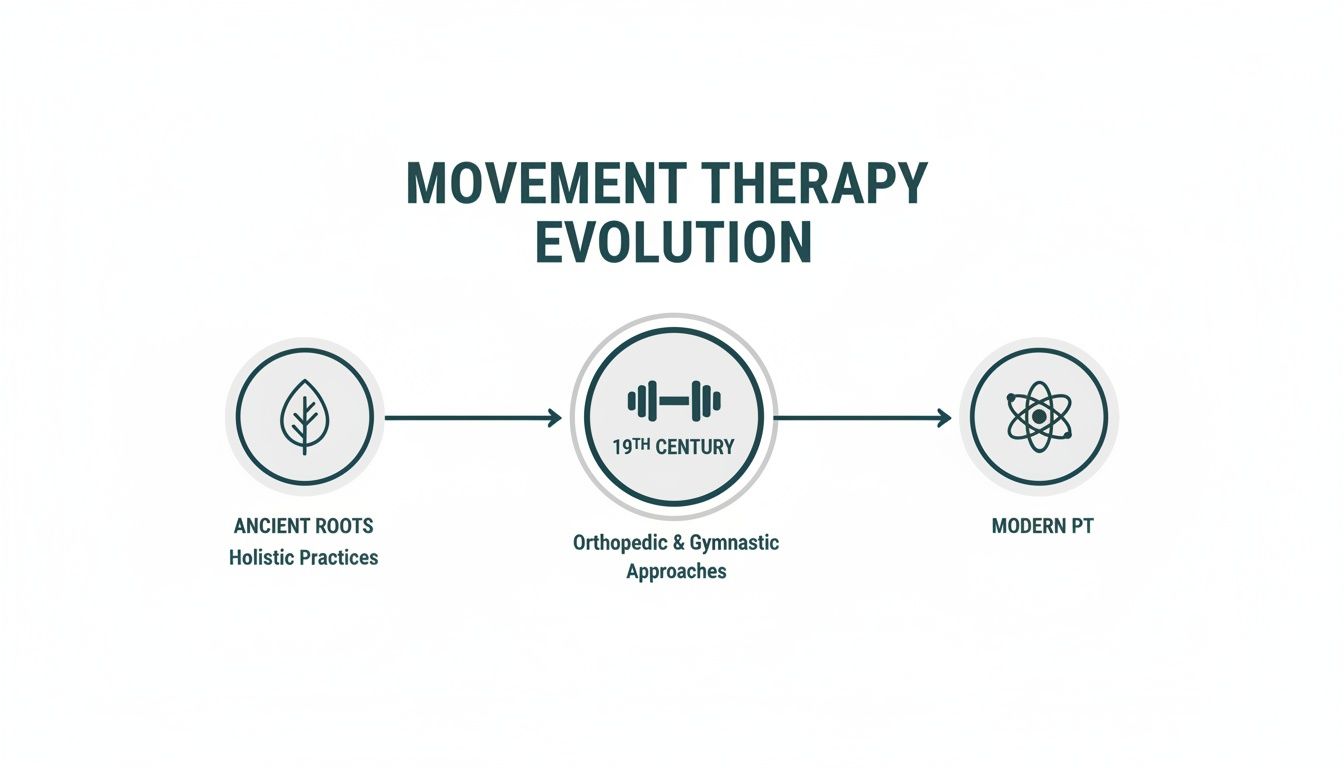
The biggest takeaway from this evolution? Our growing reliance on objective data to validate and guide every therapeutic decision we make.
To connect these concepts, let's look at how specific digital tools align with common functional assessments.
Matching Objective Tools to Functional Assessments
| Functional Metric to Measure | Objective Assessment Tool | What It Quantifies |
|---|---|---|
| Joint Flexibility & Mobility | Digital Goniometer | Measures exact degrees of joint range of motion during movements like a knee bend or shoulder raise. |
| Muscular Strength & Endurance | Dynamometer | Captures peak and average force output (in Newtons or pounds) during isometric contractions. |
| Balance & Stability | Force Plate | Assesses postural sway, center of pressure, and weight distribution during static and dynamic tasks. |
| Power & Explosiveness | Force Plate | Quantifies jump height, rate of force development, and limb symmetry during movements like a countermovement jump. |
This table helps illustrate how modern devices provide the hard numbers needed to accurately evaluate and track progress in key areas of functional performance.
The Power of Tangible Proof
Objective data doesn't just inform clinicians; it has a profound impact on the person doing the work—the patient. There is nothing more motivating than seeing tangible proof that your effort is paying off.
When a patient sees their strength measurement increase by 20% on a dynamometer report or watches their balance improve on a force plate analysis, it validates their hard work. This concrete evidence transforms recovery from a slow process into a series of clear, measurable wins.
This shift from subjective feeling to objective fact is a cornerstone of modern care. It provides the clear, undeniable evidence needed to justify treatment plans to insurance providers and demonstrate value to patients.
Furthermore, this data creates a common language between the patient, therapist, and other stakeholders like surgeons or coaches. A report showing an athlete's jump height on their surgically repaired leg is now within 5% of their uninjured leg is a much stronger indicator of readiness than simply saying they "look good" at practice. Ultimately, objective measurement tools make functional physical therapy exercises more effective, accountable, and engaging for everyone involved.
Building a Complete Functional Exercise Program
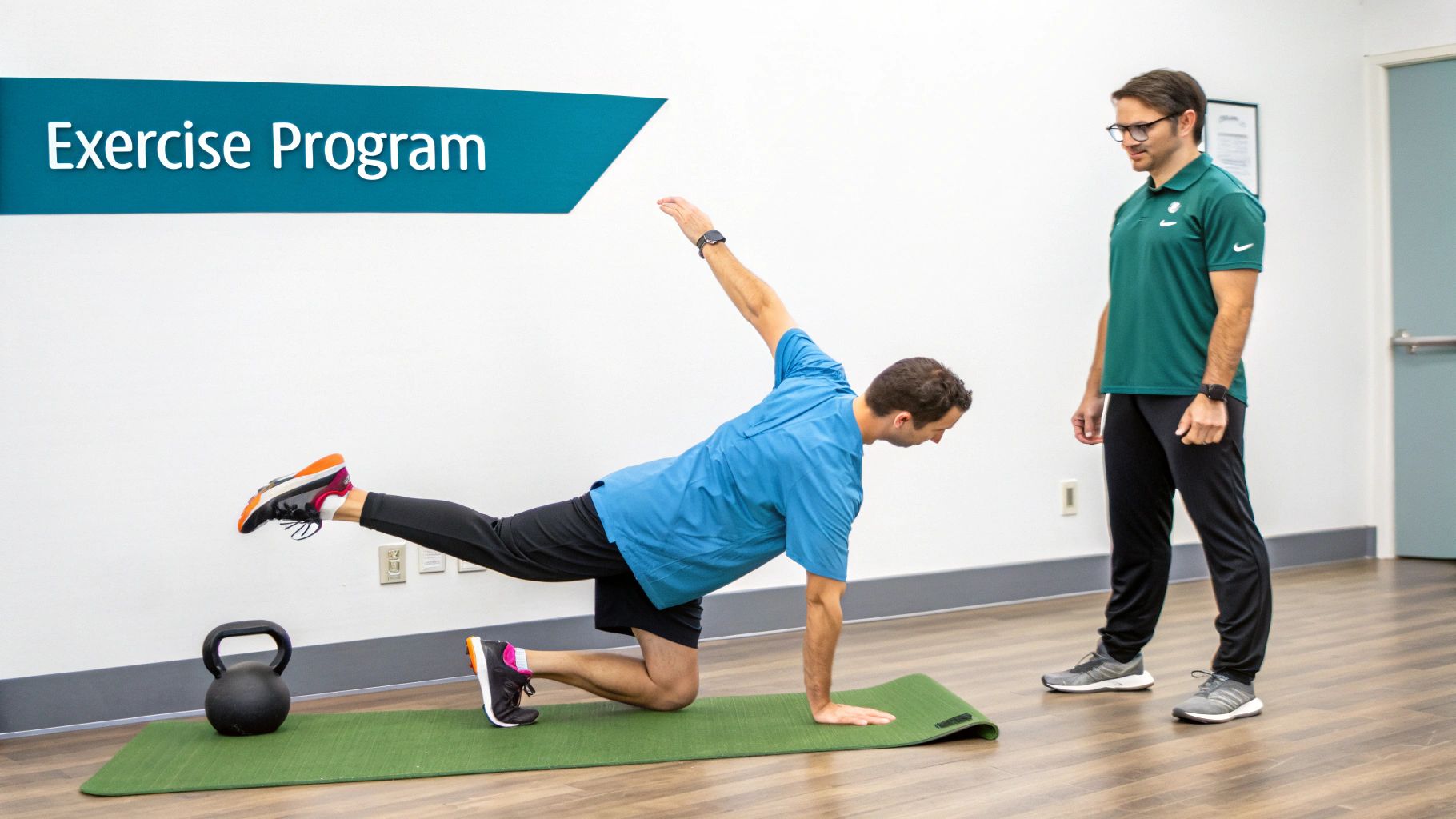
This is where assessment data is turned into real-world results. An effective program of functional physical therapy exercises is not just a random list of movements; it’s a carefully structured plan that addresses the fundamental pillars of human movement. By focusing on these core components, we build a balanced, effective path toward not just recovery, but lasting performance.
These pillars do not exist in isolation. Balance, strength, mobility, and core stability are deeply intertwined. A solid core is the anchor for powerful limb movements, good mobility allows for safe strength building, and sharp proprioception coordinates it all.
Let's break down each category.
Enhancing Balance and Proprioception
Balance isn't just about standing still. It's a dynamic skill that hinges on proprioception—your body's sense of its position in space. This is vital for everything from navigating an uneven trail to making a split-second defensive play in sports.
To improve proprioception, we must challenge the body's stability systems. The goal is to sharpen the constant, rapid conversation between the brain, nerves, and muscles.
- Single-Leg Stance: This is a foundational balance exercise. To increase the difficulty, try closing your eyes, which forces your proprioceptive system to work harder. Standing on an unstable surface like a foam pad is another progression.
- Tandem Walking: Walking heel-to-toe along a line narrows your base of support. Each step becomes a challenge requiring precise control and constant balance adjustments.
Slow, controlled execution is key. This gives the nervous system time to adapt and learn.
Developing Functional Strength and Power
Functional strength is about generating force in patterns that appear in daily life and athletic endeavors. Power is the next step, adding speed to strength for explosive, efficient movement.
These exercises are about getting multiple joints and muscle groups to work together as a team.
A core principle here is to train movements, not just isolated muscles. A kettlebell swing, for example, trains the entire posterior chain—glutes, hamstrings, back—to fire in a coordinated, powerful hip-hinge pattern. That’s the same pattern used to lift a heavy box off the floor safely.
Here are a few staples of functional strength:
- Goblet Squat: Holding a weight at your chest encourages an upright torso. This recruits your core and builds lower body strength in a pattern used every time you sit down and stand up.
- Farmer's Walk: Carrying heavy weights in each hand directly trains grip strength, core stability, and posture—similar to carrying groceries or a suitcase.
- Kettlebell Swing: This is a fantastic tool for building hip power. The key is to generate the movement with a sharp, explosive hip thrust, not by lifting the weight with your arms.
Improving Mobility and Flexibility
Here's a quick distinction: mobility is your ability to actively move a joint through its full range of motion, while flexibility is the passive range. Both are needed to perform daily tasks without restriction or compensation. If a joint cannot move as it should, the body will find another way, often putting undue stress on other areas.
Improving mobility involves active movements that guide joints and tissues through their available range. For more ideas on integrating strength and mobility, check out our guide on dynamic strength exercises.
- Cat-Cow Stretch: This classic yoga pose is excellent for promoting spinal mobility, gently moving the thoracic and lumbar spine through flexion and extension.
- Hip 90/90 Stretch: A go-to for targeting hip internal and external rotation. This is crucial for achieving a deep squat and for any rotational movements in sports.
Consistency is more important than intensity here. Short, frequent mobility work is often more effective than one long, aggressive stretching session a week.
Building Unshakeable Core Stability
The "core" is much more than the abdominal muscles. It's the entire muscular corset around your trunk and pelvis that acts as a central power station. A strong, stable core is the foundation from which all powerful arm and leg movements begin.
The best core training focuses on resisting unwanted movement—like twisting or arching—rather than creating it.
- Plank: A classic for a reason. It teaches you to engage deep abdominal muscles to resist spinal extension. To progress, try lifting one leg or arm.
- Bird-Dog: This exercise is a masterclass in resisting rotation. As you extend an opposite arm and leg, your core must work hard to keep your torso still and your spine neutral.
- Pallof Press: By pressing a resistance band away from your chest, you fight the band's pull to twist you. This trains the obliques and deep core muscles to act as anti-rotators.
By systematically working on each of these pillars, a therapist or coach can build a truly comprehensive program. The right mix of functional physical therapy exercises ensures you're not just recovering from an injury, but building a more resilient, capable body for the long haul.
Integrating Functional Exercises into Daily Practice
Knowing which functional exercises to prescribe is one thing; weaving them into a structured, data-driven session is what truly gets results. A well-designed visit has a logical flow, guiding a patient from warm-up to cool-down, with every step serving a distinct purpose. This framework not only maximizes the therapeutic benefit of each session but also provides the structure for clear, defensible documentation.
The process begins the moment your patient arrives. A quick, data-informed reassessment can be a good starting point. This isn't a full re-evaluation, but a targeted check on key metrics—like range of motion or strength—using objective tools. It sets the tone for the day's plan and allows for tracking of crucial visit-to-visit changes.
After the check-in, a dynamic warm-up follows. The goal is to prepare the body for the specific demands of the session, activating the target muscle groups and priming the nervous system for the work ahead.
Crafting the Core of the Session
The main block of the session is where the core functional exercises are introduced and progressed, tailored to the patient’s goals. The key is to be intentional, directly targeting the limitations identified during the initial assessment and any reassessments.
A typical session might include a mix of the pillars we've already covered:
- Balance and Proprioception: Starting with a single-leg stance on a stable surface.
- Strength and Power: Progressing to goblet squats to reinforce solid movement patterns under load.
- Core Stability: Finishing with exercises like the bird-dog to integrate core control with limb movement.
Dosing these exercises appropriately is critical. A good starting point comes from the American College of Sports Medicine, which suggests that for general strength, 2-4 sets of 8-12 repetitions works well for most adults (1). This provides a solid, evidence-based foundation that can then be adjusted based on individual response. For patients integrating these movements into their training or daily life, teaching them how to speed up muscle recovery is also vital for consistency and preventing setbacks.
The Power of Data-Driven Documentation
Effective clinical documentation does more than record what happened; it tells a compelling story of progress, backed by hard numbers. This is where objective data is invaluable. Instead of a vague note like "patient is stronger," you can paint a powerful, evidence-based picture.
Objective Note Example: "Patient performed 3 sets of 10 goblet squats with a 20 lb kettlebell, demonstrating improved form. Dynamometer testing of right quadriceps showed a peak force of 150 Newtons, a 15% increase from the previous session's 130 Newtons. This indicates progress toward restoring strength symmetry for return-to-sport criteria."
This type of documentation is a game-changer for a few reasons:
- Strengthens Medical Necessity: It gives payers clear, quantifiable proof that justifies the need for continued care.
- Improves Communication: It creates an unambiguous record of progress you can easily share with physicians, coaches, and the patient.
- Boosts Patient Motivation: Showing patients their progress in black and white is incredibly motivating. It validates their hard work and keeps them engaged.
Finally, every session should wrap up with a cool-down. This helps the body transition back to a resting state and is a perfect time for light mobility work or patient education. Reviewing the session's key takeaways and outlining the plan for the next visit ensures the patient leaves feeling empowered and clear on their path forward, transforming each visit from a simple workout into a strategic step toward lasting recovery.
References
- American College of Sports Medicine. Progression Models in Resistance Training for Healthy Adults. Medicine & Science in Sports & Exercise. 2009;41(3):687-708.
Prioritizing Safety in Functional Training
Effective rehabilitation is safe rehabilitation. While we aim to help clients improve, knowing when to modify, pause, or stop an exercise is a non-negotiable part of the job. This is where solid clinical judgment comes in, helping us identify situations where a functional exercise needs a second look to prevent injury and promote recovery.
The first step is understanding the difference between absolute and relative contraindications. Think of them as red lights and yellow lights in programming.
Absolute Contraindications: Red Lights
These are hard stops—the red lights. In these situations, specific movements are off-limits until a medical professional gives the all-clear. Pushing through could cause serious harm.
- Unstable Fractures: Any exercise that puts stress on or near an unstable fracture site is contraindicated.
- Acute Post-Operative States: Immediately after surgery, strict protocols are in place for a reason. They dictate exactly which movements are allowed to protect the surgical repair.
- Deep Vein Thrombosis (DVT): A suspected or confirmed DVT is a medical emergency. Exercise could dislodge a clot, so all activity must stop.
- Unstable Cardiovascular Conditions: This includes conditions like an uncontrolled arrhythmia or a recent heart attack. The risk is too high.
Relative Contraindications: Yellow Lights
These are your yellow lights. They signal the need for caution, clinical reasoning, and creativity. The exercise isn't necessarily forbidden, but it likely needs modification, closer monitoring, or a different approach.
A core principle here is to listen to the body. Sharp, stabbing, or radiating pain during an exercise is a clear signal to stop and rethink the movement, the load, or the form.
Some common yellow lights include:
- Significant Pain: Forcing a client to push through high levels of pain can be counterproductive, potentially flaring up tissue irritation and reinforcing poor movement patterns.
- Systemic Illness: When someone has a fever or feels generally unwell, exercise intensity should be reduced or postponed.
- Certain Chronic Conditions: Issues like severe osteoporosis or uncontrolled hypertension don't mean stopping all activity, but they demand smart program adjustments to manage risk.
Recognizing Critical Red Flags
Beyond contraindications, some symptoms that appear during a session are immediate red flags. These are emergency signals that mean you stop everything and refer the person for immediate medical evaluation.
Recognizing these signs is a critical responsibility for any therapist or coach.
- Sudden Dizziness or Fainting
- Chest Pain or Shortness of Breath
- Sudden Numbness, Tingling, or Weakness
- Loss of Bowel or Bladder Control
- Changes in Vision or Slurred Speech
For certain groups, like older adults, balance is a significant safety concern. You can dive deeper into specific screening tools in our guide to balance assessment tests for the elderly.
By keeping this framework of red lights, yellow lights, and emergency signals in mind, you can build functional training programs that are not only effective but, most importantly, fundamentally safe.
A Few Common Questions About Functional Physical Therapy
Even after breaking down the concepts, it's natural to have a few questions when exploring a new approach to rehabilitation. Let's tackle some of the most common ones about functional physical therapy. The goal is to provide clear, science-backed answers that make sense to everyone.
How Long Does Functional Physical Therapy Take to Work?
This is a common question, but the honest answer is: it's completely individual. There is no standard timeline. The rate of progress depends on several factors—the severity of the injury, your fitness level at the start, consistency with the program, and your ultimate goals (1).
Some people feel a difference in pain and basic movement within a few weeks. However, for bigger goals, like returning to a competitive sport, a longer duration is expected. This could take several months to safely rebuild the necessary strength, coordination, and confidence. The real key isn't a magic number of weeks; it's consistent, quality effort.
Is Functional Training Only for Athletes?
Absolutely not. While functional training is a cornerstone of athletic rehabilitation, its principles are universal. The "function" we're talking about is your personal, everyday function.
For a grandparent, a functional exercise might be mastering the squat-to-stand motion so they can get out of a chair without help. For a firefighter, it might be a loaded carry that mimics hauling heavy equipment. The movements are always scaled and tailored to an individual’s life demands, which is what makes this approach so powerful for everyone.
Can I Do These Exercises at Home?
Yes, and you absolutely should. A good functional program will include exercises you can do at home. Many foundational movements require little to no equipment, focusing on bodyweight to improve balance, core stability, and mobility.
Your therapist's job is to guide you on proper form and show you how to progress things safely, ensuring you can keep moving forward between your clinic visits. Questions may also arise about supporting your body’s healing outside of exercise. This is where topics like nutritional strategies for recovery come into play, as they are a vital piece of a successful rehabilitation plan. Ultimately, the combination of expert guidance in the clinic and consistent work at home is what delivers lasting results.
References
- Meira E. The Guide to Being a Private Practice Physical Therapist. 1st ed. On Target Publications; 2018.
At Meloq, we believe that objective data is the key to unlocking true functional progress. Our ecosystem of digital goniometers, dynamometers, and force plates empowers clinicians to replace guesswork with precision, track progress with confidence, and build more effective, evidence-based rehabilitation programs. See how our tools can elevate your practice at https://www.meloqdevices.com.

Featured Product
EasyForce Digital Dynamometer
Handheld muscle strength testing with 99% accuracy. Used in 40+ peer-reviewed studies.
Learn More