

Think about the difference between trying to throw a baseball and trying to push a stalled car. One is all about speed with relatively low force, while the other is pure force with almost no speed. This simple contrast gets right to the heart of the force velocity formula, a fundamental principle that dictates how all athletic movement happens.
The Secret Balance of Strength and Speed
At its core, the force-velocity relationship is a trade-off wired into our physiology: our muscles can either produce extremely high forces at low speeds, or they can generate incredibly high speeds with low forces. It's physically impossible for a muscle to do both at the same time.
Picture a powerlifter grinding out a one-rep max deadlift. The bar moves painfully slow, but the force they’re producing is at its absolute peak. Now, think about a sprinter’s foot striking the ground for just a fraction of a second. The movement is lightning-fast, but the force generated in that instant is much lower than what they could produce in a slow, heavy lift.
Understanding the Athletic Trade-Off
This natural seesaw between strength and speed is present in every sport. A soccer player needs the high-force ability to cut and change direction on a dime, but they also need high-velocity skill to sprint onto a through ball. The most explosive athletes aren't always the strongest or the fastest; they're the ones who master the perfect blend of both for their specific needs.
This is where performance science really shines. The relationship between force and velocity was scientifically described in the early 20th century, notably through the work of Nobel laureate A.V. Hill. His research on muscle mechanics gave us the classic force-velocity curve, which clearly shows that as a muscle’s contraction speed goes up, the force it can generate predictably goes down.
Why This Relationship Matters
Understanding this principle is a game-changer for coaches and therapists. It allows us to move beyond vague goals like just getting an athlete "stronger" or "faster." Instead, we can analyze an individual's unique force-velocity profile to pinpoint exactly what's holding them back.
By quantifying an athlete's abilities across the entire force-velocity spectrum, training can become highly specific. It provides a roadmap for targeting weaknesses, whether an athlete needs to develop raw strength or improve their explosive speed.
To really get this, it helps to understand the biology at play, like the cross section of skeletal muscle, which is the foundation of strength potential. Ultimately, mastering this balance is how we unlock an athlete's true power. This also ties directly into how quickly force can be generated, a crucial metric we cover in our guide on the rate of force development.
Tracing the Origins of Force and Motion
To fully appreciate the elegant equations used in sports science today, it’s helpful to understand their historical context. The concepts we now use daily—force, velocity, acceleration—weren't figured out overnight. They are the result of nearly two thousand years of curiosity, fierce debate, and discovery that built the foundation for modern performance training.
Our journey kicks off in ancient Greece with Aristotle. He was one of the first thinkers to formally suggest that an object’s motion was a direct result of an external force pushing or pulling on it. While his ideas had their limits, he established the core principle that force and motion are deeply connected, an idea that would stick around for centuries.
But that was just the beginning. The understanding of force and motion evolved through countless small steps over an astonishing 1,700 years from Aristotle's initial thoughts to Isaac Newton's game-changing laws. This long road wound through Greece, medieval England, France, and Italy, with each generation of thinkers adding another piece to the puzzle. You can check out the full history of projectile motion to appreciate just how much work went into it.
From Philosophy to Physics
During the Middle Ages and the Renaissance, scholars started to challenge the ancient Greek models. They introduced new ideas like "impetus"—what they saw as an internal force given to an object to keep it moving. While not entirely correct by today's standards, it was a huge mental leap away from thinking a constant external push was always needed.
This period was essential for sharpening the very language of physics. The definitions of mass, force, and velocity were debated and clarified, slowly creating the conceptual tools needed for the next big breakthrough. It was a messy, collaborative process that shows how science really moves forward: not in a straight line, but by questioning, revising, and building on what came before.
Newton's Unifying Laws
The culmination of this history arrived with Isaac Newton in the 17th century. Newton took centuries of observations and ideas and distilled them into his three clear, universal laws of motion. He finally provided the mathematical framework that precisely connected force, mass, and acceleration.
Newton’s Second Law of Motion is the real keystone for our discussion here. It states that an object's acceleration is directly proportional to the net force applied to it and inversely proportional to its mass. You probably know it as the famous equation F = ma.
This law changed everything. It gave us a predictable, mathematical way to describe how forces create motion, forming the bedrock of classical mechanics.
Every single biomechanical principle we use today—including the force velocity formula relied on by top physiotherapists and performance coaches—stands on the shoulders of this foundational work. It’s a great reminder that the equations we use to measure athletic power have deep, powerful roots. For a closer look at the math, you can dig into our overview of force calculations and formulas.
Breaking Down the Force Velocity Formula
To really get a handle on the force-velocity relationship, we have to look at the science that drives it. The foundational model here is A.V. Hill's classic equation, a true cornerstone of muscle physiology. It might look a bit intimidating at first, but each piece is surprisingly practical for any coach or athlete.
The most common form of the force velocity formula you'll see is:
(F + a)(V + b) = (F_max + a)b
Let's translate that from mathematical language into something you can actually picture on the field or in the gym. At its core, this equation simply describes the inverse relationship we've been talking about: as a muscle's contraction velocity goes up, the amount of force it can produce goes down.
Our understanding of this didn't just appear overnight. It's the result of centuries of scientific thought, building on one idea after another.

This long journey from early concepts to the precise biomechanical models we use today is what allows us to quantify athletic performance with such incredible detail.
Decoding the Variables
To make the force velocity formula useful, we need to know what each part means in a real-world athletic movement.
- F (Force): This is the actual force a muscle is generating during a specific movement. Think of it as the output at any given moment—the force you're pushing into the pedals on a bike or driving into the ground during a sprint.
- V (Velocity): This is the speed of the muscle contraction during that same movement. It’s simply how fast you're moving a weight, or even your own body.
- F_max (Maximum Isometric Force): This one is key. It represents the absolute maximum force a muscle can produce without changing length, which is an isometric contraction. Imagine pushing against an immovable wall with everything you've got; that peak force you exert without any movement is your F_max.
The other two variables, 'a' and 'b', are constants derived from experimental data. For practical purposes, you can think of them as "curve-shaping" factors that fine-tune the formula to accurately reflect the specific muscle group being tested.
The Power Connection
So, why does any of this matter? Because it all leads directly to the ultimate metric in sports performance: power. Power is what separates good athletes from great ones, and it's simply the product of force and velocity.
Power = Force × Velocity
This simple equation unlocks a critical insight. An athlete's peak power isn't found at maximum force (where velocity is zero) or at maximum velocity (where force is minimal). It happens somewhere in the middle of that curve.
It's that perfect blend of being "strong enough" and "fast enough." A powerlifter who can squat an immense weight very slowly has high force, but low power. A sprinter who can swing their limbs rapidly with little resistance has high velocity, but also low power. The goal of performance training is to find and expand that sweet spot where force and velocity combine to produce the highest power output. You can dive deeper into the nuances of the force and velocity relationship in our detailed guide.
By understanding the components of Hill's equation, we can see why just chasing a bigger squat number or a faster 40-yard dash time in isolation is not the whole picture. True athletic development comes from improving the entire force-velocity profile, which means an athlete can generate more force at every possible velocity.
How to Build an Athlete's Force Velocity Profile
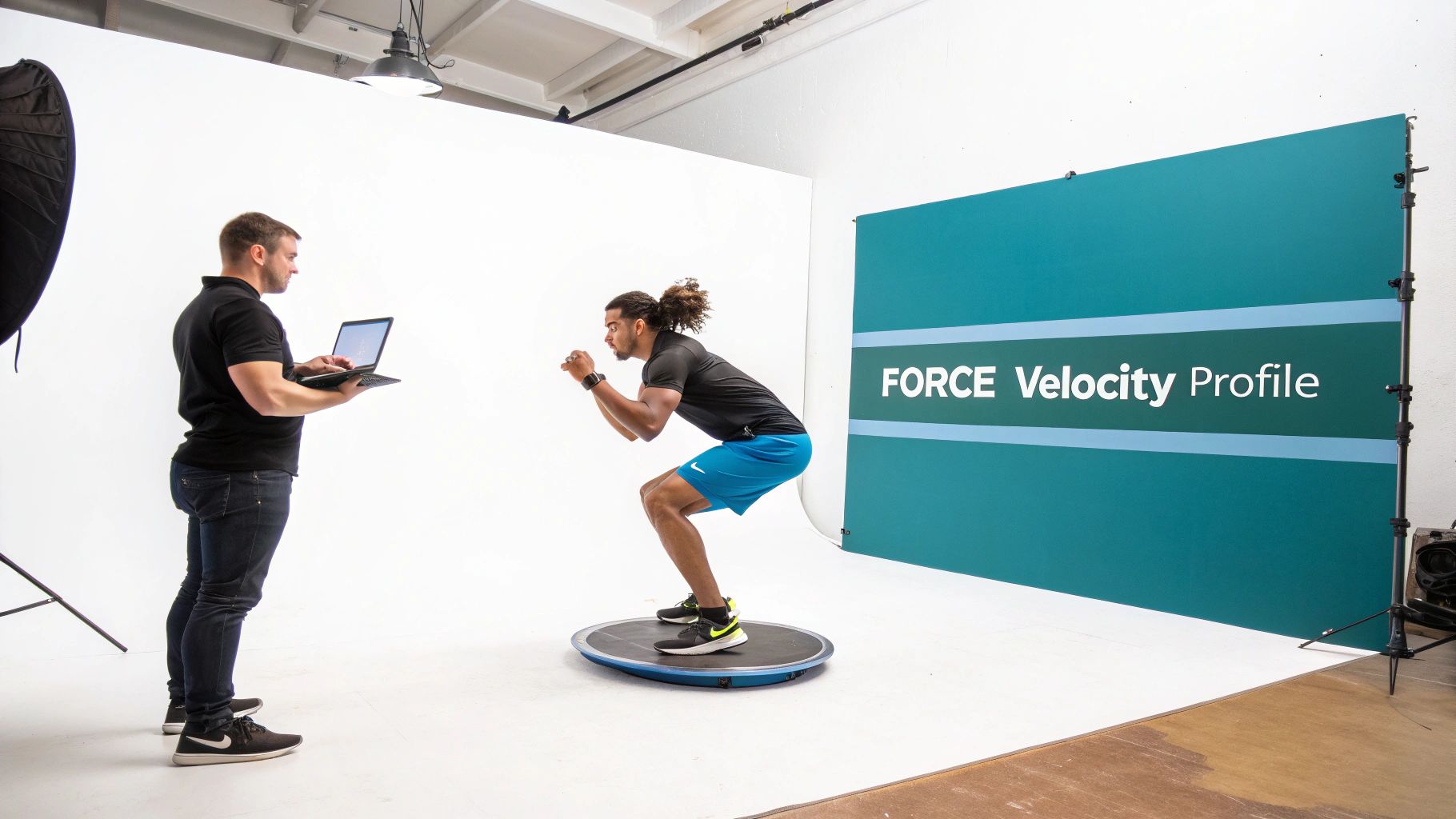
Now let's move from theory to practice. This is where the force velocity formula stops being an abstract concept and becomes a powerful tool in your coaching arsenal.
Building an athlete's force-velocity (F-V) profile isn't just about collecting numbers; it's about creating a personalized roadmap for their training. The goal is to map out their unique capabilities across the entire strength-speed spectrum. We do this by having them perform a key exercise with maximum intent, testing them with everything from heavy, grinding loads to light, explosive ones.
The Assessment Process Step-by-Step
A solid F-V profile hinges on a precise, structured approach. While specific protocols might differ slightly, the core sequence is designed to capture an athlete's true maximal ability at every single load.
Here’s a common breakdown:
- Select a Core Movement: Choose a compound, multi-joint exercise that’s directly relevant to the athlete's sport. Think squat jumps, countermovement jumps, or even bench press throws for upper-body athletes.
- Vary the Loads: The athlete performs the exercise at several different loads, typically between three and five. This spread is crucial—it needs to cover the high-force, low-velocity end (heavy weight) all the way to the low-force, high-velocity end (light weight or just bodyweight).
- Demand Maximum Intent: This is non-negotiable. On every single rep, the athlete must give 100% effort. Their goal is to move that weight as fast as humanly possible, regardless of the load. This ensures the data reflects their absolute peak output.
- Capture the Data: As they perform each rep, specialized equipment is used to measure the force they produce and the velocity they achieve. This is the raw data used to build the profile.
These data points become the building blocks for the athlete's unique force-velocity curve.
Key Technologies Used in Profiling
To get accurate data, you need the right tools. Sports scientists and clinicians rely on a few key pieces of technology to paint a complete picture of an athlete's performance.
The point of this technology isn't just to generate numbers. It's about getting objective insights into an athlete's neuromuscular capabilities, taking the guesswork out of program design.
Here’s a look at the most common tools for the job.
Common Tools for Force Velocity Profiling
To accurately create an F-V profile, practitioners use specific technologies. Each has its strengths, and understanding them helps in selecting the best setup.
| Measurement Tool | Primary Measurement | Common Application | Pros | Cons |
|---|---|---|---|---|
| Force Plates | Ground Reaction Force (GRF) | Vertical Jumps, Landings | Gold standard for force data; highly accurate and reliable for ground-based movements. | Can be expensive; less portable; primarily measures vertical forces. |
| Linear Position Transducers (LPTs) | Barbell/Body Velocity | Squats, Bench Press, Deadlifts | Excellent for measuring velocity directly from the bar or athlete; relatively affordable. | Tethers can sometimes interfere with natural movement; measures linear path only. |
| Camera-Based Systems | Movement Velocity & Biomechanics | Sprints, Jumps, Agility Drills | Non-invasive; captures full-body kinematics for deeper analysis. | Requires more complex setup and data processing; lighting can affect accuracy. |
| Inertial Measurement Units (IMUs) | Acceleration, Velocity | Any dynamic movement | Highly portable and versatile; can be worn by the athlete during sport-specific actions. | Accuracy can drift over time; data may require more filtering and interpretation. |
As you can see, the "best" tool often depends on the specific movement being tested and your budget.
For example, force plates are the gold standard for measuring ground reaction forces. When an athlete jumps or lifts, the plate precisely records how much force they push into the ground. This gives you the "force" side of the equation with incredible accuracy. To dig deeper into how they work, check out our guide on force platforms in biomechanics.
Linear Position Transducers (LPTs), on the other hand, are perfect for capturing the "velocity" component. These devices attach to a barbell and measure its speed with great precision throughout the lift.
Once you’ve collected the force and velocity data from each load, you plot it on a graph. The resulting line is the athlete's unique F-V profile. This visual snapshot instantly tells you if they're more force-dominant or velocity-dominant and, most importantly, reveals exactly where you need to focus your training to make them better.
Putting Your Profile into Action for Training and Rehab
Once we've mapped out an athlete's unique force-velocity profile, the real work begins. This data isn't just an interesting graph; it’s a powerful diagnostic tool that completely changes how we approach training and rehabilitation. It's the difference between a generic program and a surgical, highly individualized plan.
The first step is to interpret the curve. The slope of the F-V profile gives a clear picture of an athlete's neuromuscular tendencies. Are they a powerhouse who can produce incredible force but struggles to move fast? Or are they lightning-quick but lack the raw strength to generate elite power?
This analysis helps us classify an athlete's needs, leading to a targeted training approach.
The Force-Deficient Athlete
A force-deficient athlete might be described as "fast but weak" in relative terms. On their F-V curve, you'll see a steep drop-off on the force axis. These are the athletes who lack the foundational strength to produce high levels of power, even if they can move their limbs quickly.
The training prescription here is clear: build absolute strength. The goal is to shift their entire force-velocity curve upward, meaning they become stronger at every single velocity.
- Focus: Heavy Resistance Training
- Primary Exercises: Back Squats, Deadlifts, Bench Presses, Overhead Presses
- Intensity: Loads typically above 85% of their one-rep max (1RM)
- Rationale: This type of training improves the nervous system's ability to recruit high-threshold motor units and increases the muscle's cross-sectional area—both fundamental components of force production (1).
By boosting their F-max (maximum isometric force), we are essentially raising the ceiling for their power potential across the board.
The Velocity-Deficient Athlete
On the flip side, you have the velocity-deficient athlete. These athletes may be strong, but they lack the ability to express that strength rapidly. Their F-V profile will show high values on the force axis but will be underwhelming on the high-velocity end of the spectrum.
For this group, the priority is to get better at expressing force quickly. This means programming exercises that emphasize moving a load—or just their own bodyweight—as fast as humanly possible.
- Focus: Ballistic and Plyometric Training
- Primary Exercises: Loaded Squat Jumps, Kettlebell Swings, Box Jumps, Medicine Ball Throws
- Intensity: Light to moderate loads, often in the 30-60% of 1RM range, or even just bodyweight.
- Rationale: This style of training specifically targets the high-velocity end of the F-V curve. It trains the neuromuscular system to generate force at incredible speeds, directly improving their rate of force development (RFD) (2).
A key principle here is intent. It doesn’t matter if the load is light or heavy; the athlete's focus must always be on moving it with maximal velocity. That's what drives the specific adaptations we're after.
To really dial in performance, strategies that focus on how to increase speed and strength must be tailored directly to the athlete's individual profile.
Application in Rehabilitation and Return-to-Play
The force-velocity relationship isn't just for chasing peak performance; it's a critical tool in modern sports rehab. Following an injury, athletes don't just lose strength—they also lose their ability to produce force quickly. A traditional rehab plan might focus only on getting back to baseline strength, but this narrow approach can leave an athlete dangerously exposed to re-injury.
Clinicians now use F-V profiling to guide a much more complete and effective recovery. For example, after an ACL reconstruction, an athlete might get back to symmetrical strength in a slow, controlled leg press. But their F-V profile could reveal a glaring deficit in force production at high velocities in the injured leg—a gap that traditional testing would miss.
This insight allows therapists to build a smarter, more targeted program:
- Early Stage: Rebuild the force foundation with controlled, foundational strength exercises.
- Mid Stage: Start retraining explosive capacity by introducing light-load, high-velocity movements.
- Late Stage: Progress to sport-specific plyometrics to ensure the athlete can handle the dynamic, chaotic demands of competition.
By tracking the F-V profile throughout the rehab journey, clinicians can make objective, data-driven decisions about an athlete's readiness to return to play. It ensures they haven't just healed but have fully rebuilt the specific power capabilities they need to compete safely and effectively, dramatically cutting the risk of another injury.
References
- Suchomel TJ, Nimphius S, Stone MH. The Importance of Muscular Strength in Athletic Performance. Sports Medicine. 2016;46(10):1419-1449.
- Cormie P, McGuigan MR, Newton RU. Developing maximal neuromuscular power: part 1 - biological basis of maximal power production. Sports Medicine. 2011;41(1):17-38.
Understanding the Limits of the Model
The force-velocity formula is an incredibly powerful framework, but it's important to remember what it is: a model. It’s a brilliant simplification of an astonishingly complex biological reality. Just as no single equation can perfectly predict the weather, the classic F-V curve doesn't capture every nuance of human movement. Knowing its limitations is what allows us to apply its principles intelligently.
The original model, after all, was developed using isolated animal muscles in highly controlled lab settings. That's a world away from a soccer player making a split-second cut on a wet field or a weightlifter executing a complex clean and jerk. Real-world athletic movements involve entire kinetic chains—muscles, tendons, and bones all working in concert—a level of intricacy the basic formula doesn't fully account for.
Factors Beyond the Basic Formula
To really put the force-velocity relationship to work, we have to consider several real-world variables that the classic model doesn't directly address.
- Technique and Skill: An athlete’s technical skill can dramatically change their force and velocity output. Two athletes with identical physiological profiles might produce wildly different results simply because one has more efficient movement mechanics.
- Fatigue: Neuromuscular fatigue is a game-changer. It drastically alters an athlete's ability to produce both force and velocity. An F-V profile measured at the start of a training session will look very different from one taken after an exhaustive workout.
- The Stretch-Shortening Cycle (SSC): Many explosive actions, like jumping or throwing, get a huge boost from the SSC. This is the rapid eccentric (lengthening) contraction followed immediately by a concentric (shortening) one. This "spring-like" effect allows for much greater power output than a purely concentric movement, a key detail not included in the original Hill equation (1).
A Model, Not a Mandate
Thinking critically about scientific models is the hallmark of a good practitioner. Even a concept as fundamental as Newton's second law (F = ma) went through centuries of refinement. While Newton published his work in the late 17th century, the mathematical precision we rely on today wasn't fully buttoned up until thinkers like Lord Kelvin introduced new concepts in the 19th century to resolve its initial logical gaps. You can discover more about this scientific journey.
The force-velocity formula should be seen as an indispensable guide, not an infallible rule. Its real value is in providing a foundational understanding of the trade-off between strength and speed. We can then layer that foundation with our knowledge of biomechanics, fatigue, and skill.
By understanding these limitations, we avoid the trap of treating the F-V profile as an absolute truth. Instead, it becomes a powerful starting point for a deeper, more holistic analysis of an athlete's performance. This is what leads to smarter training decisions and, ultimately, better outcomes.
References
- Turner AN, Jeffreys I. The Stretch-Shortening Cycle: Proposed Mechanisms and Methods for Enhancement. Strength and Conditioning Journal. 2010;32(4):87-99.
Force-Velocity Formula: Your Questions Answered
Let's tackle some of the most common questions that come up when coaches and clinicians start digging into the force-velocity formula and how it applies in the real world.
Is an Athlete's Force-Velocity Profile Genetic?
This is a classic nature versus nurture question. While genetics certainly deal an athlete their initial hand—influencing their baseline muscle fiber type and natural lean towards either strength or speed—their force-velocity profile is far from set in stone.
Think of it this way: genetics might define the starting point, but dedicated training dictates the journey. An athlete can absolutely shift their curve. Consistent heavy lifting will bolster their max force capabilities, while a solid block of plyometrics will improve how quickly they can express that force. Training is a powerful sculptor of an athlete's performance profile (1).
How Often Should I Profile an Athlete?
The right frequency really hinges on the training phase and the specific goals. A great rule of thumb is to run a full profile at the beginning of any new training block. This gives you a solid, objective baseline to work from.
From there, re-testing every 4-6 weeks is a common and effective cadence in most performance settings. It's the sweet spot—long enough for meaningful physiological adaptations to take place, but frequent enough to keep your finger on the pulse and ensure the program is actually working.
When it comes to rehab, you might find yourself profiling more often. This allows for more granular, data-backed decisions on when to progress an exercise or how to safely manage an athlete's return to play.
Does the Force-Velocity Relationship Apply to Every Sport?
Absolutely. The core principle—that force and velocity share an inverse relationship—is a fundamental truth of human movement. It's just as relevant for a powerlifter moving massive weight slowly as it is for a sprinter exploding out of the blocks.
Where it gets interesting is in the application. The "ideal" profile shape changes dramatically depending on the sport's demands. A shot-putter's profile should be heavily weighted towards the force end of the spectrum. A badminton player, on the other hand, needs to produce force effectively at incredibly high speeds. The magic isn't just in creating the profile; it's in interpreting it within the unique context of the athlete's sport.
Ready to stop guessing and start measuring? Meloq delivers the accurate, portable tools you need to quantify performance and make truly data-driven decisions. Explore our devices and start building better, more resilient athletes today.

Featured Product
EasyForce Digital Dynamometer
Handheld muscle strength testing with 99% accuracy. Used in 40+ peer-reviewed studies.
Learn More