

Force Measuring Instruments: A Guide to Precise Data in Rehabilitation and Performance
Team Meloq
Author
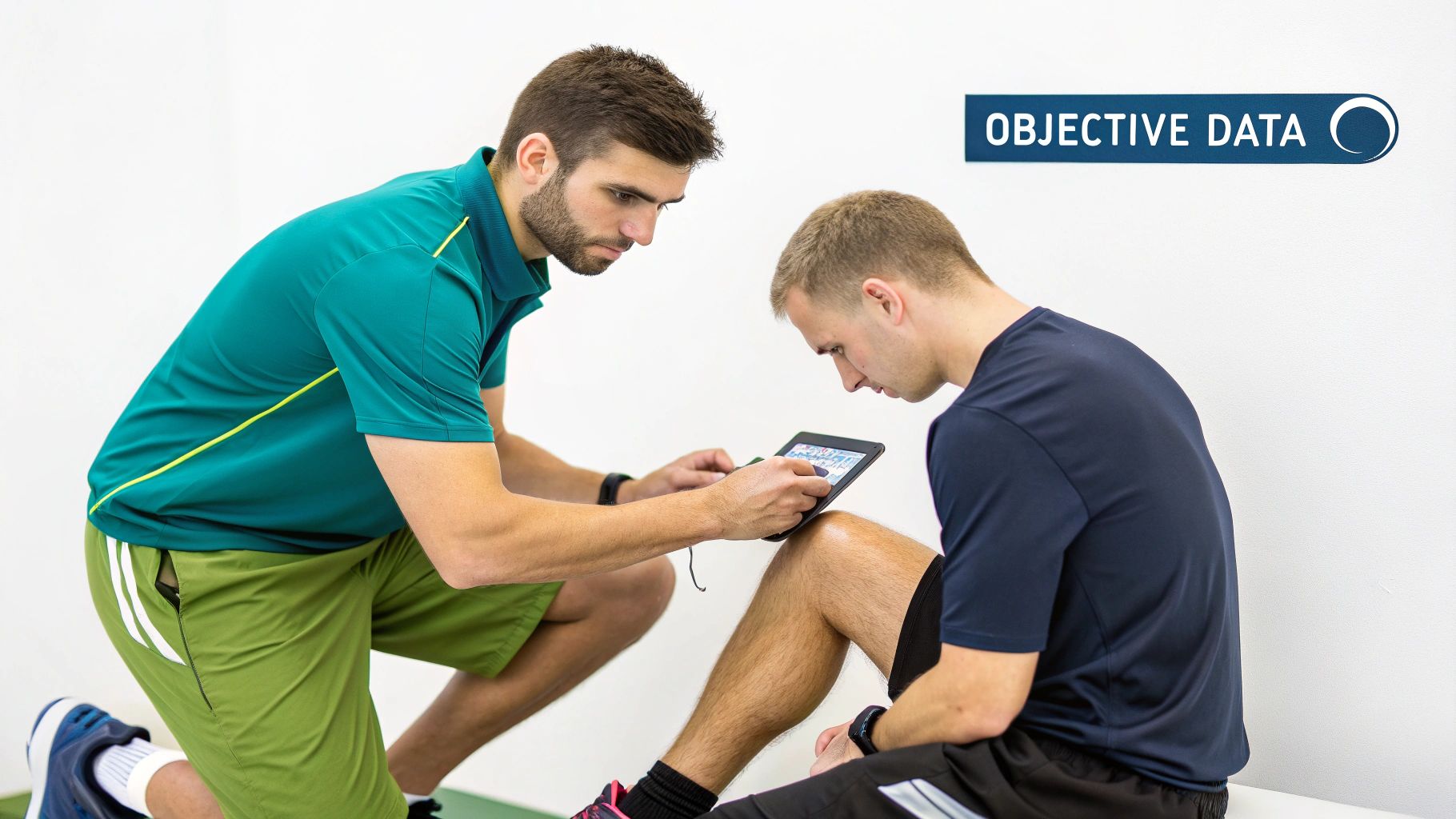
Force measuring instruments are essential tools that provide objective, measurable data on push, pull, and torque. These devices are central to a significant shift in physiotherapy and sports training, moving practices away from subjective clinical guesswork and toward precise, data-driven decisions.
Moving Beyond Guesswork With Objective Data
Consider the process of clearing an athlete for return-to-play after an ACL reconstruction. Historically, this decision relied heavily on a clinician's hands-on feel and professional judgment. While this experience is valuable, it is also subjective. It can lead to inconsistencies between therapists, or even between sessions with the same therapist. This lack of quantitative data makes it challenging to definitively track progress or confidently decide on an athlete's readiness to return to competition (1).
This is precisely where objective data from force measuring instruments changes the paradigm. They replace ambiguity with accuracy, providing the clear, reliable numbers needed to validate recovery milestones. This approach is rapidly becoming the new standard of care in rehabilitation and performance conditioning.
The Value of Quantifiable Metrics
Quantifiable data allows for better management of clinical and performance outcomes. Assigning a numerical value to strength or power offers several advantages over qualitative assessment. It allows clinicians and coaches to establish a clear baseline for an individual. From that point, every subsequent test provides objective data showing improvement, stagnation, or decline. This approach makes clinical work more precise and effective.
- Confident Clinical Decisions: Quantitative data helps therapists identify subtle asymmetries or deficits that might be missed by manual assessment alone (2).
- Personalized Training Programs: Objective data can highlight specific weaknesses, enabling the creation of targeted interventions rather than relying on generic protocols.
- Enhanced Patient Motivation: Seeing tangible improvements in strength numbers can be a powerful motivator, potentially boosting engagement and adherence to rehabilitation programs (3).
The principle of replacing estimation with evidence extends beyond force measurement. Many are now tracking other forms of objective biophysical data to build a more complete picture of health and performance. If you're looking to understand the fundamentals, our guide on what is force measurement is a great place to start.
The growing adoption of these technologies is reflected in market trends. The global market for force gauges and torque meters, valued at USD 1.2 billion in 2023, is projected to reach USD 1.8 billion by 2033 (4). This growth indicates a significant shift toward data-driven protocols, with healthcare being a prominent segment.
How Force Measurement Technology Actually Works
Force measuring instruments operate on well-established scientific principles that convert a physical push or pull into a digital number. Understanding the underlying technology can help build confidence in the data they provide, making them reliable partners in clinical or performance settings.
The most common technology is the strain gauge. This is a sensor whose electrical resistance varies with applied force. When a force is applied to a structure containing a strain gauge—such as a dynamometer or force plate—the structure deforms slightly.
This microscopic deformation stretches or compresses the sensor, changing its electrical resistance. The instrument measures this change with high precision and converts it into a force measurement, typically displayed in Newtons, kilograms, or pounds. For a closer look at its application, you can explore how a dynamometer works.
Strain Gauges: The Heart of Modern Measurement
The reliability of strain gauge technology is why it is so widely used. These sensors are particularly effective for measuring static or slowly changing forces, such as during a sustained isometric muscle contraction test. Their consistency and accuracy are crucial for establishing baselines and tracking progress over time, where even small changes are meaningful.
The market for force sensors, the core component in these instruments, was valued at approximately USD 3.07 billion in 2023 (5). Strain gauge-based sensors hold a significant market share due to their reliability and typical accuracy within 0.1% of their full scale. This represents a substantial improvement over older mechanical spring scales, which could have larger margins of error.
In essence, a strain gauge provides a highly accurate answer to the question: How much did this object just deform? By measuring that minute change, it offers a powerful window into human force production, turning subtle physiological events into actionable data.
Piezoelectricity: Capturing Explosive Power
While strain gauges are excellent for steady forces, another technology is better suited for capturing rapid, dynamic actions: piezoelectric sensors. The term "piezo" originates from the Greek word for "to squeeze," which accurately describes their function.
Piezoelectric sensors are constructed from special crystalline materials. When these materials are compressed—for instance, by the impact of an athlete landing from a jump—they generate an electrical charge. The magnitude of the force is proportional to the strength of the charge.
This property makes them ideal for force plates used to analyze dynamic movements like sprinting, jumping, or sudden changes of direction. The sensor's near-instantaneous response provides a high-fidelity view of how force develops and dissipates over fractions of a second. As you consider implementing this technology, it is helpful to look into understanding how various health wearables and sensors contribute to data-driven insights for a broader context on sensor types and accuracy.
Ultimately, whether using the steady precision of a strain gauge or the rapid response of a piezoelectric crystal, the goal is the same: to translate the invisible world of force into clear, objective data.
Choosing the Right Force Measuring Instrument
With many force measurement tools available, selecting the right one can seem daunting. The best choice depends on what you need to measure, your work environment, and your intended outcomes. A clear understanding of your needs ensures you invest in a tool that becomes an integral part of your practice.
The primary consideration is data quality. For clinical documentation, rehabilitation tracking, or performance analysis, you need trustworthy numbers. This is where accuracy (closeness to the true value) and reliability (consistency of results) are paramount.
A device with minimal error and high test-retest reliability ensures that observed changes reflect actual physiological progress, not measurement variability (6). This allows you to make defensible clinical decisions, demonstrate the effectiveness of interventions, and build trust with clients and athletes.
Defining Your Primary Use Case
Before comparing models, you must answer a fundamental question: What are you measuring?
Are you focused on static, isometric muscle strength in a fixed position? Or are you analyzing dynamic, explosive movements like a jump? The answer to this question is the first step in the selection process.
This flowchart illustrates this initial decision point.
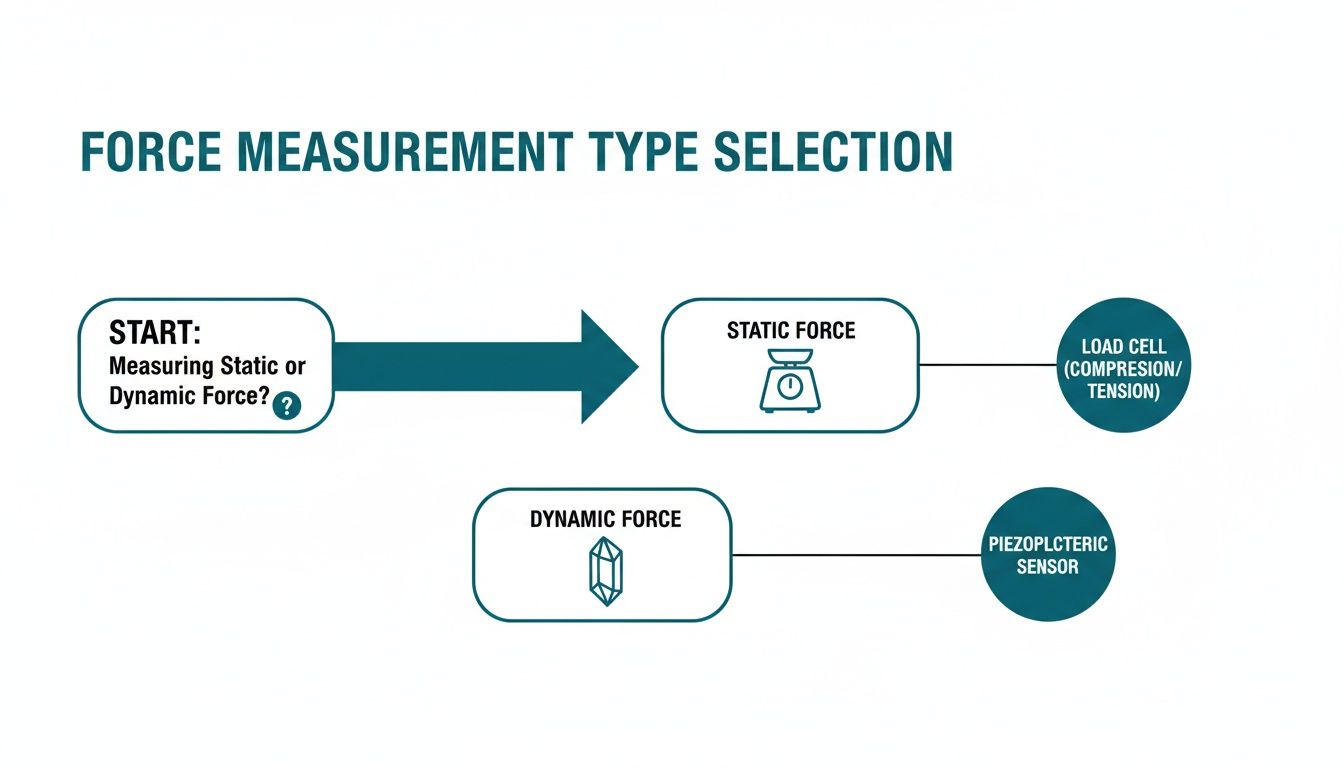
As the visual shows, your intended application—assessing a steady contraction versus a powerful, rapid movement—guides you toward different types of technology.
Different tools are designed for different tasks. A handheld dynamometer is excellent for isolating specific muscle groups in a clinical setting, such as assessing rotator cuff strength. A force plate, in contrast, is designed to capture complex ground reaction forces during gait or a countermovement jump.
Comparison of Common Force Measuring Instruments
This table outlines the most common instruments in clinical and performance settings to help clarify which tool is appropriate for which task.
| Instrument Type | Primary Use Case | Key Metrics Measured | Portability | Best For |
|---|---|---|---|---|
| Handheld Dynamometer | Manual muscle testing (MMT) for isolated muscles | Peak Force, Average Force, Rate of Force Development | High | Rehab tracking, baseline strength testing, field assessments |
| Force Plate | Analyzing ground reaction forces during movement | Jump Height, Power, Asymmetry, Landing/Takeoff Forces | Low to Moderate | Biomechanical analysis, return-to-sport testing, balance assessment |
| Integrated Load Cell | Measuring force within resistance training equipment | Peak Force, Force Over Time, Work, Power | Low (integrated) | Performance monitoring, exercise prescription, research in a gym setting |
Each instrument offers a unique perspective on human performance. Your goal is to choose the one that provides the most relevant and actionable insights for your specific needs.
Key Criteria for Your Selection
Once you have identified your primary application, other practical factors should be considered. It is about balancing technical specifications with daily usability.
- Portability and Environment: Will you be testing exclusively in a clinic, or do you need to conduct assessments on the field or courtside? Stationary force plates are powerful but fixed. Portable dynamometers or newer compact force plates offer the flexibility to test in various locations.
- Software Ecosystem: The device is only one part of the equation. The software translates raw numbers into useful insights. Look for a platform that is intuitive, provides instant feedback, visualizes progress, and simplifies reporting. A seamless workflow is essential.
- Return on Investment (ROI): Consider the value beyond the initial cost. An effective force measurement tool can improve client outcomes, which in turn can enhance your professional reputation and client retention.
Furthermore, objective data from a calibrated device can be invaluable for documentation. It replaces subjective notes with hard numbers, helping to justify the medical necessity of treatment and potentially supporting reimbursement claims.
Categorizing Your Options
With these criteria in mind, let's look at the main categories of instruments and their best applications.
- Handheld Dynamometers: These portable devices are the standard for quantitative manual muscle testing (MMT). They provide precise readings of peak and average force for specific muscles, making them invaluable for tracking progress after an injury (7).
- Force Plates: Available in both fixed and portable versions, force plates measure ground reaction forces. They are considered the gold standard for analyzing balance, gait, jump profiles, and asymmetries, offering deep insights into complex movements.
- Integrated Load Cells: These are sensors that can be built into other equipment, such as cable machines or custom testing rigs. They are ideal for measuring force output during specific strength exercises, helping to monitor performance and fatigue in a training environment.
Choosing the right tool is a strategic decision. By carefully considering your needs for accuracy, usability, and data management, you can find a device that elevates your practice and helps you deliver better results.
Applying Force Measurement in Your Practice
While understanding the theory is important, seeing force measuring instruments in action provides a clearer picture of their utility. Let's explore concrete, evidence-based scenarios that demonstrate how objective data can directly shape clinical reasoning, optimize training, and lead to better outcomes for patients and athletes.
Case Study: ACL Reconstruction and Return to Play
One of the most critical scenarios in sports physiotherapy is guiding an athlete's recovery from an anterior cruciate ligament (ACL) reconstruction. The decision to clear them for return-to-play can be enhanced significantly with objective data. By using a handheld dynamometer, a physiotherapist can establish data-driven milestones.
From the early stages of rehabilitation, the therapist can measure the isometric strength of the quadriceps and hamstrings on both the surgical and non-surgical legs. This provides a clear, numerical value for muscle function.
A common goal is to achieve a Limb Symmetry Index (LSI) of 90% or greater. This means the strength of the recovering limb should be at least 90% of the healthy limb before a return to sport is considered (1). This metric provides a clear target for both the therapist and the athlete.
Regular, repeatable tests document progress, identify plateaus, and confirm the effectiveness of the strengthening program. This data-driven approach not only helps prevent premature returns and potential re-injury but also builds the athlete's confidence as they see tangible proof of their recovery.
Case Study: Enhancing Vertical Power in Volleyball
Now let's shift from rehabilitation to performance enhancement. A performance coach working with a collegiate volleyball player who wants to increase their jump height can use a force plate to gain insights beyond what a simple vertical jump test can provide.
By having the athlete perform countermovement jumps on the force plate, the coach can analyze key metrics:
- Peak Vertical Force: The total force the athlete drives into the ground.
- Rate of Force Development (RFD): How quickly the athlete can produce that force.
- Asymmetry Analysis: Whether the athlete favors one leg during takeoff or landing.
Force plate data might reveal that while the athlete's peak force is high, their RFD is slow, suggesting a need to focus on explosive power training. Alternatively, it could reveal a significant asymmetry, with the athlete generating 15% more force with their right leg. Such imbalances can be inefficient and are associated with an increased risk of lower extremity injuries (8). Armed with this data, the coach can prescribe targeted unilateral exercises to address the asymmetry and plyometrics to improve RFD, leading to a safer, more powerful athlete.
Case Study: Gait Analysis in Veterinary Rehabilitation
Force measurement is not limited to human athletes. In veterinary rehabilitation, force plates are instrumental for assessing gait symmetry in animals recovering from orthopedic surgery, such as a dog after a tibial-plateau-leveling osteotomy (TPLO).
An animal cannot verbally communicate its pain levels or functional limitations. However, by having the dog walk across a force plate, a veterinarian can objectively measure the peak vertical force exerted by each limb. A healthy dog typically shows relatively symmetrical limb loading.
After surgery, the data might show the dog is placing only 30% of its body weight on the affected leg, providing a precise baseline. As the dog undergoes rehabilitation—perhaps including underwater treadmill therapy and specific exercises—follow-up force plate assessments can track the gradual increase in limb loading. This objective data helps the clinician adjust the rehabilitation plan and provides the owner with clear evidence of their pet's recovery.
The use of these instruments is growing. For instance, the specialized force gauge market is projected to reach USD 43.8 million by 2032 (9). In healthcare, their application in grip strength rehabilitation has been associated with improved functional outcomes in certain patient populations. Learn more about these market insights.
Integrating Objective Data Into Your Daily Workflow
Acquiring a powerful piece of equipment is just the first step. The true value of force measuring instruments is realized when they are seamlessly integrated into daily clinical practice. By weaving objective data into your workflow, you can enhance patient outcomes and build trust through transparent, data-driven care.
At the heart of trustworthy data is consistency. Without it, the data collected can be misleading. Establishing standardized testing protocols is the most important step to ensure your measurements are both reliable and repeatable over time. A solid protocol minimizes variables that can contaminate data and lead to incorrect clinical conclusions.
Establishing Ironclad Testing Protocols
To build a protocol that produces clean, comparable data, several key factors must be controlled. Small variations in setup can cause significant swings in force output, undermining the objectivity you aim to achieve.
Your standardized procedure should always define the following:
- Consistent Patient Positioning: Document the precise joint angles, body posture, and any stabilization methods used. For example, when testing hip abduction strength, specify whether the patient is supine or side-lying and detail how the pelvis is stabilized to prevent compensation (10).
- Standardized Verbal Cueing: The words you use can impact performance. Using a consistent script, such as, "Push as hard as you can... harder... harder... relax," ensures that every patient receives similar encouragement, which can influence maximal effort.
- Defined Test Duration: For isometric tests, be specific about the length of the contraction. A 3- to 5-second hold is a common standard. This consistency is crucial for comparing metrics like peak force from one session to the next.
From Raw Numbers to Meaningful Stories
Collecting data is one part of the process; making it understandable and motivating for a patient or athlete is another. Raw force values in Newtons may be meaningful to a practitioner, but they often are not to the client. The art lies in translating that data into a visual story of their progress.
Modern software ecosystems connected to force measuring instruments can generate clear, visual reports that track progress over time. A simple line graph showing a steady increase in quadriceps strength can be a powerful motivator for an athlete recovering from surgery. If you're looking for more on framing these conversations, our guide on what is outcome measurement is a great place to start.
Research suggests that providing athletes with regular, visual feedback on performance data can enhance adherence to their rehabilitation programs compared to verbal feedback alone (3).
This visual feedback loop does more than motivate. It helps educate your patients, allowing them to understand the "why" behind their exercises and giving them a tangible sense of ownership over their recovery. It can shift your role from simply a provider to a partner in their success.
Common Questions About Force Measurement
Adopting objective data measurement is exciting, but it naturally brings up practical questions. Here are clear, straightforward answers to some of the most common queries from clinicians, coaches, and students.
How Hard Are These Tools to Actually Use?
Modern force measuring instruments, such as digital dynamometers and force plates, are designed with busy professionals in mind. They typically feature intuitive interfaces and are often paired with software applications that guide users through testing procedures.
While a solid understanding of biomechanics and testing principles is crucial for interpreting the data, the technical skill required to operate the device is generally straightforward. Most clinicians can become proficient in collecting reliable data after a short period of practice.
Will Insurance Actually Cover This?
The use of objective data from calibrated medical devices is increasingly recognized in healthcare because it provides quantifiable proof of medical necessity and documents a patient's progress.
For example, showing a 30% quadriceps strength deficit after surgery and tracking its improvement over time with precise measurements can provide strong support for insurance claims and justify the need for continued care. This kind of hard data can be a valuable tool in clinical documentation.
Can I Use One Device for a Bunch of Different Tests?
Yes, versatility is a key feature of many modern systems. A quality handheld dynamometer, for instance, can be used with different attachments and protocols to test a wide range of muscle groups, from the small rotator cuff muscles to larger muscles like the quadriceps and hamstrings.
Similarly, a force plate is not just for elite athletes. It can be used to assess balance and fall risk in older adults one moment and then analyze the explosive power of a basketball player the next. This adaptability makes these tools a smart investment for practices with diverse patient populations.
Peer-reviewed protocols have demonstrated that handheld dynamometry has excellent reliability across multiple joints, provided that positioning and stabilization are standardized. This makes it an incredibly versatile clinical tool (7).
How Do I Make Sure My Data Is Accurate and Reliable?
The key is standardization. To obtain trustworthy data, you must use a consistent, evidence-based protocol for every test. This involves standardizing everything from the patient's position and stabilization to the verbal cues used during the test.
Regular calibration of your equipment, following the manufacturer's guidelines, is also essential for ensuring accuracy. By adhering to established protocols, you not only get precise data but also data that can be compared to normative values from research, adding another layer of clinical credibility to your assessments.
Ready to stop guessing and start measuring? The Meloq ecosystem, with the EasyForce dynamometer and EasyBase force plate, gives you the accurate, portable tools you need to build objective data into your daily practice. Discover how Meloq can elevate your practice.

Featured Product
EasyForce Digital Dynamometer
Handheld muscle strength testing with 99% accuracy. Used in 40+ peer-reviewed studies.
Learn More