

When we talk about fitness tests for seniors, we're not referring to grueling athletic combines. Instead, these are simple, intelligent assessments designed to measure the fundamentals of functional health: strength, balance, mobility, and endurance.
These tests provide a crucial snapshot of an older adult's physical abilities. More importantly, they help identify potential risks, such as a decline in balance that could increase the likelihood of a fall, before they become serious problems. This objective information is the bedrock for creating safe and effective exercise programs grounded in evidence.
Why Regular Fitness Testing Matters for Seniors
It is helpful to view regular fitness assessments not as a pass-fail exam, but as a preventative check-up for the body. This approach offers an objective look at physical health, providing a solid foundation for maintaining independence and vitality.
This proactive approach is critical as the global population ages and the focus shifts to healthspan—the number of years lived in good health. Understanding the "why" behind regular fitness testing is a cornerstone of any sound senior health and wellness guide, as it provides the data needed to support healthy aging through personalized exercise.
Establishing a Clear Baseline
The first goal of any fitness test is to establish a clear, objective baseline of an individual's current physical state. This starting point is essential for several key reasons:
- Personalized Exercise Plans: It allows physical therapists and qualified trainers to design programs that are both safe and effective, matched to an individual's current capacity.
- Risk Identification: Low scores in specific areas, like balance or leg strength, can signal an increased risk of falls. Peer-reviewed studies consistently show this correlation, allowing for targeted interventions to address the weakness (1).
- Motivation and Goal Setting: Seeing initial measurements provides a powerful incentive, making the goal of improvement tangible and measurable.
Tracking Progress and Ensuring Safety
Once a baseline is set, every subsequent test becomes a powerful tool for tracking progress. Observing tangible improvements over weeks or months is highly motivating and confirms that the prescribed program is effective.
Regular assessments are key to making informed decisions about health. They transform guesswork into a data-driven strategy, ensuring that efforts are not only effective but, most importantly, safe.
This process also acts as a crucial safety net. If a test reveals a sudden decline in function, it can be an early warning sign that the routine may need adjustment or that a medical consultation is warranted. This ongoing monitoring helps prevent injuries and keeps individuals safely engaged with physical activity. A significant part of this involves understanding what is normative data and how an individual's results compare within a clinical context.
A Growing Focus on Senior Fitness
The fitness industry has seen a substantial increase in programming for older adults. According to a global survey by the American College of Sports Medicine, exercise for older adults is now a top-ten fitness trend.
This is not surprising, considering demographic shifts. For example, in the United States, all 73 million baby boomers are projected to be over the age of 65 by 2030. This demographic is increasingly prioritizing physical activity as central to maintaining a high quality of life.
The Five Pillars of Senior Fitness Assessment
A comprehensive senior fitness assessment can be likened to building a house. For the structure to be sound, it must rest on a solid foundation with strong, supporting walls. In fitness, this foundation is built on five critical pillars: strength, balance, in some cases endurance, mobility, and flexibility.
These five areas work in concert to support an active and independent life. Neglecting one is like building a house with a missing wall—the entire structure becomes less stable.
A thorough evaluation examines each pillar individually while also considering how they function as a whole. This provides a complete picture of a person's physical capabilities, highlighting not just weaknesses to address but also strengths to build upon. It is a necessary step to create a clear, personalized, and effective fitness plan.
Let's break down each of these essential components.
Here is a brief overview of why each fitness domain is critical for older adults and the objective of its assessment.
Key Fitness Domains and Their Importance for Seniors
| Fitness Domain | Importance in Daily Life | Primary Assessment Goal |
|---|---|---|
| Strength | Lifting groceries, rising from a chair, pushing doors. | To measure the muscle force available for functional tasks and fall prevention. |
| Balance | Standing steady, walking on uneven surfaces, preventing falls. | To evaluate the body's ability to maintain stability and identify fall risk. |
| Endurance | Walking longer distances, engaging in hobbies without excessive fatigue. | To assess cardiorespiratory capacity for sustained activity. |
| Mobility | The ability to move joints actively through their intended range of motion. | To evaluate active, functional movement patterns. |
| Flexibility | Reaching for high shelves, tying shoes, looking over a shoulder. | To measure the passive range of motion in joints and identify stiffness. |
By assessing these five areas, we gain a meaningful and actionable overview of an older adult's physical health, paving the way for targeted interventions that preserve function and independence.
Strength: The Engine of Daily Movement
Strength is the force your muscles generate to move your body and interact with the world. It is the engine for nearly every physical action.
Consider everyday tasks—lifting a bag of groceries, pushing open a heavy door, or rising from a comfortable armchair. Without sufficient strength, particularly in the lower body, these simple actions can become difficult and exhausting.
Research from physiotherapy journals consistently demonstrates a direct link between lower body strength and a reduced risk of falls and greater functional independence in older adults (1). This is why measuring this foundational pillar, often with tests like chair stands or grip strength, is a non-negotiable part of a comprehensive senior fitness assessment.
Balance: Your Body’s Internal GPS
Balance is the body's ability to maintain its center of gravity. It is like an internal GPS, constantly making small, unconscious adjustments to keep you stable and upright. This complex system relies on continuous communication between your eyes, inner ears, and the sensory nerves in your muscles and joints.
With age, this intricate system can become less efficient, which is why balance is a major focus in senior fitness.
Poor balance is one of the most significant predictors of falls, making its evaluation a critical safety measure. You can explore this topic in our guide on balance assessment tests for the elderly. Standardized tests, like the Four-Stage Balance Test, are used to safely challenge this internal GPS and pinpoint where improvements are needed.
Endurance: Fueling Sustained Activity
Endurance, often termed cardiorespiratory fitness, is the body's ability to sustain activity over time. It's what allows you to enjoy a long walk, play with grandchildren, or complete a day of gardening without feeling completely fatigued.
At its core, endurance reflects how efficiently your heart and lungs deliver oxygen-rich blood to your working muscles.
Assessing endurance helps determine a person's capacity for prolonged physical effort, which is vital for prescribing exercise that is both safe and effective. Common tests like the 6-Minute Walk Test provide valuable data on cardiovascular health and overall stamina—two factors that directly impact an individual's quality of life.
Mobility and Flexibility: Your Range of Motion
Finally, we have mobility and flexibility. While often used interchangeably, they are distinct. Mobility is your ability to actively move a joint through its range of motion, while flexibility refers to its passive range. Together, they enable you to reach for an item on a high shelf, bend down to tie your shoes, or look over your shoulder while driving.
Maintaining a good range of motion is fundamental to performing everyday tasks efficiently and without pain. When joints become stiff, the body often compensates, which can lead to poor movement patterns and an increased risk of injury.
Tests like the "Back Scratch" or "Sit and Reach" help quantify this pillar. By understanding how these five interconnected components work together, we can obtain a holistic view of an older adult's health and create a truly effective plan.
Step-by-Step Guide to Essential Fitness Tests
Knowing the what and why of senior fitness is the first step, but the real value comes from measurement. This section provides a practical guide to some of the most trusted, evidence-based fitness tests for older adults.
We will walk through each protocol step-by-step, covering the setup, instructions, and what to measure.
Think of these tests less like a final exam and more like information-gathering tools. They are designed to be simple and require minimal equipment. Above all, safety is paramount—always ensure the area is clear and have a sturdy chair or support nearby.
This image below illustrates how these different fitness domains build upon each other, creating a path toward greater independence.
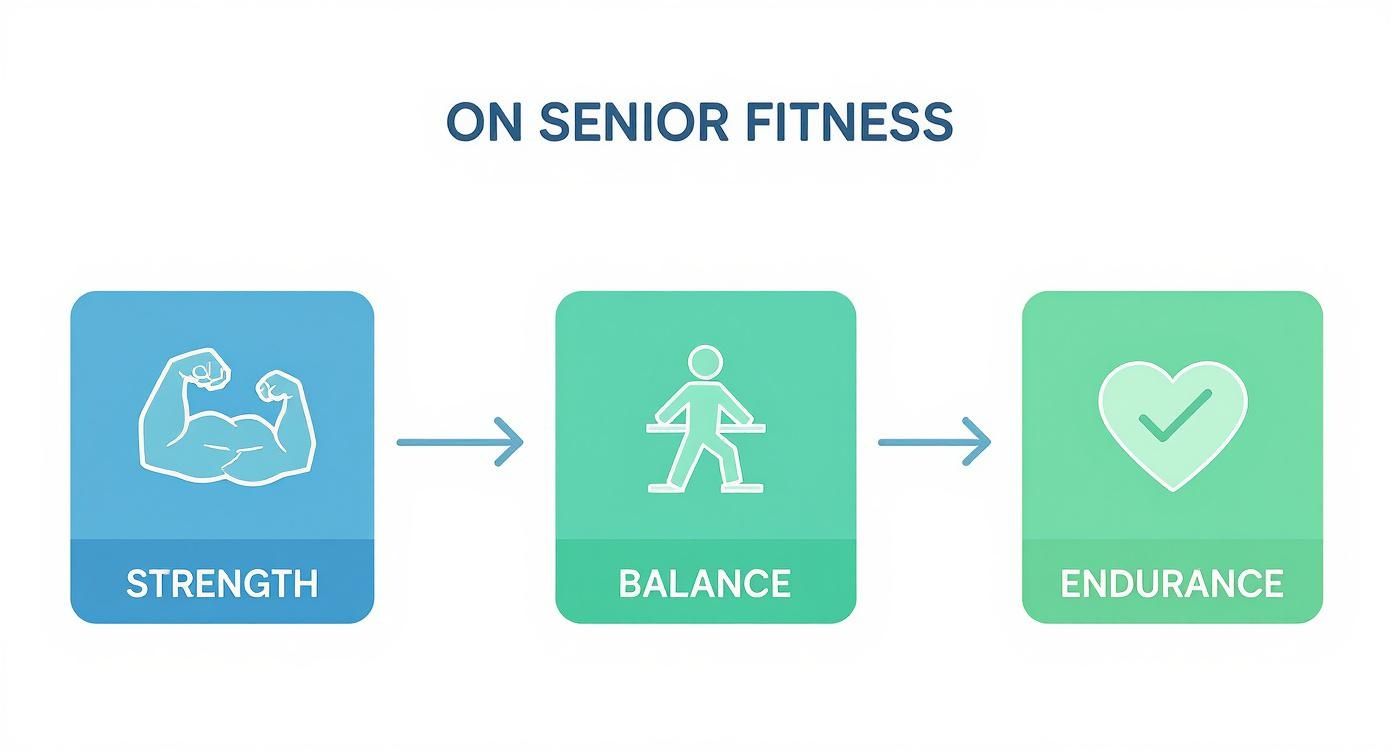
As shown, foundational strength is often the starting block. That strength supports better balance, which in turn contributes to the endurance needed for various daily activities.
The Timed Up and Go Test (TUG)
The Timed Up and Go (TUG) is a widely used test of functional mobility. It is quick, simple, and provides significant information about a person's dynamic balance, walking speed, and general mobility. It simulates a common daily activity: getting out of a chair, walking a short distance, and sitting back down.
Here is the standard protocol:
- Setup: Place a standard armchair against a wall to prevent sliding. Measure 3 meters (about 10 feet) from the front of the chair and mark the spot clearly on the floor.
- Instructions: The person starts seated with their back against the chair. On the "Go" command, they stand up, walk at their normal, safe pace to the 3-meter mark, turn around, walk back, and sit down again completely.
- Measurement: Start the stopwatch on "Go" and stop it the moment they are fully seated.
This test is valuable because it integrates multiple functional components: the leg strength to stand, gait speed, and the balance required for turning. It provides a functional snapshot of everyday movement.
A score of 12 seconds or more on the TUG is a well-established indicator of an increased risk of falling, based on peer-reviewed research (1). This provides a clear, evidence-based benchmark for when to focus on balance and strength interventions.
The 30-Second Chair Stand Test
This test is a direct measure of lower body strength, which is crucial for activities like climbing stairs, getting out of a car, or rising from a low sofa. The objective is to determine how many times an individual can stand up and sit down in 30 seconds.
Here is the procedure:
- Setup: Use a straight-backed chair without armrests, placed securely against a wall. The person sits in the middle of the seat with their feet flat on the floor and arms crossed over their chest.
- Instructions: On the "Go" command, they stand all the way up and then sit all the way back down. This is repeated as many times as possible in 30 seconds.
- Measurement: Count the total number of full stands completed in the 30-second window. A repetition only counts if they reach a fully upright position.
This test effectively isolates the major muscles of the legs and hips. Tracking the number of repetitions over time is an excellent way to demonstrate tangible improvements from an exercise program.
The 4-Stage Balance Test
Balance is a complex system, not a single skill. This test breaks it down into four progressively challenging stances, helping to pinpoint the level at which an individual's balance becomes unstable. This provides precise information for targeted training.
Administer it safely with these steps:
- Setup: Stand next to the person to offer immediate support if needed. Ensure the area is clear of obstacles.
-
Instructions: Ask the person to attempt holding each of the following four positions for 10 seconds. They pass a stage if they can do so without moving their feet or reaching for support.
- Stage 1: Stand with feet side-by-side.
- Stage 2: Place the instep of one foot so it touches the big toe of the other (semi-tandem stance).
- Stage 3: Place one foot directly in front of the other, heel-to-toe (full tandem stance).
- Stage 4: Stand on one foot.
- Measurement: The test ends if the person cannot hold a position for the full 10 seconds. Their score is the last stage they successfully completed.
Measuring Grip Strength
Grip strength is a surprisingly powerful metric. It serves as a strong indicator of overall muscle strength and has been linked to general health status. It is also easily measured with a tool called a hand-held dynamometer. If you're new to these devices, learning how to use a dynamometer correctly is key to obtaining accurate, repeatable results.
The protocol is straightforward:
- The person can sit or stand, but their elbow should be bent at a 90-degree angle with the arm unsupported.
- They squeeze the dynamometer with maximum effort for a few seconds.
- Typically, two or three trials are performed with each hand, and the best score is recorded.
A decline in grip strength can be an early indicator of frailty and functional decline. Monitoring this simple metric provides valuable insight into a person's overall health trajectory.
How to Interpret Your Results and Set Smart Goals
Obtaining a score from a fitness test is just the beginning. The true value of these assessments comes from understanding what the numbers mean for daily life and using them to map out the next steps. This process is about gaining clarity, not passing or failing.
Think of test results as coordinates on a map. They show you exactly where you are right now, which is the most critical information needed before starting any journey. Without knowing your starting point, any plan is based on guesswork.
Understanding Normative Data
The first step in making sense of scores is to compare them against normative data. These are established reference values collected from large populations, typically categorized by age and gender (1). They provide the context needed to understand performance relative to peers.
For instance, completing eight repetitions on the 30-Second Chair Stand test is one piece of information. But learning that the average for women of a similar age is between 12 and 17 repetitions gives that number real meaning (2). You can explore resources like this guide on sit-to-stand test norms to see where you land.
It is important to view these norms as reference points, not as final grades. They are tools that help pinpoint areas that could benefit from more focus.
Your test results are not a final verdict on your fitness. They are a starting point for a conversation with a health professional—a way to turn objective data into a personalized and effective action plan.
A score that falls below the average is not a cause for alarm. Instead, it is a clear signal, pointing you and your physical therapist toward a specific area to work on, whether that's lower body strength or dynamic balance. This allows for truly targeted and efficient training.
From Data to Action With SMART Goals
Once you have a clear picture of your current status, it's time to turn that insight into a solid plan. Vague goals like "get stronger" or "improve my balance" are nearly impossible to track and often lead to frustration. This is where the SMART goal-setting framework is incredibly useful.
SMART is an acronym that guides the creation of effective goals:
- Specific: Clearly define what you want to achieve.
- Measurable: Use numbers to track progress objectively.
- Achievable: Set a goal that is challenging but still within reach.
- Relevant: Ensure the goal matters to your broader health objectives, like maintaining independence.
- Time-bound: Set a deadline to create focus and motivation.
This structure transforms a general wish into a concrete, actionable target.
Putting SMART Goals into Practice
Let's see how this works in a real-world context, using the senior fitness tests we've discussed.
Vague Goal: "I want to have better balance."
SMART Goal: "I will improve from being able to hold Stage 2 to successfully holding Stage 3 (tandem stance) of the 4-Stage Balance Test for 10 seconds within the next six weeks."
The difference is clear. This goal is specific (Stage 3), measurable (10 seconds), achievable (a logical one-stage progression), relevant (better balance reduces fall risk), and time-bound (six weeks).
Vague Goal: "I need to get up from chairs more easily."
SMART Goal: "I will increase my 30-Second Chair Stand score from 8 repetitions to 11 repetitions over the next eight weeks by performing targeted leg-strengthening exercises three times per week."
This method provides a clear finish line to work toward. By re-testing at the end of the eight weeks, you get objective proof of your progress. Working with a physical therapist or a certified trainer is the best way to craft these goals and build a safe, effective exercise program to achieve them. They will ensure your targets are appropriate and can adjust the plan as you get stronger.
Bringing Technology into Senior Fitness Testing
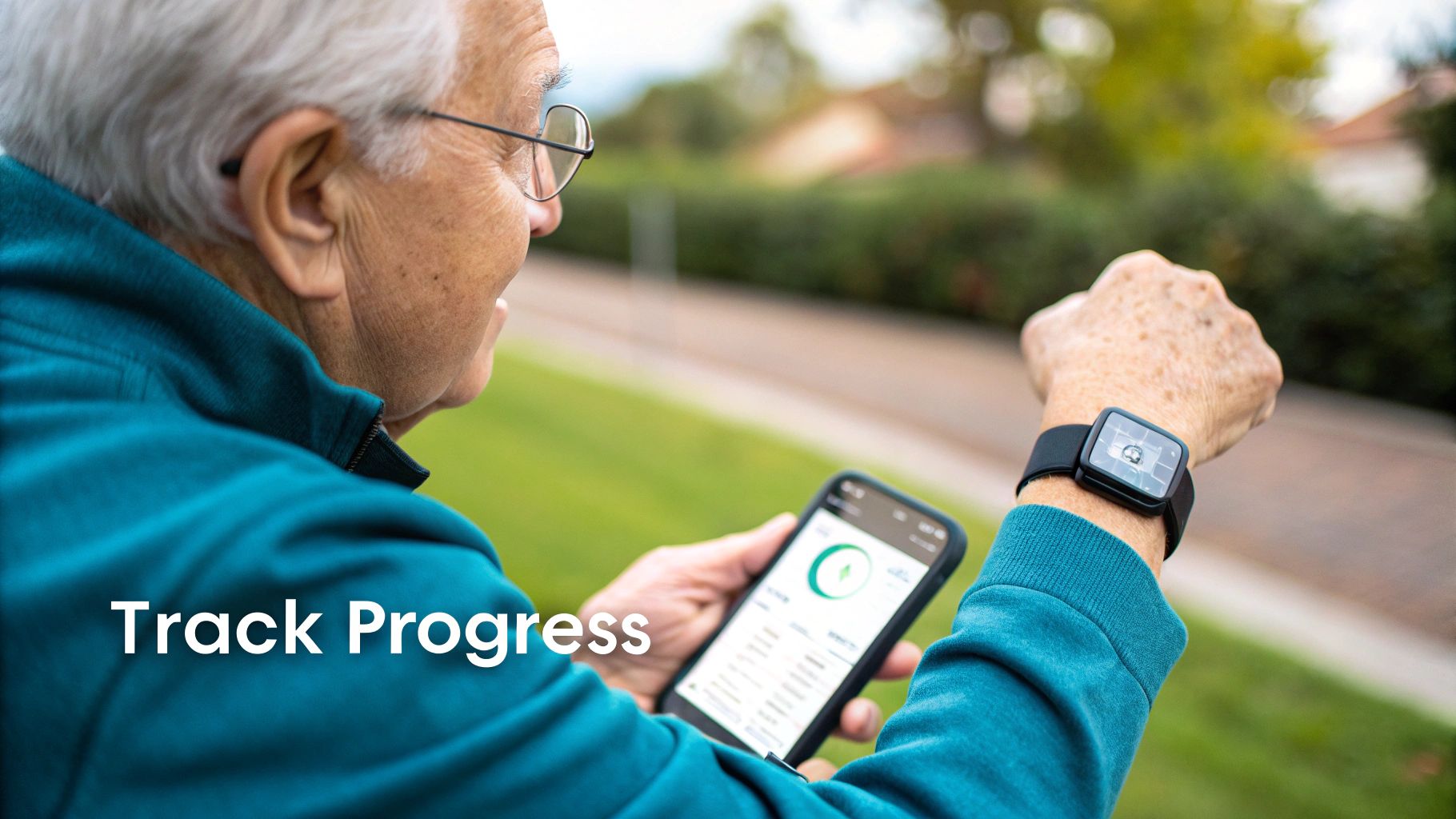
While traditional fitness tests provide invaluable information, modern technology allows for deeper, more precise analysis. We can now gather more objective data, moving our assessments beyond simple stopwatches and visual observation. These tools provide a clearer window into an individual's physical condition.
Consider the difference between a film photograph and a high-resolution digital image. Both capture the moment, but the digital version allows you to zoom in, see fine details, and notice subtle changes over time that might otherwise go unnoticed.
This represents a genuine step forward in health monitoring. It gives both seniors and their healthcare providers the power to make smarter, more informed decisions based on solid, repeatable data.
The Shift to Objective Measurement Tools
The reliance on purely observational assessment is diminishing. Accessible technology, like wearable sensors and smartphone applications, can now quantify movement with high accuracy, changing how we approach senior fitness assessments.
For instance, instead of just timing how long it takes someone to walk across a room, these tools can break down the subtle mechanics of their gait.
Modern digital instruments allow us to move beyond simply asking "how did the test feel?" to answering "what precisely happened during the test?" This objective data is crucial for identifying subtle declines in function or celebrating small, meaningful improvements that motivate continued effort.
This level of detail paints a much richer picture of a person's functional health, helping to spot potential issues earlier and design more targeted, effective interventions.
Key Metrics We Can Now Measure Better
Digital tools excel at capturing data that is difficult, if not impossible, to measure accurately by hand. They deliver consistent, unbiased readings that can be reliably tracked over weeks, months, and years.
Here are a few examples of how technology elevates traditional assessments:
- Gait Speed and Quality: An application using a smartphone's internal sensors can measure walking speed with high precision. More advanced systems can even analyze metrics like gait symmetry and step variability, offering potential early clues about neurological or musculoskeletal health.
- Balance and Sway: Force plates or sophisticated applications can quantify postural sway—the small, constant corrections the body makes to stay upright. Measuring sway provides a highly sensitive indicator of balance control that goes far beyond a simple pass/fail on a timed stance.
- Heart Rate Variability (HRV): Many wearables now track HRV, which is the small variation in time between each heartbeat. Research suggests this metric can be a window into the body's ability to handle stress and recover, offering insights into overall physiological resilience (1).
This data-driven approach allows for a truly personalized exercise plan. A physical therapist can see exactly how a balance exercise is affecting postural sway or how a new cardio routine is influencing recovery, enabling precise adjustments for the best possible outcomes.
Technology's Role in the Bigger Health Picture
This move toward data-driven fitness is part of a larger trend. The growth of the entire fitness industry is tied to technology, with wearable tech being a dominant force for several years. For older adults, these devices can be valuable for tracking everything from daily activity levels to stress responses via heart rate variability.
This engagement is reflected in participation numbers. For example, total health club visits have climbed to 6.25 billion globally, indicating a population that is more connected to their health and the tools that help measure it. You can explore more about the state of the fitness industry on LEK.com.
Common Questions About Senior Fitness Tests
When it comes to fitness testing for seniors, many practical questions arise. Whether you are an older adult, a family member, or a clinician, getting clear answers is the first step toward building confidence and ensuring safety.
Let's address some of the most common questions, with answers based on established practices in physiotherapy and exercise science.
How Often Should a Senior Undergo Fitness Testing?
There is no single "magic number" for testing frequency; it depends on the individual's health status and activity level. Think of it as a routine health check-up, where the schedule adapts to what is needed.
As a general guideline, a comprehensive assessment once a year is a good starting point for healthy, active seniors (1). This provides a valuable annual snapshot to track long-term changes and adjust fitness goals.
However, for someone beginning a new exercise program, recovering from an illness or surgery, or managing a chronic condition, more frequent check-ins are advisable. In these cases, re-assessing every 3-6 months allows for timely, data-informed adjustments to their plan, ensuring the program remains both effective and safe. A physical therapist specializing in geriatrics can provide the best recommendation based on a person's specific health profile.
Are There Any Seniors Who Should Avoid These Tests?
Yes, absolutely. Safety always comes first. There are definite situations, known as contraindications, where some tests may need to be modified or postponed.
Some individuals should not perform these tests without clearance from their physician. The main reasons to delay or modify the plan include:
- Acute Medical Events: A recent heart attack, unstable angina (chest pain), or any severe, uncontrolled medical condition are absolute contraindications for testing.
- Severe Cognitive Impairment: If an individual cannot understand or safely follow the test instructions, the assessment may not be appropriate.
- Acute Injury or Severe Pain: An unhealed fracture, a recent joint replacement, or sharp, severe joint pain means any tests that stress that area should be postponed or significantly modified.
It is critical to consult with a physician or physical therapist before starting any assessment protocol, especially for individuals with a complex health history. A qualified professional is the only one who can truly determine which fitness tests are safe and how to adapt them to an individual's abilities.
Can I Perform These Fitness Tests at Home by Myself?
While many of these tests appear simple, it is strongly recommended that the initial assessment be conducted with a qualified professional, such as a physical therapist or a certified trainer. They provide two essential components: expertise and safety.
A professional ensures that you use the correct technique, which is key to getting accurate and reliable results over time. More importantly, they are present to provide immediate support to prevent a fall or injury, especially during balance and mobility tests like the Timed Up and Go.
After establishing a professional baseline, if you wish to monitor progress at home, it is always safest to have a family member or caregiver nearby.
When preparing for an at-home check-in, follow these simple rules:
- Clear the Area: Remove any tripping hazards like rugs, cords, or furniture.
- Use Sturdy Support: Ensure a heavy, stable chair or a countertop is within arm's reach.
- Listen to Your Body: This is the most important rule. Stop immediately if you feel dizzy, unwell, or experience any sharp pain.
Following these steps will help you track your progress at home in a productive and safe manner.
At Meloq, we believe that objective data is the key to better outcomes. Our portable digital measurement tools are designed to help clinicians replace subjective guesswork with precise, repeatable data, empowering them to create more effective and personalized rehabilitation programs. Learn more about how our ecosystem can elevate your practice at https://www.meloqdevices.com.

Featured Product
EasyForce Digital Dynamometer
Handheld muscle strength testing with 99% accuracy. Used in 40+ peer-reviewed studies.
Learn More