

Balancing Exercises for Athletes: Build Stability & Power
Team Meloq
Author
When discussing balance exercises, it's easy to picture someone simply standing on one leg. But for an athlete, the concept is far more dynamic. These drills are designed to fine-tune the high-speed communication between your brain, nerves, and muscles, which is fundamental to enhanced stability, explosive power, and razor-sharp agility.
Why Balance Is Your Untapped Athletic Advantage
We’re often drawn to impressive displays of explosive power and incredible speed. Yet, behind almost every jaw-dropping athletic play is a foundation of superior balance. This isn't merely about not falling over; it's a dynamic, highly trainable skill that underpins true athletic performance.
In a clinical context, this skill is known as postural control. It can be thought of as a constant, near-instantaneous conversation between the nervous system and muscles to maintain stability. It’s what allows a basketball player to stick a landing after a jump shot without their knee collapsing, or a soccer player to change direction abruptly without losing momentum.
The Science of Staying Upright
To appreciate why balance is so crucial, it's important to understand the systems operating behind the scenes. Your body constantly processes a vast amount of information from three key sources to maintain its equilibrium:
- The Vestibular System: Located in the inner ear, this system acts as the body's internal gyroscope. It senses every tilt and rotation of the head, providing the brain with vital feedback about orientation in space.
- Vision: Your eyes provide powerful cues about your position relative to the environment. This is why balancing with your eyes closed is significantly more challenging—you've removed a major data stream the brain uses for predictive adjustments.
- Proprioception: Often called the body's "sixth sense," this is the inherent awareness of where your limbs are and how they're moving. Tiny sensory receptors in your muscles, tendons, and joints constantly send signals to the brain about position, tension, and force.
These three systems form a sophisticated feedback loop, integrating data to give the brain a complete picture. This process enables the precise, rapid muscular adjustments that keep you centered and in control. To explore these principles further, you can read our post on the biomechanics of sport and exercise.
From Stability to Athleticism
Every time an athlete performs balance exercises, they are strengthening that neuromuscular connection. The direct result is a significant boost in performance. A more stable body creates a rigid platform from which to generate force. On the field, this translates to more power in a sprint, higher vertical jumps, and greater velocity in a throw.
For an athlete, superior balance is not a passive state but an active skill. It's the ability to control the body's position while producing force, which translates directly to improved agility, reduced injury risk, and more efficient movement on the field or court (1).
So, when performing a balance drill, remember you're not just working muscles. You're upgrading the high-speed data connection between your body and your brain. It's this refined control that separates good athletes from great ones.
How to Objectively Measure Your Current Stability
Before you can build elite balance, you need an objective starting point. For a performance-driven athlete, subjective feelings like "feeling wobbly" are not useful metrics. To achieve genuine improvement, it's essential to move toward objective data. This is how sports physiotherapists and performance coaches pinpoint specific weaknesses and track real, measurable progress.
By using simple, standardized tests, you can get a clear picture of your current stability. These protocols are designed to be repeatable, which is key to comparing results over time. This data-driven approach is the foundation of any effective training program.
Balance isn't just about raw muscle strength; it's a high-speed conversation between your brain, nerves, and muscles that can be trained and sharpened.
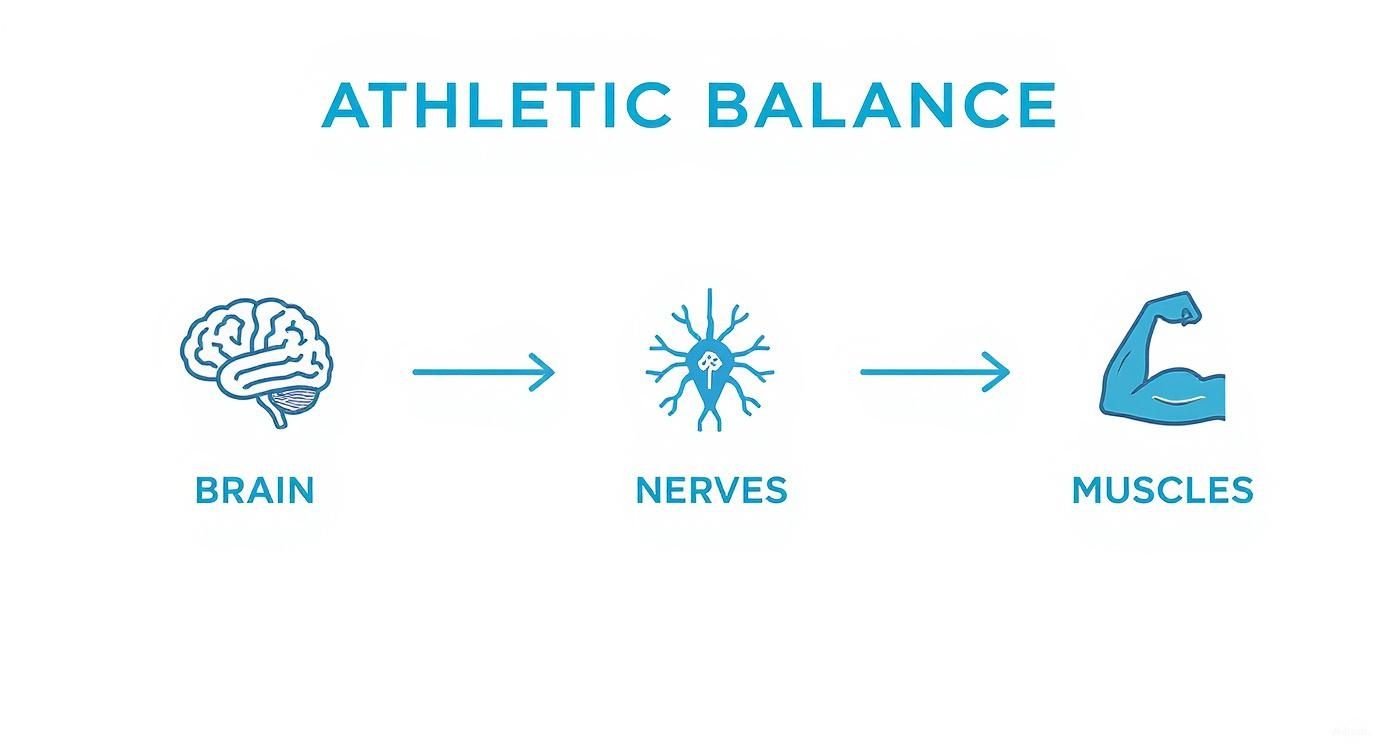
This process happens in fractions of a second, and every component can be improved with the right training.
Your Guide to Functional Balance Assessment
Getting started with objective measurement doesn't have to be complicated. The table below outlines some of the most effective and widely used tests in athletic settings. It’s a quick reference to help you understand what each test involves, what data you're collecting, and why it matters for your performance.
| Test Name | Procedure Overview | What to Measure | Primary Focus |
|---|---|---|---|
| Single Leg Stance (SLS) | Stand on one leg, hands on hips, and hold for as long as possible. Repeat with eyes open and closed. | Max time held (seconds) | Static postural control, proprioceptive awareness |
| Star Excursion Balance Test (SEBT) | Balance on one leg while reaching with the other foot in 8 different directions. | Max reach distance (cm) in each direction | Dynamic stability, identifying limb asymmetries |
| Y-Balance Test (YBT) | A simplified version of the SEBT, reaching in 3 directions (anterior, posteromedial, posterolateral). | Max reach distance (cm), composite score | Dynamic stability, injury risk screening |
These tests provide a solid, quantifiable baseline. From here, you can build a targeted program and have a reliable way to see if your hard work is paying off.
Foundational Assessment: The Single Leg Stance Test
One of the simplest yet most insightful tests is the Single Leg Stance (SLS). It’s a fundamental measure of static postural control and is a staple in both clinical and athletic environments for good reason.
Here’s the correct way to perform it:
- Stand barefoot on a firm, flat surface.
- Lift one foot off the ground, bending the knee so your foot is near the ankle of your standing leg. Ensure your legs don't touch.
- Place your hands on your hips and fix your gaze on a point about 3 meters (approx. 10 feet) in front of you.
- Start a timer and hold the position for as long as you can.
The test stops the moment your raised foot touches the ground, your standing foot hops or pivots, or your hands leave your hips. For healthy adults, a hold of around 30 seconds is a common reference value, though this can vary by age. For elite athletes, the goal should be much longer with minimal swaying (2).
To challenge your proprioceptive system, try the test again with your eyes closed. You'll immediately feel how much your brain relies on visual cues for stability. It's common for balance time to drop significantly with eyes closed, highlighting a potential area for improvement for many athletes. Research has shown that normative values for eyes-closed single-leg stance can be less than half of the eyes-open time in some adult populations (2).
Dynamic Assessment: The Star Excursion Balance Test
Static balance is one component, but most sports require stability during movement. The Star Excursion Balance Test (SEBT) provides more functional insight by assessing dynamic postural control. It requires you to maintain a stable base while another limb is in motion.
To perform the SEBT, you stand at the center of a grid with eight lines extending outward. Balancing on one leg, you reach with your other foot as far as you can along each line, lightly touching it before returning to the center. The goal is to measure your maximum reach distance in every direction without losing balance.
This test is valuable because it can expose asymmetries between limbs. Research has indicated that a difference in anterior reach of more than 4 cm between limbs may be associated with an increased risk of lower-extremity injuries in some athletic populations (3).
Moving to Advanced Measurement Tools
For the highest level of detail, professionals use tools like force plates. These advanced devices measure the small, rapid shifts in pressure—known as the center of pressure (COP)—as you work to maintain balance. They provide objective data on postural sway and stability that the naked eye cannot detect.
This level of analysis allows for the quantification of balance with incredible precision, tracking subtle improvements that might otherwise go unnoticed. For any coach or therapist serious about data-driven athletic development, understanding how force platforms function in biomechanics is a game-changer. By turning balance into hard data, you can build a truly targeted program that leads directly to better, safer performance on the field.
Building a Foundation with Core Balancing Exercises
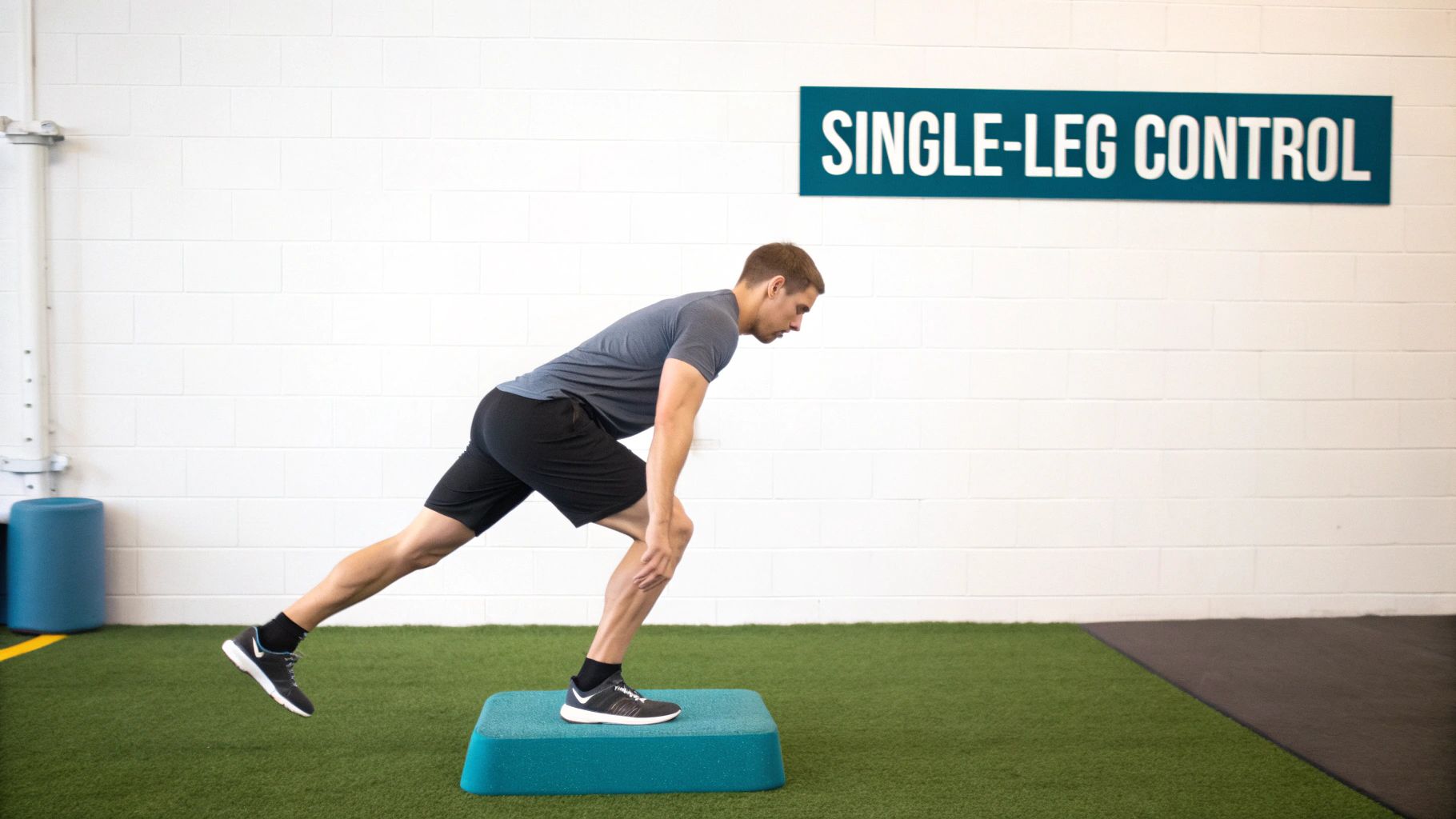
Once you have a solid baseline measurement, it's time to put that data to work. Building elite balance is similar to building strength or speed—it requires progressive overload. Start by mastering simple static holds to dial in the neuromuscular system, then layer in dynamic movements and instability to prepare the body for the chaotic, unpredictable nature of sport.
This isn't a race to the most complex drill. Quality of movement is paramount. Think of these exercises as a high-speed software update for the communication lines between your brain, inner ear, and muscles. The result is a more responsive, stable, and resilient athletic foundation.
Foundational Drills for Static Control
The first phase is about establishing rock-solid static control. These drills might look simple, but they are essential. They teach the body how to manage its center of gravity over a fixed base of support. Mastering this stage is crucial before moving on to more complex patterns.
Your primary goal here is to minimize swaying and hold each position with complete confidence.
- Tandem Stance: Stand as if you're on a tightrope, with the heel of one foot touching the toes of the other. The narrow base of support immediately challenges your stability. Aim to hold this for 30-60 seconds on each side.
- Single-Leg Stance: This is a cornerstone of balance training. Stand on one leg with a slight bend in the knee and hands on your hips. Aim for a 30-60 second hold with minimal wobble. To increase the difficulty, close your eyes—this forces greater reliance on proprioceptive feedback.
- Bird Dog: This classic exercise integrates core stability with balance. On all fours, slowly extend one arm and the opposite leg, keeping your back completely flat. The challenge is to prevent hip rotation, which requires deep core engagement. For more on this connection, check our guide on core strength testing.
Intermediate Exercises Introducing Instability
After building a solid static base, it's time to introduce controlled instability and dynamic movement. This phase begins to mimic real athletic action, where you must maintain balance while moving or on an unpredictable surface.
Research supports this approach. Instability resistance training, which involves training on unstable surfaces, has been shown to improve balance in athletes. A systematic review of 20 studies concluded that this type of training is an effective method for enhancing balance by forcing the neuromuscular system to adapt and improve coordination (4).
Here’s how to start adding that challenge:
- Single-Leg Romanian Deadlift (RDL): This exercise develops single-leg stability and hamstring strength simultaneously. While balancing on one leg, hinge at your hips and extend the other leg straight back. The key is to keep your hips square to the floor and your back flat.
- Lunges on a Foam Pad: Performing a standard lunge on an unstable surface like a foam pad will immediately engage the small stabilizing muscles in your ankle and hip. Control the downward movement, then drive back up to the starting position.
Pro Tip: For any single-leg exercise, focus on "gripping" the floor with your entire foot—from your heel to your toes. This creates a more stable base and enhances the sensory feedback from your foot to your brain.
Advanced Sport-Specific Movements
The final phase makes balance training directly transferable to your sport. These drills are dynamic, reactive, and often mimic movements you'll make in competition. They challenge your ability to absorb force, control landings, and change direction rapidly.
The focus shifts from simply holding a position to controlling movement through a full range of motion.
Mastering Controlled Landings
The ability to land safely after a jump is a critical athletic skill that depends heavily on dynamic balance. Poor landing mechanics are a significant contributor to lower limb injuries, particularly in sports involving frequent jumping.
- Single-Leg Hops with Stick: Hop forward, sideways, or backward on one leg and "stick" the landing. The goal is to land softly and hold the position for 2-3 seconds with no extra steps or wobbling.
- Box Jumps with Single-Leg Landing: Jump onto a low box with two feet, but land on only one. This forces your body to absorb all landing forces on a single limb, challenging your eccentric strength and postural control.
Developing Reactive Stability
In a game, you don't have time to think about balance—it has to be automatic. These drills train your body to react instantly to unexpected changes, which is crucial for agility and injury prevention.
- Partner Perturbation Drills: Stand in an athletic stance (or on one leg) while a partner provides light, unpredictable pushes from different directions. Your job is to resist the push and maintain your position without taking a step.
- Catching Drills on Unstable Surfaces: Stand on a foam pad or balance disc while a partner throws you a medicine ball or tennis ball. The act of catching the object will constantly shift your center of gravity and challenge your stability.
By moving through these phases—from static holds to dynamic, sport-specific movements—you're not just practicing balance. You are systematically building a new level of control, power, and resilience that will translate to performance on the field, court, or track.
Integrating Balance Drills Into Your Training Routine
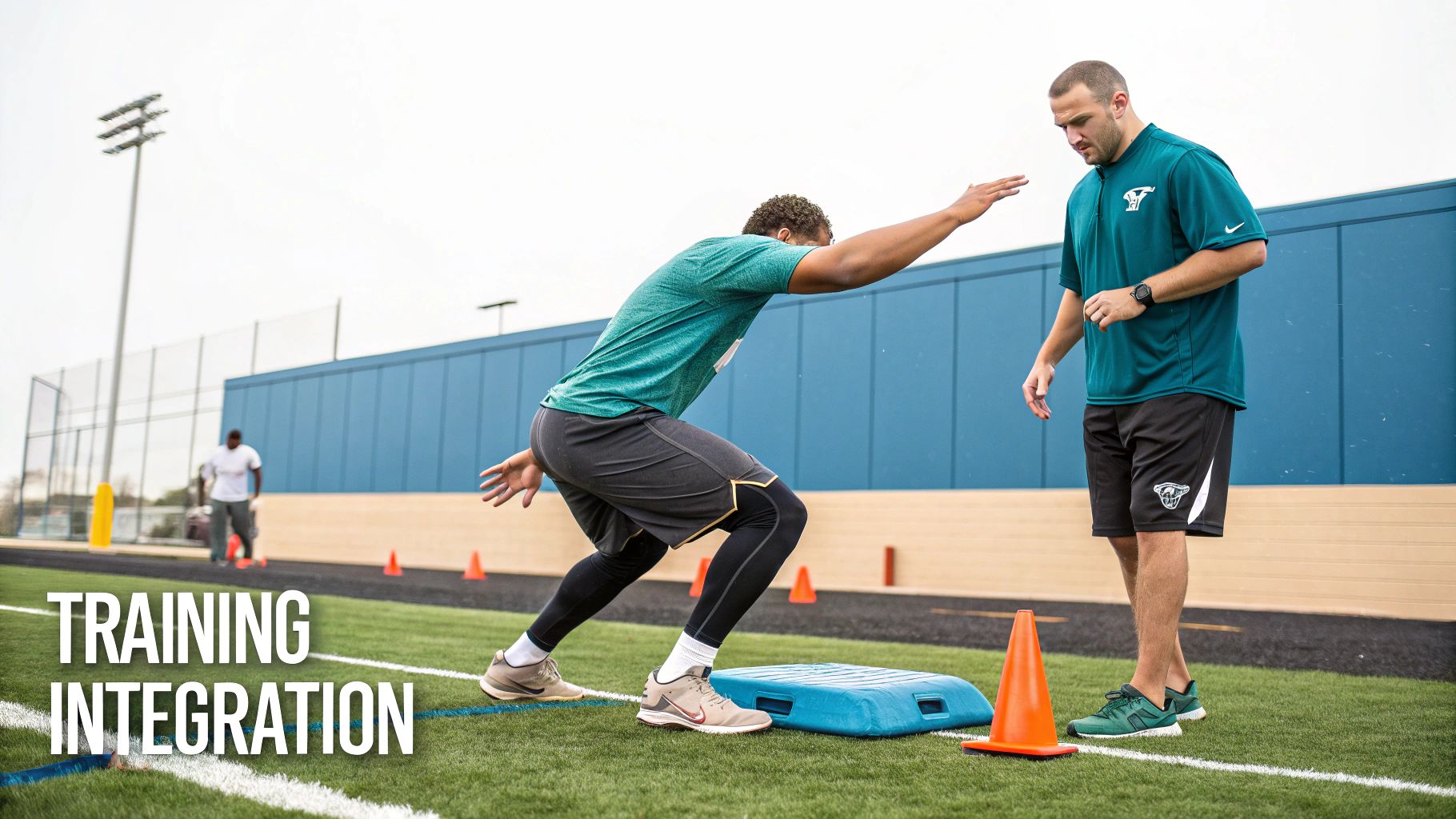
Knowing which balance exercises to do is only the beginning. The real skill is weaving them into an athlete's training schedule to enhance performance, rather than just becoming another task to complete.
The key is to view balance work not as a separate chore, but as a fundamental component that sharpens every other athletic quality you're building. Where you place these drills—in a warm-up, cool-down, or standalone session—depends on the athlete's goals, their sport, and their current training phase.
There is no single "best" method, but there are smarter strategies. The number one rule is that quality of movement is everything. Balance training is primarily neurological, and sloppy repetitions only reinforce poor motor patterns.
Where to Fit Balance Work in Your Schedule
Determining the "when" is crucial for maximizing the benefits of these drills. Each placement has distinct advantages.
-
In the Warm-Up: This is a preferred option for most athletes. A few light balance drills at the start of a session are perfect for activating the neuromuscular system. It "wakes up" small stabilizing muscles and gets proprioceptive pathways firing before more intense work begins. It is ideal for pre-game or pre-practice activation.
-
Paired with Strength Training: Balance exercises can be paired with main lifts. For instance, performing a set of single-leg stances on a foam pad between heavy squat sets is a time-efficient way to build stability without extending the workout.
-
As a Standalone Session: Dedicating a couple of short sessions—around 15-20 minutes—each week purely to balance work allows for greater focus and intensity. This is especially useful in the off-season or for an athlete returning from a lower-body injury.
For most individuals, a combination of approaches works best. Use balance drills as a quick daily activation in your warm-up, and schedule a more focused session once or twice a week. And remember, consistent progress and athlete well-being depend on a clean environment; proper hygiene in sports facilities is non-negotiable.
Real-World Scenario: Soccer Pre-Season Circuit
Let’s be practical. A soccer coach aiming to build injury resilience and boost agility during the pre-season can create a simple but potent balance circuit to be performed twice a week as part of the team's warm-up.
This circuit focuses on dynamic, sport-specific stability.
| Exercise | Sets & Reps/Duration | Rest | Coaching Cue |
|---|---|---|---|
| Single-Leg Stance with Head Turns | 2 sets x 30 sec each leg | 15 sec | Keep hips level and core tight. Slowly turn your head side-to-side without losing your base. |
| Forward Lunge with Trunk Rotation | 2 sets x 8 reps each side | 30 sec | Control the lunge down, then rotate your torso over the front leg. Drive back to the start with power. |
| Lateral Hops with 3-Second Stick | 2 sets x 6 hops each side | 30 sec | Land softly. Absorb the force and freeze instantly—no extra hops or steps. |
| Partner Perturbation on One Leg | 2 sets x 20 sec each leg | 15 sec | Brace everything. Resist light, unpredictable nudges from a partner. |
This entire sequence takes less than 15 minutes but covers essentials for on-field performance: static control with distractions, dynamic stability, and reactive control.
Real-World Scenario: Return-to-Play Ankle Sprain Protocol
Balance training is not just for performance; it's a cornerstone of rehabilitation. Consider a basketball player recovering from a Grade II lateral ankle sprain. Their return-to-play protocol will be built around a progressive plan to restore proprioception and, just as importantly, confidence in the joint.
The key is criterion-based progression—the athlete must master one stage before moving to the next.
A critical goal in post-injury rehabilitation is restoring neuromuscular control to pre-injury levels. Deficits in proprioception and balance after an ankle sprain are a leading predictor of re-injury. A structured balance progression is non-negotiable for a safe and effective return to sport (5).
Here’s a simplified snapshot of what that progression might look like:
-
Phase 1 (Early Stage): The initial focus is on restoring static control on a solid, stable surface.
- Exercises: Tandem stance, Single-leg stance (eyes open).
- Goal: Achieve a 30-second hold with minimal swaying.
-
Phase 2 (Intermediate Stage): Introduce controlled instability with unstable surfaces and simple dynamic movements.
- Exercises: Single-leg stance on a foam pad, bodyweight Single-leg RDLs.
- Goal: Demonstrate control and stability through the full movement, completely pain-free.
-
Phase 3 (Advanced Stage): Progress to sport-specific, reactive drills that mimic game demands.
- Exercises: Forward and lateral hops with controlled landings, catching a ball while balancing on one leg.
- Goal: Execute dynamic, unpredictable movements with precision and confidence.
This methodical approach ensures healing tissues are not overloaded while systematically rebuilding the brain-to-ankle connection. By integrating these specific balancing exercises for athletes, the player not only heals but also builds a more resilient foundation, potentially reducing their risk of re-injury.
The Link Between Balance, Agility, and Injury Prevention
For any competitive athlete, two primary goals are improving speed and agility, and staying healthy enough to compete. These are not separate pursuits. They are deeply connected, and balance training is the critical link that ties them together.
Agility is not just about raw speed. It is the ability to decelerate, change direction, and accelerate into a new movement—all without losing speed or control. That requires exceptional neuromuscular control.
Picture an elite point guard crossing over a defender or a soccer player cutting hard to evade a tackle. These explosive, multi-directional movements are effective because the athlete's body can absorb and redirect force from a stable base. The body constantly makes instantaneous adjustments to maintain its center of gravity. This is where balance training becomes a direct investment in dynamic athletic performance.
This is supported by scientific evidence. When an athlete consistently works on their balance, they fine-tune the high-speed communication between their sensory systems (vision, vestibular, proprioception) and their muscles. This sharpened proprioception can lead to quicker reaction times and more efficient movement patterns.
Sharpening Agility Through Neuromuscular Control
Better balance translates directly to better agility by optimizing how the nervous system recruits muscles. When you're standing on one leg or on an unstable surface, you're teaching your brain to fire muscles in the correct sequence and with the precise amount of force needed to stay upright.
This heightened control allows for more powerful and precise movements. Consider an athlete landing from a jump. A well-trained neuromuscular system can instantly stabilize the ankle, knee, and hip joints. That stability creates a rigid platform for the next action—an immediate sprint, a cut, or another jump—which can maximize the rate of force development and shave off crucial milliseconds. If you want to dive deeper into this key metric, check out our guide on the rate of force development.
A well-developed sense of balance allows an athlete to maintain control and body alignment during deceleration and re-acceleration, which are the fundamental components of agility. It may reduce braking forces and allow for a quicker, more powerful transition into the next movement.
The Scientific Case for Injury Prevention
The role of balance in injury prevention further underscores its importance. Many common non-contact injuries in sports—such as ACL tears and ankle sprains—occur during moments of instability, like landings, pivots, or sudden changes in direction when the body cannot adequately manage the forces involved.
Balance training directly addresses the mechanisms that protect joints in these scenarios. It strengthens the small stabilizing muscles around vulnerable areas like the knee and ankle and improves an athlete's ability to maintain proper alignment under stress. When that athlete inevitably lands awkwardly, their body is better prepared to control the joint and prevent it from moving into a dangerous position.
The data is compelling. A systematic review and meta-analysis found that balance training programs can significantly reduce the risk of ankle sprains in athletes (6). Another influential study demonstrated that a multi-component injury prevention program, with balance training as a key element, significantly reduced the incidence of lower extremity injuries in female soccer players (7). These improvements are attributed to better sensorimotor coordination and neuromuscular control.
Ultimately, by dedicating time to balancing exercises for athletes, you're doing more than just improving your stability. You are building a more resilient, agile, and efficient athletic machine from the ground up. And while balance is key, it's part of a bigger picture of physical awareness, which includes things like mastering safe lifting techniques to protect the body during all aspects of training.
Common Questions About Balance Training for Athletes
Even with a great plan, questions often arise. Let's tackle some of the most common inquiries from athletes and coaches regarding balance training.
How Often Should I Do Balancing Exercises?
Consistency is key. For most athletes, incorporating balance exercises 2-3 times per week is an effective frequency (5). These do not need to be long sessions; 10-15 minutes of focused work is often sufficient to stimulate the neuromuscular system.
A practical way to fit this in is during your warm-up. It serves as an excellent primer to activate crucial stabilizers before you begin more intense training. During the off-season, you can dedicate more time to building a solid stability foundation. In-season, you can shift to shorter, maintenance-focused drills that mimic the demands of your sport.
Can I Do Balance Exercises With a Current Injury?
This question requires a cautious and professional response: it depends, and you need guidance from a qualified healthcare provider. Always consult a physiotherapist or sports medicine professional before starting any new exercises while injured.
In some cases, such as a recovering ankle sprain, specific and controlled balance drills are a core component of rehabilitation (5). They are essential for retraining proprioception and restoring joint stability. However, for other injuries, the same movements could be detrimental. A professional can assess your specific injury and provide a safe, progressive plan.
Never guess when you're injured. A customized rehabilitation plan from a physiotherapist is designed to help you return stronger and more resilient. Attempting to self-manage an injury can lead to setbacks. Smart, guided rehabilitation is the most effective path back to competition.
What Equipment Do I Need to Start?
You already possess the most important piece of equipment: your own body. You do not need a fully equipped gym to begin. Foundational balance work, such as a single-leg stance on a flat, stable floor, is highly effective for building initial control.
Once you have mastered the basics and your stability improves, you can introduce new challenges with simple tools:
- Foam Pads: These create an unstable surface that increases the demand on the small muscles in your feet and ankles.
- Wobble Boards or Balance Discs: These introduce multi-directional instability, forcing you to sharpen reactive control.
- Instability Domes: With both a flat and an unstable side, these are excellent for progressing a wide range of exercises.
The key is to earn your progression. Do not advance to more challenging tools until you have mastered simpler variations.
Should I Wear Shoes for Balance Training?
For foundational, static holds, training barefoot is often recommended. When your feet are in direct contact with the ground, the thousands of sensory receptors in them can send richer feedback to your brain about your position. This direct connection can lead to better muscle activation and fine-tuned control in the feet and lower legs.
However, when you progress to dynamic, loaded, or sport-specific movements, it is generally advisable to train in the same footwear you use for competition. You need to develop balance adaptations that are directly transferable to your sport. An effective routine will likely include a mix of both barefoot and shod training to achieve the best of both worlds.
References
- Hrysomallis C. Balance Ability and Athletic Performance. Sports Med. 2011;41(3):221-32.
- Springer BA, Marin R, Cyhan T, Roberts H, Gill NW. Normative values for the unipedal stance test with eyes open and closed. J Geriatr Phys Ther. 2007;30(1):8-15.
- Plisky PJ, Rauh MJ, Kaminski TW, Underwood FB. Star Excursion Balance Test as a predictor of lower extremity injury in high school basketball players. J Orthop Sports Phys Ther. 2006;36(12):911-9.
- Behm D, Colado JC. The effectiveness of resistance training using unstable surfaces and devices for rehabilitation. Int J Sports Phys Ther. 2012;7(2):226-41.
- McKeon PO, Hertel J. Systematic review of postural control and lateral ankle instability, part II: is balance training effective in treatment and prevention? J Athl Train. 2008;43(3):305-15.
- Schiftan GS, Ross LA, Hahne AJ. The effectiveness of proprioceptive training in preventing ankle sprains in sporting populations: a systematic review and meta-analysis. J Sci Med Sport. 2015;18(3):238-44.
- Mandelbaum BR, Silvers HJ, Watanabe DS, Knarr JF, Thomas SD, Griffin LY, et al. Effectiveness of a neuromuscular and proprioceptive training program in preventing anterior cruciate ligament injuries in female athletes: 2-year follow-up. Am J Sports Med. 2005;33(7):1003-10.
At Meloq, we're all about replacing guesswork with objective data to unlock peak athletic performance. Our precision measurement tools, like the EasyForce dynamometer and EasyBase force plate, give clinicians and coaches the scientific accuracy they need to track progress and build more resilient athletes. See how our devices can make a difference in your practice by visiting https://www.meloqdevices.com.

Featured Product
EasyBase Force Plates
Portable dual force plate system for jump testing, balance & rehab. No subscription fees.
Learn More