

A Definitive Guide to Balance Training for Athletes
Team Meloq
Author
When you watch an elite athlete move, you're seeing more than just raw power or speed. You're witnessing a masterclass in balance. It’s the invisible skill that underpins every explosive cut, graceful landing, and powerful strike. That's why dedicated balance training for athletes isn't a "nice-to-have"; it's a non-negotiable for anyone serious about reaching their peak performance.
This isn't about simply standing still. For athletes, balance is a dynamic skill—a constant, high-speed conversation between the brain, nerves, and muscles.
The True Foundation of Athletic Performance
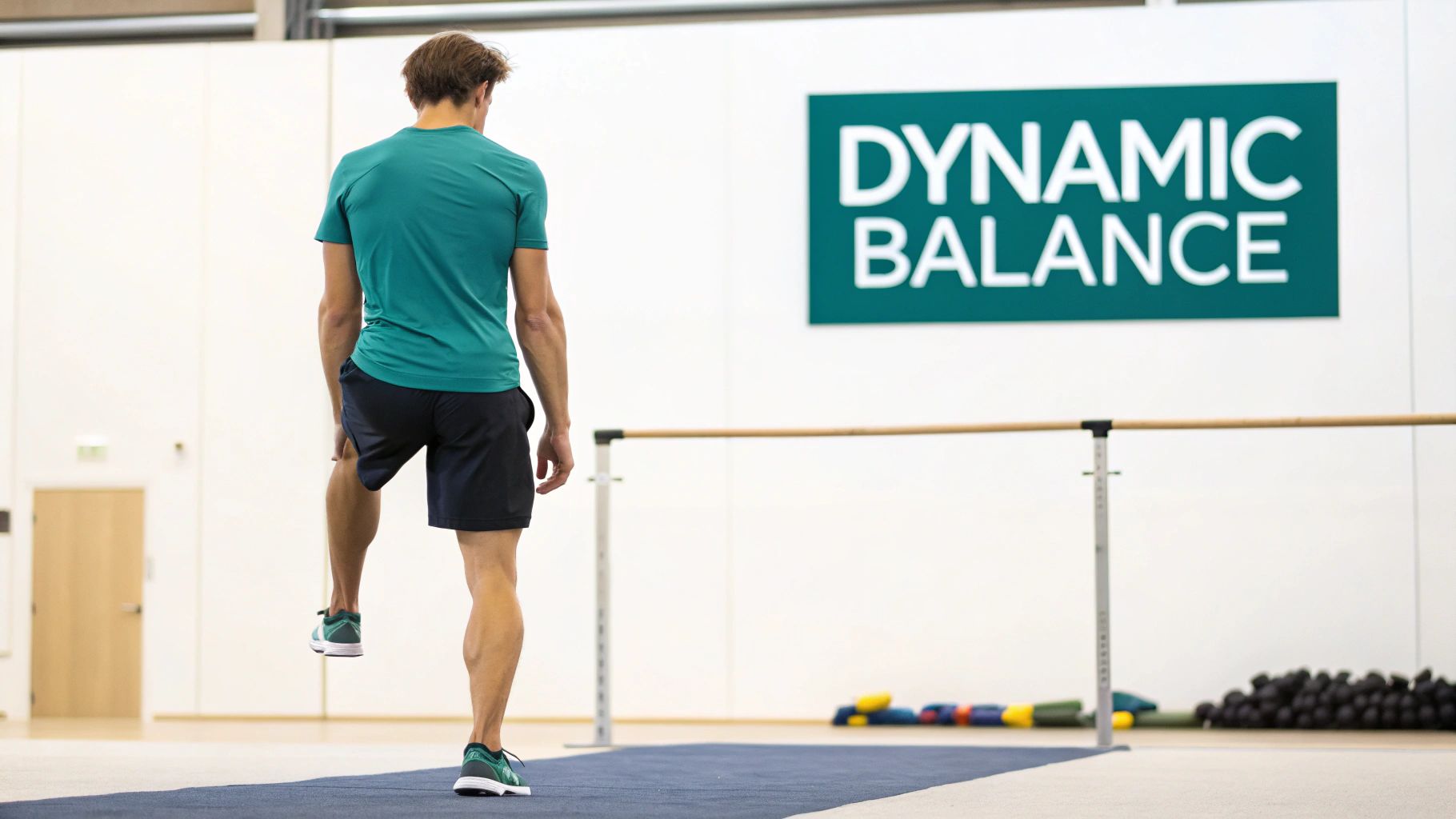
Without a solid foundation of balance, an athlete cannot effectively transfer force, react to a chaotic game, or express their full potential. It's the critical link that turns strength into skillful, game-winning movement.
This skill is all about controlling the body's center of mass over its base of support, whether that base is stationary or moving at high speed. So, when we train balance, we are doing more than just wobble drills. We're fine-tuning the intricate communication network between the brain and the body, making it faster and more resilient.
The Science of Stability
The secret ingredient here is proprioception, which you can think of as the body's "sixth sense." It's your brain's internal GPS, providing information on where your limbs are in space without you having to look. This system relies on tiny sensory receptors in your muscles, tendons, and joints that constantly send feedback to your central nervous system (1).
When you deliberately challenge this system, you can achieve some incredible adaptations:
- Faster Muscle Reactions: Your stabilizing muscles learn to fire microseconds faster to correct an imbalance, often before you consciously realize you were unstable.
- Improved Coordination: A sharp proprioceptive system smooths out movement patterns, which means less wasted energy and better technique.
- Greater Joint Stability: By activating and strengthening the small muscles around your ankles, knees, and hips, you’re building a dynamic support system that helps protect your ligaments during explosive movements. For instance, balance training has been shown to reduce the incidence of ankle sprains (2).
This isn't just for gymnasts. Think about a powerlifter setting their feet for a heavy squat or a soccer player weaving through defenders. They both rely on a highly developed sense of neuromuscular control. A basketball player who can snatch a rebound, land on one foot, and immediately pivot without thinking is demonstrating world-class dynamic stability.
To really get a handle on this, it's helpful to understand the building blocks. You can learn more about what is static balance and see how it lays the groundwork for more complex movements.
One of the biggest mistakes is treating balance as a passive state. For an athlete, it's the exact opposite. It is an active, dynamic process of making constant, tiny adjustments to stay in control in a chaotic environment.
From Subjective Skill to Measurable Advantage
For a long time, balance was treated like an innate talent—you either had it or you didn't. But sports science has completely changed that view. We now know it's a highly trainable skill. Even better, we can move past the old-school "eye test" and use objective data to measure an athlete's stability.
With modern tools and evidence-based assessments, we can pinpoint specific weaknesses and asymmetries that the naked eye might miss. By getting a data-driven baseline, we can stop guessing and start programming with precision. This means every drill and progression directly targets an athlete's individual needs, leading to faster progress and a more resilient athlete.
Establishing Your Data-Driven Balance Baseline
To unlock an athlete's full potential, you first have to know where they stand. Literally. Effective balance training moves beyond simple observation and into the world of objective data. Establishing a solid, quantifiable baseline is the only way to pinpoint subtle weaknesses, track real progress, and build a program that actually gets results.
Guesswork has no place in high-performance training. By using standardized, evidence-based assessments, we can create a detailed balance profile for every athlete. Think of this profile as a blueprint—it guides every training decision and ensures that time and effort are spent exactly where they're needed most.
Key Assessments for Athletic Balance
A few key tests are trusted across sports science and rehabilitation for measuring an athlete's stability with precision. These aren't just academic exercises; they provide actionable data that's directly tied to performance and injury risk.
Three of the most reliable and insightful assessments include:
- Single Leg Stance (SLS): A foundational test measuring an athlete's ability to hold steady on one leg, often with eyes open and then closed to increase the challenge. It’s a simple but incredibly powerful indicator of fundamental postural control.
- Star Excursion Balance Test (SEBT): This one is more dynamic. The athlete stands on one leg and reaches with the other in multiple directions as far as possible. The SEBT is fantastic for spotting asymmetries between limbs and checking dynamic stability (3).
- Y-Balance Test (YBT): Essentially a streamlined version of the SEBT, the YBT has the athlete reach in three specific directions (anterior, posteromedial, and posterolateral). Because it's structured, it’s highly reliable for pre-season screening and monitoring progress over time.
These tests are designed to challenge the neuromuscular system in ways that reveal subtle deficits in control and stability—the kind of things that often go unnoticed until an injury happens.
Moving Beyond Just Pass or Fail
Simply having an athlete perform these tests isn't enough. The real value is in the objective metrics we can pull from them, which tell a much deeper story about an athlete's balance. This is where modern tools like portable force plates become indispensable.
Instead of just clocking how far an athlete can reach, these devices capture precise data points that reveal the quality of their movement. We start looking at key metrics like:
- Sway Velocity: This measures how fast an athlete's center of pressure is moving while they're trying to stand still. Higher sway velocity suggests poorer postural control.
- Time to Stabilization: After a movement like a jump or landing, how quickly can the athlete regain their stability? A longer time may suggest inefficient neuromuscular control, which can be a red flag for injury risk.
- Limb Asymmetry: We quantify the performance difference between the left and right legs. Some research suggests that significant asymmetries, often cited as greater than 10%, could be linked to a higher risk of lower limb injuries (4).
Understanding how an athlete's center of pressure moves is fundamental to this whole process. For a deeper dive, check out this post on how the center of pressure provides critical balance insights.
An athlete might complete a Y-Balance Test without falling, but the data could show significant sway and a long time to stabilize on their previously injured leg. This objective data flags a lingering deficit that the naked eye would miss, allowing us to intervene before they get back on the field.
Here's a quick look at how these assessments provide practical, actionable insights for athletic training.
Key Objective Balance Assessments for Athletes
The table below breaks down some of the most common evidence-based balance tests, what they're for, and the key metrics we track to get a full picture of an athlete's capabilities.
| Test Name | Primary Purpose | Key Metrics to Measure | Clinical Significance |
|---|---|---|---|
| Single Leg Stance (SLS) | Assesses static postural control and proprioceptive feedback. | Sway velocity, Center of Pressure (COP) area, Time held without error. | Identifies foundational stability deficits and the impact of visual input on balance. |
| Y-Balance Test (YBT) | Measures dynamic balance and identifies limb asymmetries. | Reach distance in 3 directions, Composite score, Asymmetry percentage. | Predicts lower extremity injury risk and provides a reliable baseline for return-to-sport decisions. |
| Star Excursion (SEBT) | Evaluates dynamic balance and neuromuscular control across multiple planes. | Reach distance in 8 directions, Asymmetry between limbs. | Offers a more detailed assessment of dynamic stability and functional movement patterns. |
By using this data-driven baseline, you can shift from a generic approach to a highly specific one. It’s what allows us to create targeted balance training that directly addresses an athlete's unique profile, maximizing performance and building a more resilient, injury-proof competitor.
Designing Effective Balance Training Progressions
Once you have a data-driven baseline from your assessments, the real work begins. Designing a smart progression is what separates random drills from building a robust, sport-ready athlete. A structured approach is the only way to ensure balance training actually translates to the field, court, or track. It's all about layering challenges logically, making sure an athlete masters one stage before moving to the next.
This isn't about just throwing an athlete onto a wobble board on day one. A proper progression respects how the body learns and adapts. It always starts with mastering control in a predictable environment before we systematically introduce complexity, variability, and sport-specific demands. This methodical approach is what forges true, functional stability.
From Static Foundations to Dynamic Control
The journey begins with static balance on a stable surface. This is the foundational layer where an athlete learns to control their center of mass over a fixed base of support. Think of classic exercises like single-leg stances or tandem stance holds. The goal here is simple but absolutely crucial: build neuromuscular control without the extra chaos of movement or unstable surfaces.
Once an athlete shows they've got it—meaning they can hold these positions with minimal sway and without losing balance—we up the challenge. This is where we introduce an unstable surface, like a foam pad or balance disc. This simple change dramatically increases the demand on the proprioceptive system. It forces the small stabilizing muscles around the ankle, knee, and hip to work much harder to maintain equilibrium.
From there, we transition into dynamic balance. Now, the athlete has to maintain control while their body is in motion. The exercises in this phase start to directly mimic what happens in sport:
- Single-Leg Squats: These challenge stability through a full, functional range of motion.
- Controlled Landings: Stepping off a box and "sticking" the landing on one leg trains the body to absorb and control force instantly.
- Forward and Lateral Lunges: These movements require maintaining balance while actively shifting the center of mass.
This phase is critical for bridging the gap between gym-based stability and on-field performance. We're teaching the body to stay balanced while moving, which is the reality of nearly every single sport. For more ideas, you can find a helpful list of balancing exercises for athletes that fit perfectly into this progression.
Integrating Reactive and Sport-Specific Drills
The final and most advanced phase of the progression introduces reactive balance. In a game, athletes rarely have the luxury of preparing for a loss of balance; they have to react to completely unpredictable situations. This is the exact skill we're training here.
We start adding external stimuli that force the athlete to adjust on the fly. This could be a coach giving light pushes (perturbations), having them catch a ball thrown from an odd angle, or making them react to a visual cue while holding a single-leg stance. These drills sharpen the connection between what the athlete sees and how their body responds, building the automatic, reflexive stability needed in chaotic game environments.
A well-designed program doesn't just improve balance; it makes an athlete more adaptable. They learn to feel comfortable and in control even when things get unpredictable—that's the hallmark of elite performance.
This infographic gives a great visual of how a well-structured balance program should flow, moving from initial assessment through to ongoing planning.
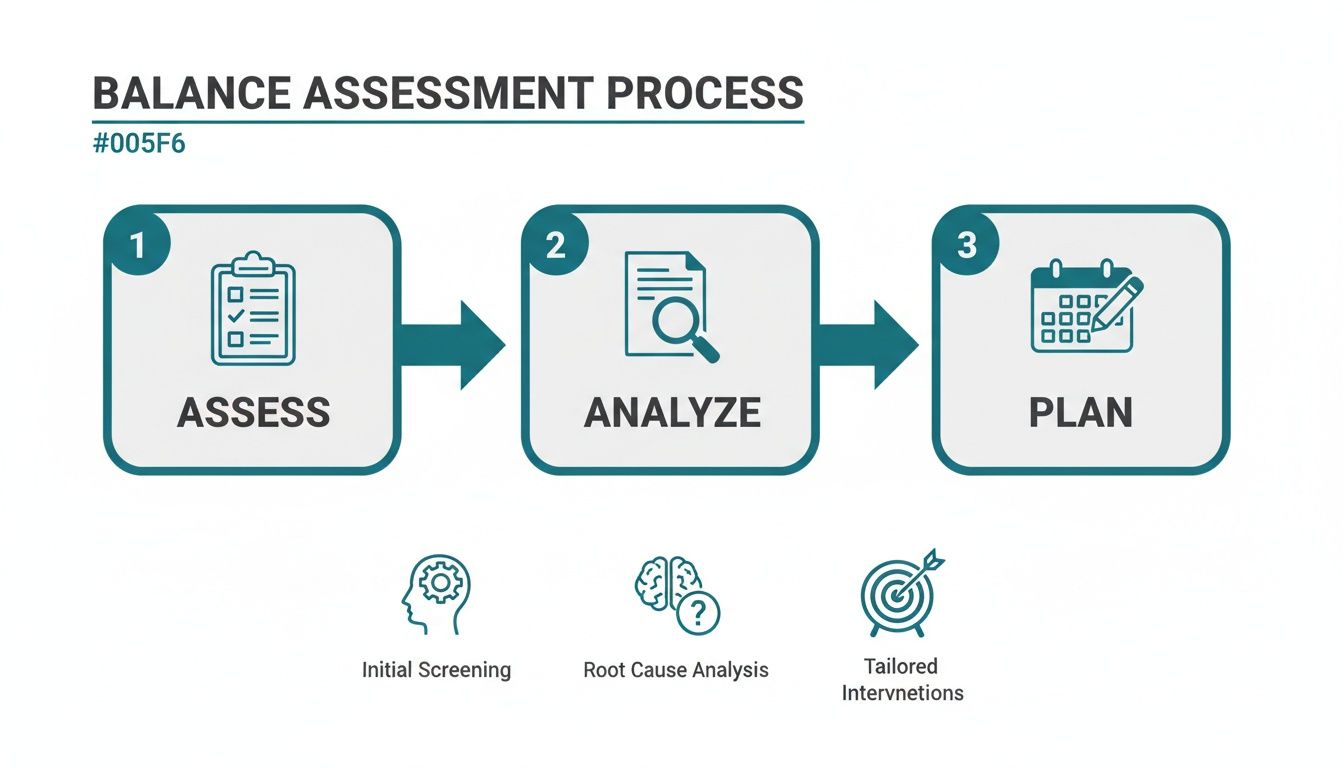
As you can see, it's a cycle. The data from assessments continuously informs the planning phase, ensuring the program evolves right alongside the athlete.
Connecting Balance to Agility and Injury Prevention
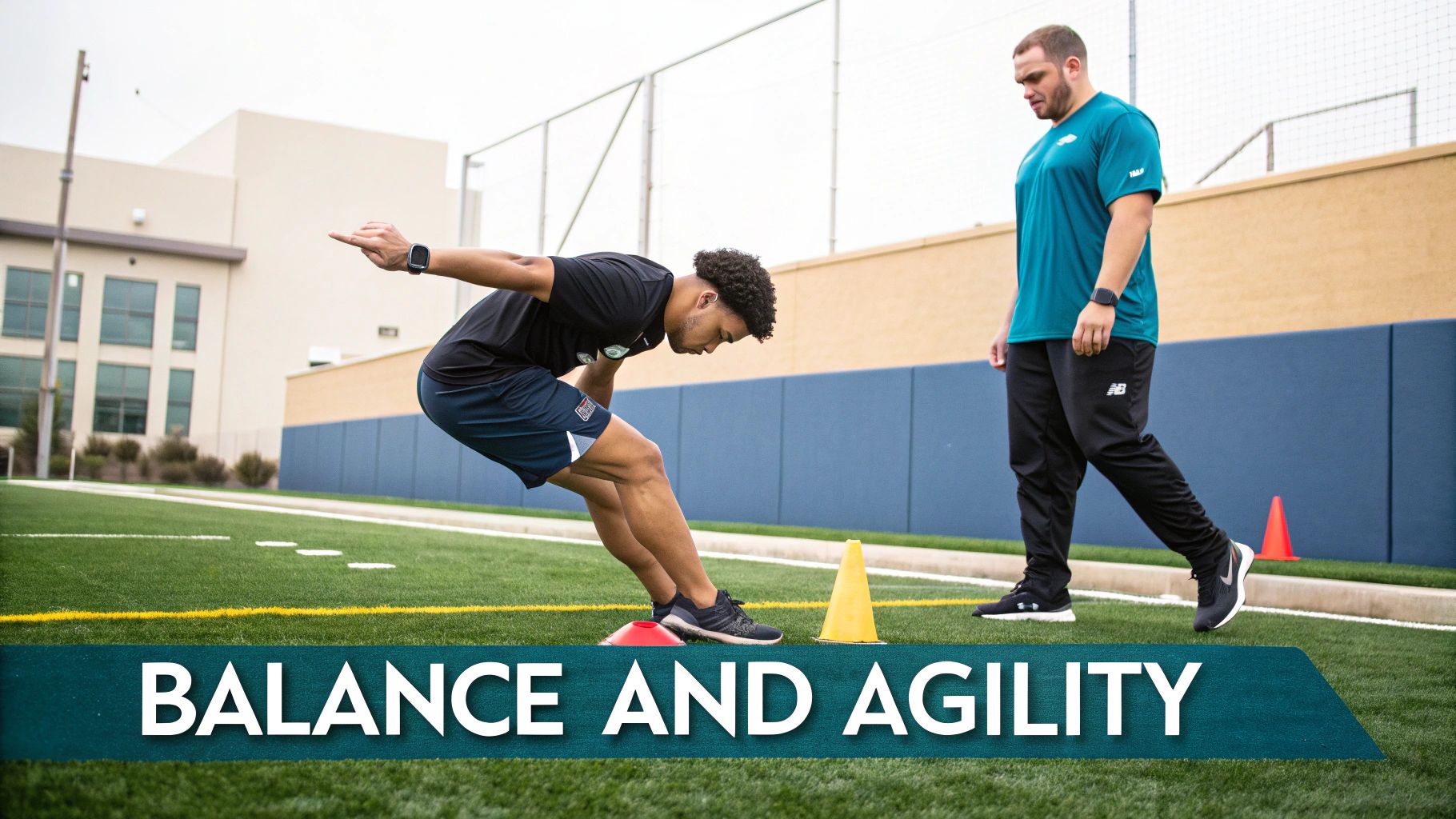
So, how does mastering a single-leg stand actually translate to game-winning plays on the field? The connection is far more direct than you might think. Dedicated balance training for athletes is the bridge between an athlete's raw physical capacity and their functional skill, specifically impacting agility and acting as a powerful defense against injury.
It’s about much more than just being steady—it’s about being efficient. An athlete with a highly-tuned balance system can absorb, redirect, and generate force with incredible speed and precision. This translates directly into faster cuts, more explosive changes of direction, and greater control during those chaotic, unpredictable moments in a game.
The Link Between Stability and Speed
Agility isn't just about how fast you can run in a straight line. It's about how quickly you can decelerate, stabilize, and then reaccelerate in a completely new direction. Superior dynamic balance is the engine that drives this ability.
When an athlete’s neuromuscular system is sharp, their muscles can fire in the correct sequence with lightning speed to maintain control during these transitions. This rapid stabilization allows for a much more effective transfer of force into the ground. Instead of wasting energy with wobbly, inefficient movements, the athlete remains a stable platform ready to launch their next action. Think of a basketball player making a hard cut to the hoop or a soccer player dodging a defender—they both rely on this split-second stability to maintain momentum and power.
Agility is stability in motion. An athlete who can control their center of mass during high-speed, multi-directional movements will always have an edge over a stronger, faster opponent who lacks that control.
A well-developed balance system also enhances an athlete's ability to anticipate and react. By improving proprioception—the body's awareness of its position in space—balance training helps an athlete feel more "connected" to their movements. This leads to smoother, more intuitive adjustments during play. For a deeper dive into these principles, check out our article on the biomechanics of sport and exercise.
Building a Shield Against Injury
Perhaps the most compelling argument for making balance training a priority is its profound role in injury prevention. Many common non-contact injuries, like ankle sprains and ACL tears, happen during moments of instability—an awkward landing, a sudden stop, or a quick pivot. These events often occur when neuromuscular control falters.
Balance training directly targets the very mechanisms that protect joints from excessive stress. By challenging the stabilizing muscles around the ankle, knee, and hip, these exercises build a dynamic, responsive support system. This improved neuromuscular control means the body can react faster to correct potentially injurious positions, often before the athlete is even consciously aware of the danger.
A systematic review of multiple studies suggests that balance training programs can be effective in reducing the incidence of certain sports injuries. For example, some programs have been shown to lower the risk of ankle sprains in athletes (2).
Practical Mechanisms of Protection
So how does this work on a physiological level? The protective effects of balance training for athletes come down to a few key adaptations:
- Sharpened Proprioceptive Feedback: Training enhances the sensitivity of receptors in your joints and muscles, sending faster, more accurate information to the brain about limb position.
- Quicker Muscle Activation: The stabilizing muscles learn to contract more rapidly and forcefully in response to a sudden loss of balance, effectively acting like a dynamic brace for the joint.
- Improved Inter-muscular Coordination: Balance drills teach muscle groups to work together more cohesively, ensuring that forces are distributed properly across the kinetic chain instead of being concentrated on a single, vulnerable joint.
Beyond specific training, a holistic approach to athletic health is always best. Athletes can also benefit from understanding how sports massage can help alleviate chronic pain and muscle tightness, which contributes to overall injury prevention and faster recovery. By combining targeted balance work with smart recovery strategies, athletes can build a truly resilient body ready for the demands of their sport.
Using Objective Data to Guide Return-to-Sport
Making the final call on an athlete's return to play is one of the highest-stakes decisions a coach or clinician can make. For years, there was a reliance on timelines based on injury type, but that approach doesn't account for the massive variability in individual recovery.
To guide these critical decisions with confidence, we need to move beyond guesswork. A modern, data-driven framework gives us clear, quantifiable evidence of an athlete's readiness, taking emotion and subjectivity out of the equation. It's about knowing they're ready, not just feeling like they are.
Re-Assessing Progress with Precision
The key is to re-assess athletes at regular intervals throughout their rehabilitation, not just at the end. These check-ins should use the exact same objective tests you performed at baseline, like the Y-Balance Test or a series of single-leg hop tests.
This creates a powerful feedback loop. We're not just looking for general improvement; we're hunting for symmetry. By comparing the performance of the injured limb to the uninjured one—and to their own pre-injury baseline—we get a clearer picture of their recovery status.
For instance, we're watching for specific changes that signal real progress:
- Sway Velocity: A drop in sway velocity during a single-leg stance tells us their postural control is sharpening up.
- Reach Distance: Pushing further on the Y-Balance Test demonstrates better dynamic stability in action.
- Time to Stabilization: Sticking a landing faster after a jump points to more efficient, reactive neuromuscular function.
Setting Objective Return-to-Sport Criteria
This data allows us to establish non-negotiable criteria that an athlete should meet before they are cleared. The conversation shifts from "how much time has passed?" to "have you demonstrated the capacity to compete safely?" This is a fundamental change in how we approach balance training for athletes and manage their recovery.
A solid set of criteria might look something like this:
- Limb Symmetry Index (LSI): The athlete should aim to achieve >90% limb symmetry on a battery of functional tests, like a single-leg hop for distance (5).
- Landing Mechanics: They need to show stable, controlled landings with minimal knee valgus (that inward collapse), especially when fatigued.
- Baseline Performance: The goal is to match or, ideally, exceed their pre-injury baseline scores on key balance and power tests.
I've seen it many times. An athlete feels strong, they're pain-free, and they're itching to get back out there. But the data tells another story: a 15% asymmetry in their hop distance and shaky landing control under fatigue. That data gives us the objective evidence we need to hold them back and protect them from a preventable re-injury.
Building Resilience for Competitive Demands
When we weave balance training into an athlete's program, we aren't just improving their skills—we're building resilience. Long-term adaptations from consistent work can help them fight off fatigue and injury.
Research in sports like soccer has shown that dedicated balance training may help athletes maintain performance even after a fatiguing workout, challenging the idea that balance simply deteriorates with tiredness. This resilience is absolutely critical for an athlete returning to sport, where they will be pushed to their limits. You can dive deeper into the research on balance adaptations and fatigue to see the evidence for yourself.
This data-driven approach does more than just keep athletes safe. It builds confidence. When an athlete sees their own numbers—proving their strength, stability, and symmetry are right where they need to be—they step back on the field knowing they are truly prepared for the challenge ahead.
Common Questions on Athletic Balance Training
When you start adding a new element to your training programs, a lot of practical questions pop up. Let's tackle some of the most common ones from coaches, therapists, and athletes about integrating balance work. The goal here is to give you clear, evidence-based answers you can put into practice.
How Often Should Athletes Perform Balance Training?
For real, lasting improvements, research suggests a frequency of two to three sessions per week is effective (3). This doesn't mean you need to block out huge chunks of time for separate balance workouts.
You can get measurable gains in both static and dynamic control by dedicating a focused 15-minute block to these exercises. Even just weaving 5-10 minutes of balance drills into your dynamic warm-ups will do the trick. The big takeaway is that consistency is far more important than how long any single session lasts. Regular, brief exposure is the key for driving the neuromuscular adaptations that build better stability.
Can Athletes Do Balance Training on an Off-Day?
Absolutely. An off-day or a recovery day can be a perfect time for this. Balance training is low-intensity work that primarily challenges the nervous system, not the metabolic or muscular systems like a heavy lifting or conditioning session would.
Think of it as a form of active recovery. Doing balance drills on these days helps reinforce critical motor patterns and sharpens proprioception without piling on significant physiological stress. It's a great way to keep the central nervous system firing on all cylinders between your high-intensity days.
What Is the Difference Between Static and Dynamic Balance?
Getting this distinction right is crucial for designing a program that actually translates to the field or court.
- Static Balance: This is your ability to hold your body stable over a fixed base of support while you're not moving. The classic example is a simple single-leg stand, maybe with your eyes open or closed. It’s the foundation of all balance.
- Dynamic Balance: This is where the magic happens for athletes. It’s the ability to maintain your equilibrium while your body is in motion—think of a basketball player sticking a landing after a jump shot or a soccer player making a sharp cut to dodge a defender.
For any athlete, dynamic balance is what really matters because it mirrors the chaotic, unpredictable nature of sports. A smart program will always ensure an athlete masters static control first before moving on to challenges that demand dynamic stability.
An athlete can have perfect static balance but still look shaky in a game. Our job is to bridge that gap, progressing them from simple holds to complex, reactive movements that look and feel like their sport.
When Should an Athlete Progress to a Harder Exercise?
This is all about mastery, not the calendar. An athlete is ready to move on when they can nail the current exercise for the prescribed time or reps with clean form and very few mistakes.
Before you make things harder, look for these signs of proficiency:
- No Touch-Downs: They can get through all the reps without having to tap their other foot down for support.
- Minimal Compensation: You don't see them flailing their arms or using wild trunk movements just to stay upright.
- Task Success: They can handle the specific challenge of the drill, whether it's keeping their eyes closed or catching a ball, without losing their form.
Once they hit that level of control, it’s time to up the ante. You can introduce a more unstable surface, add a cognitive layer like having them call out numbers, or even apply light, unexpected nudges to train their reactive stability. This ensures the challenge always keeps pace with their ability.
References
- Han J, Anson J, Waddington G, Adams R, Liu Y. The Role of Proprioception in Fathering and Balance Control. J Sport Health Sci. 2015;4(2):153-161.
- McGuine TA, Keene JS. The effect of a balance training program on the risk of ankle sprains in high school athletes. Am J Sports Med. 2006;34(7):1103-11.
- Hrysomallis C. Relationship Between Balance Ability, Training and Sports Injury Risk. Sports Med. 2007;37(6):547-56.
- Plisky PJ, Rauh MJ, Kaminski TW, Underwood FB. Star Excursion Balance Test as a predictor of lower extremity injury in high school basketball players. J Orthop Sports Phys Ther. 2006;36(12):911-9.
- Grindem H, Snyder-Mackler L, Moksnes H, Engebretsen L, Risberg MA. Simple decision rules can reduce reinjury risk by 84% after ACL reconstruction: the Delaware-Oslo ACL cohort study. Br J Sports Med. 2016;50(13):804-8.
At Meloq, we’re focused on replacing subjective guesswork with hard data. Our portable measurement tools, like the EasyForce dynamometer and EasyBase force plate, give you the precise metrics you need to assess balance, track progress objectively, and make return-to-sport decisions with confidence. See how you can build better, more resilient athletes by visiting https://www.meloqdevices.com.

Featured Product
EasyForce Digital Dynamometer
Handheld muscle strength testing with 99% accuracy. Used in 40+ peer-reviewed studies.
Learn More