

A Clinician's Guide to the 5 Times Sit to Stand Test
Team Meloq
Author
The 5 times sit to stand test, or 5xSST, is a beautifully simple yet powerful assessment. All it involves is timing how long it takes someone to stand up fully and sit back down five times in a row. It’s a fundamental tool we use to get a quick, real-world look at lower body strength, dynamic balance, and overall functional mobility.
What Is the 5 Times Sit to Stand Test?
Think about the daily movements we take for granted—getting up from a low sofa, pushing out of a car, or standing up from the dinner table. These tasks require a surprising mix of strength, balance, and coordination. The 5 times sit to stand test gives us a fast, objective way to measure these exact abilities. In just a handful of seconds, it provides a clear snapshot of a person's functional capacity.
The best part? Its simplicity. All you need is a standard chair and a stopwatch, which makes it incredibly practical for almost any setting, from a busy physiotherapy clinic to a home health visit. Despite its low-tech nature, the data it produces is rich with insight, helping clinicians understand a patient's real-world physical performance.
A Window into Functional Health
The time it takes to complete the five reps is far more than just a number on a stopwatch; it’s a vital sign for a person's independence. This single metric gives us a window into several critical health indicators, allowing us as clinicians to:
- Assess Lower Body Strength: The act of standing up repeatedly without using your arms is a direct test of leg power, hitting the quadriceps and glutes.
- Evaluate Dynamic Balance: The test challenges a person's ability to control their center of mass as they move between sitting and standing—a key element of balance needed to prevent falls.
- Predict Fall Risk: This is a big one. Slower performance times have been scientifically linked to an increased risk of falls, especially in older adults and those with neurological conditions (1).
A study in the Journal of Geriatric Physical Therapy confirmed that the 5xSST is one of the most common outcome measures used in geriatrics to quickly gauge transfer independence and lower extremity function (2).
Guiding Treatment and Tracking Progress
Beyond the initial evaluation, the 5 times sit to stand test is an excellent way to track progress. Seeing that time get faster is a fantastic motivator and a clear sign that a rehabilitation program is working. On the flip side, if the time starts to creep up, it signals a potential decline that we need to address.
It helps us answer crucial questions about what our patients can do and guides how we build out targeted exercise programs. By truly understanding the core components of physical performance testing, we can better interpret these results and, ultimately, drive better outcomes for our patients.
How to Administer the Test for Accurate Results
If you want data you can actually trust, you can't afford to be sloppy. Administering the 5 times sit to stand test using a standardized, evidence-based protocol is the only way to make sure your results are reliable, repeatable, and comparable to established norms.
This means every little detail counts, from the chair you pick to the exact words you use. Sticking to a consistent procedure gets rid of all the random variables that could throw off the results. It lets you confidently track real changes in your patient's functional ability over time.
Setting Up for Success
The initial setup is everything; it’s the foundation for accurate measurement. The whole point is to create a controlled environment that you can replicate perfectly every single time you perform the test.
Here’s what you need to nail down:
- The Chair: Grab a standard, armless chair. You're looking for a seat height of about 43-45 cm (17-18 inches) (3). A basic dining chair or a standard clinic chair is perfect. Stay away from soft couches or low seats, as they can completely change the difficulty of the test.
- The Environment: Make sure the chair is stable and won't slide. Place it on a non-slip surface, or even better, brace it against a wall for extra safety. Clear the area of any clutter or obstacles to prevent trips or interference.
Standardized Patient Protocol
Once the space is ready, getting the patient into the correct starting posture is critical. This specific position is designed to isolate their lower body strength and stop them from using compensatory movements that could make the test results useless.
Follow these steps for positioning and instructions:
- Starting Position: Have the patient sit in the middle of the chair. Their back should be straight, not leaning against the chair back. Their feet must be flat on the floor, tucked just slightly behind their knees.
- Arm Placement: Tell the patient to cross their arms over their chest, with their hands resting on the opposite shoulders. This is non-negotiable. It stops them from using their arms to push off their thighs or the chair to gain momentum.
- Verbal Instructions: Your instructions need to be clear and direct. A script that works well is: "I want you to stand up and sit down five times as quickly as you can without stopping. Keep your arms folded across your chest. I will start the timer when I say 'Go' and stop it after you sit down the fifth time. Are you ready? Go!"
This infographic really drives home what the 5xSST is designed to measure at its core.
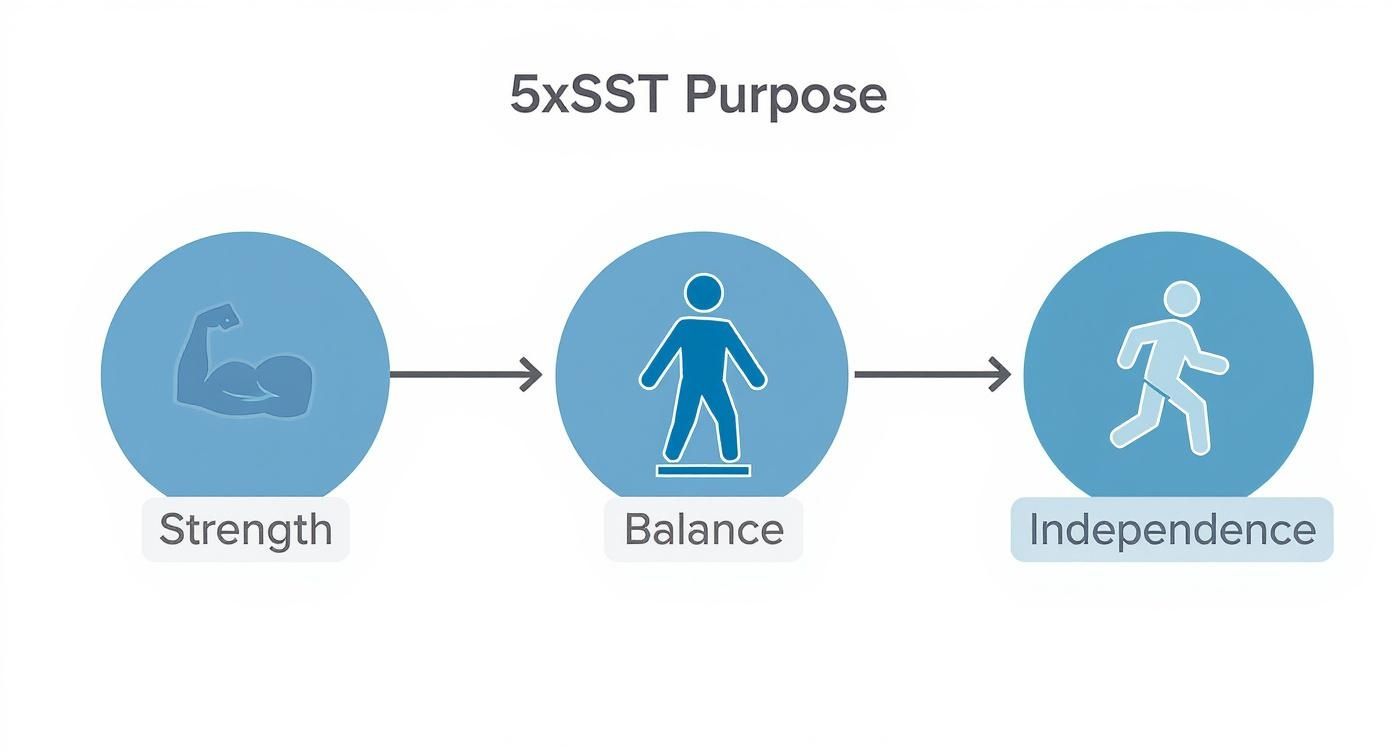
As you can see, it's a quick but surprisingly powerful window into a person's strength, balance, and the functional independence that stems from those abilities.
Timing and Observation
The last piece of the puzzle is hitting "start" and "stop" at the right moments and keeping a sharp eye on the patient's movement. Precision here is what makes the data valid.
Start the stopwatch the second you say "Go." Stop it the moment the patient’s backside touches the chair after that fifth and final rep. As they move, watch for common mistakes—like their back hitting the chair back or not coming up to a full standing position. Documenting the quality of their movement is just as important as the final time. Of course, timing is just one piece of the clinical puzzle, and it's important to be proficient in other assessments as well. You can learn more about other important range of motion measurement tools in our related article.
Following the protocol exactly is what makes the data powerful. It allows you to compare a patient's score to age-matched norms and reliably track their progress from one session to the next, knowing you are measuring genuine change, not procedural differences.
The need for accuracy in tests like the 5 Times Sit to Stand is paramount, much like the precision needed for mastering CNA skills tests. When you commit to this standardized protocol, you give yourself the power to collect high-quality data that can genuinely inform your clinical decisions and guide your patients toward better outcomes.
Interpreting Scores to Guide Clinical Decisions

A stopwatch score from the 5 times sit to stand test is just a number. It's what you do with that number—how you translate it into a meaningful story about your patient's function—that makes this test so powerful. We're moving beyond just logging seconds to uncover what the data truly reveals about a patient's ability to navigate their world.
This is all about context. By comparing a patient's score to established benchmarks, you can quickly tell if their performance is on par for their age or if it's a red flag that warrants a closer look.
Benchmarking Against Normative Data
The first step is always to see how your patient stacks up against their peers. Comparing their time to normative data—the average scores for healthy people in the same age bracket—gives you an instant frame of reference. Are they keeping pace, or are they falling behind?
Thankfully, the research gives us some solid numbers to work with. A 2011 study provided the following average times for community-dwelling adults (4):
- 11.4 seconds for ages 60–69
- 12.6 seconds for ages 70–79
- 14.8 seconds for ages 80–89
These age-related norms are crucial. A 15-second score might be a serious concern for a 65-year-old, but for a 92-year-old, that could be a fantastic starting point. It's all about setting realistic, meaningful goals based on the individual.
Distinguishing Real Change from Noise
When you re-test a patient and see a better score, how do you know if it's a real improvement? That’s where two key concepts come in: Minimal Detectable Change (MDC) and Minimal Clinically Important Difference (MCID).
- Minimal Detectable Change (MDC): Think of this as your "noise filter." It’s the smallest change that you can be sure isn't just a fluke or measurement error.
- Minimal Clinically Important Difference (MCID): This is the one that really matters to the patient. The MCID is the smallest improvement that makes a noticeable difference in their daily life.
For the 5xSST, a systematic review found the MDC is generally between 3.5 and 4.2 seconds for older adults, while the MCID is around 2.3 seconds (5). So, if a patient improves by one second, that's great, but it might just be within the range of measurement error. But an improvement of four seconds? That's not only statistically significant—it’s a change your patient can likely feel.
To help you keep these vital numbers straight, here’s a quick-reference table summarizing the key benchmarks for the 5xSST.
5xSST Performance Benchmarks and Clinical Thresholds
| Metric | Value (in seconds) | Clinical Significance |
|---|---|---|
| Normative (60-69 yrs) | 11.4 (4) | Average performance for healthy adults in this age group. |
| Normative (70-79 yrs) | 12.6 (4) | Average performance for healthy adults in this age group. |
| Normative (80-89 yrs) | 14.8 (4) | Average performance for healthy adults in this age group. |
| Fall Risk Cut-Off | >15.0 (1) | A score above this threshold indicates an increased risk of falls. |
| MCID | ~2.3 (5) | Smallest change that is meaningful and noticeable to the patient. |
| MDC | 3.5 - 4.2 (5) | Smallest change that is statistically real, beyond measurement error. |
This table serves as a clinical cheat sheet, allowing you to quickly contextualize a patient's score—whether you're setting initial goals, tracking progress, or assessing their overall fall risk.
Identifying Fall Risk with Cut-Off Scores
Perhaps the most critical use of the 5xSST is its power to help predict fall risk. This is where the test can truly be a lifesaver. Research has identified specific time thresholds that act as warning signs for future falls.
The most widely recognized cut-off score for community-dwelling older adults is 15 seconds. If a patient takes longer than this to complete the five repetitions, they are considered to have a significantly higher risk of falling (1).
This isn't just a hunch; it's an objective data point. It allows you to shift from a general concern about someone's balance to an evidence-based assessment of their specific risk level. Armed with this knowledge, you can confidently recommend proactive interventions—like targeted strength programs, balance training, or a home safety review—to mitigate that risk before an accident happens.
Using the Test to Predict Future Health Risks
The 5 times sit to stand test does far more than just give us a snapshot of a person's current physical abilities. Think of it as a tool for understanding their future health trajectory. The final number on that stopwatch is more than just a score; it’s a powerful piece of data that can act as an early warning system for clinicians, connecting directly to major long-term health outcomes.
Solid scientific evidence has backed this up. A slower time isn't just a sign of weak legs. It's a strong predictor of an increased risk for falls, potential hospitalizations, and in some populations, even mortality (6). This shifts the 5xSST from a simple functional measure into a critical tool for proactive, preventative care.
Linking Performance to Falls and Hospitalization
One of the most powerful applications of the 5xSST is its knack for flagging individuals at a high risk for future falls. A slow time on this test is a direct reflection of deficits in lower body strength and dynamic balance—two of the most critical factors that keep us steady on our feet.
By pinpointing those at higher risk, we can step in with targeted advice, like providing essential winter safety tips for seniors to help them navigate icy conditions safely. This proactive approach means we can implement specific balance and strength programs to address the deficits before a fall happens, cutting down the chances of serious injuries and hospital stays.
The test’s predictive power doesn’t stop at falls. Poor performance can also be a red flag for underlying frailty, which is closely linked to a higher chance of adverse health events, longer hospital stays, and a tougher recovery after an illness or surgery.
This is precisely why a well-rounded approach using multiple balance assessment tests for the elderly is so valuable. It helps paint a much more complete picture of a patient's functional status and overall risk profile.
Prognostic Value in At-Risk Populations
The 5xSST is particularly insightful when used with at-risk populations, like older adults who are already managing existing health conditions. For instance, its value as a prognostic tool has been clearly shown in individuals with cardiovascular disease (CVD).
A large study following older CVD patients found a powerful link between slow 5xSST times and mortality risk (7). Over a two-year follow-up, 18.3% of the patients passed away. After accounting for other factors, patients in the slowest performance group had a 34% higher risk of mortality compared to those in the fastest group. This really drives home the test's ability to identify those at greatest risk. You can discover more about these cardiovascular health findings.
What’s even more telling? The outcome for those who couldn't complete the test at all. The same study revealed that patients who were unable to perform all five repetitions faced a staggering 128% higher mortality risk. This inability to complete the test is a profound clinical signal, pointing to severe functional limitations and a dramatically elevated risk of adverse events.
This evidence isn't just academic; it underscores the test’s vital role in preventative medicine. It gives clinicians the objective data they need to identify vulnerable individuals early. With that foresight, they can roll out targeted strategies—from tailored rehab programs to simple lifestyle changes—that can genuinely change a patient’s long-term health trajectory for the better.
How to Handle Common Errors and Modifications
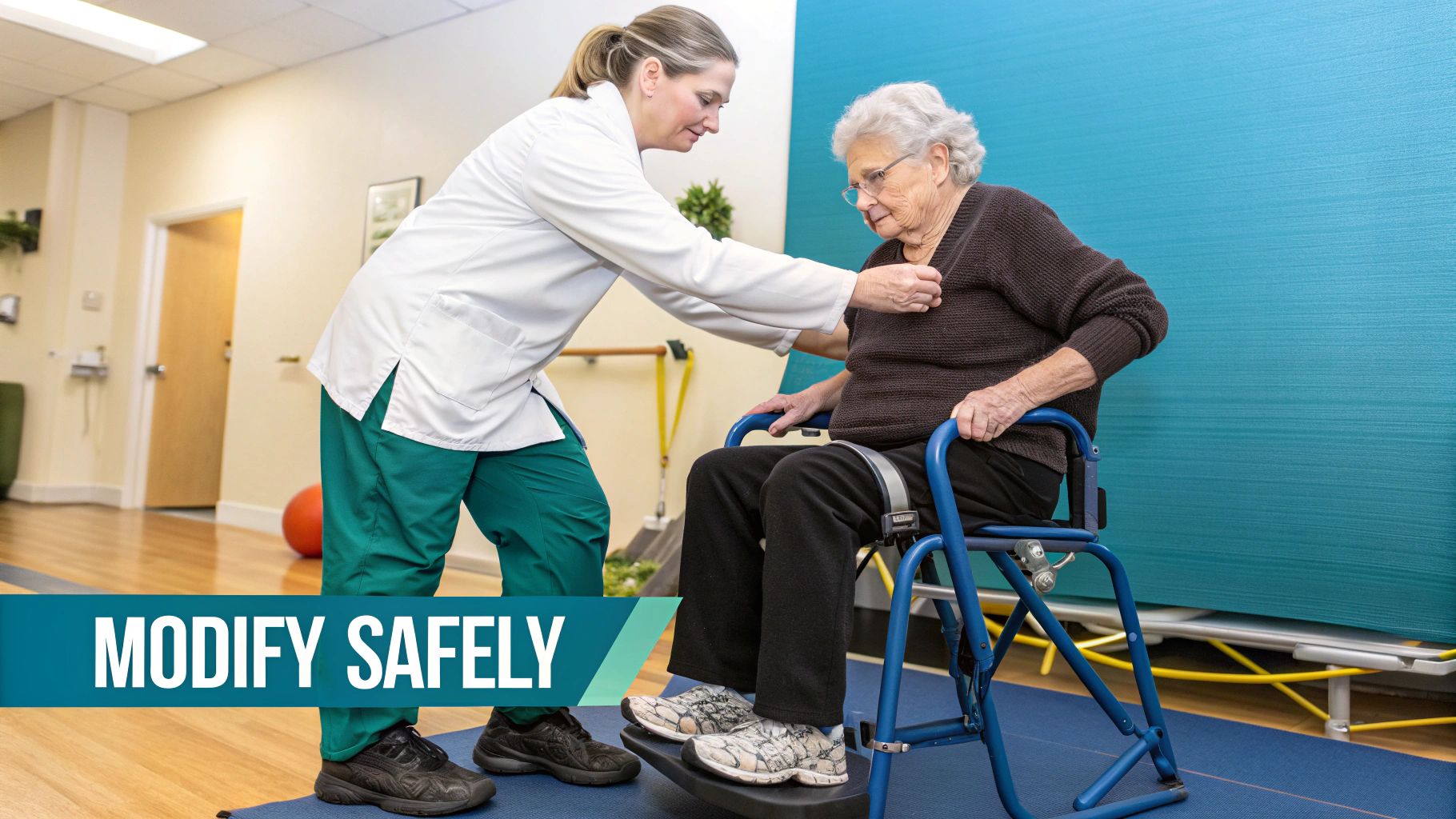
Applying any clinical test in the real world rarely goes exactly by the book. During the 5 times sit to stand test, you're bound to see some interesting compensations and will need to make on-the-spot adjustments. Knowing how to manage these situations is what separates a good clinician from a great one, allowing you to gather meaningful data while keeping your patient safe.
The goal isn't to force every person into a perfect, standardized box. It's about understanding their limitations and adapting the test in a smart, documented way. This is how you maintain the test's clinical integrity, even when the protocol needs a little tweaking.
Correcting Common Performance Errors
Certain mistakes pop up all the time with the 5xSST. Being able to spot and correct them ensures you're actually measuring lower body function, not just a patient's creative workarounds. Often, a simple, clear verbal cue is all it takes to get things back on track.
Here are the most common slip-ups and how to handle them:
-
Using Hands for Momentum: This is probably the most frequent error. Patients will almost instinctively try to push off their thighs to get going.
- Correction: Give a clear reminder: "Keep your arms folded across your chest." If they keep doing it, a gentle tap on their arms can provide the tactile cue they need to reinforce the position.
-
Incomplete Standing or Sitting: You'll see this with patients who rush or lack full confidence. They might only perform partial squats, never fully extending their hips and knees at the top.
- Correction: Before they even start, use a direct cue like, "Stand up straight all the way." If they're rushing the descent, instruct them to "touch the seat completely" on each rep.
-
Losing Balance or Stumbling: If a patient becomes unsteady, their safety immediately becomes the number one priority.
- Correction: Always stand close and be ready to provide support. If they lose their balance, stop the test. Make sure they're stable, and then document the number of reps they completed successfully.
When and How to Modify the Test
Sometimes, the standard protocol is just too much for a patient. Whether it's due to significant weakness, pain, or balance issues, forcing the standard test would be unsafe and unproductive. In these moments, a modification isn't just acceptable; it's clinically necessary. The key is to make a deliberate, documented change rather than letting uncontrolled errors muddy your data.
The ability to modify the test makes it accessible to a much broader range of individuals. Documenting that a patient used their hands for support is a valuable piece of clinical information, not a failure of the test itself.
Common, clinically accepted modifications include:
- Allowing Hand Use: If a patient simply cannot complete the test without a little help, let them push off their thighs or another stable surface. This is often recorded as a "modified" 5 times sit to stand.
- Adjusting Chair Height: For someone with severe weakness or significant knee pain, using a slightly higher or firmer chair can make the test possible.
- Using an Assistive Device: In some situations, you might permit the use of a walker or cane for stability.
Here's the crucial part: any modification must be documented clearly right next to the time. A score of "25 seconds (modified - with hands)" tells a completely different clinical story than "25 seconds (standard)." This detailed note is essential for consistent re-testing and for anyone else on the care team reading your notes. It ensures you're always comparing apples to apples when tracking that patient's progress over time.
Questions We Hear in the Clinic
Even with the best guides, questions always pop up when you start using a tool like the 5 times sit to stand test day-to-day. Let’s tackle some of the most common "what if" scenarios we hear from fellow clinicians to clear up any confusion and help you use the test confidently.
Our goal here is to get practical and talk through the real-world situations you’re bound to run into.
What If My Patient Can’t Finish All Five Reps?
First things first: stop the test. Patient safety is always the priority.
If someone can only manage two or three reps before fatigue, pain, or a balance loss forces them to stop, that’s your finding. Don’t think of it as a failed test. In reality, it’s a critically important clinical insight. Document the number of reps they completed and exactly why you had to stop.
The inability to complete the 5xSST is a powerful indicator on its own, often pointing to significant functional decline or frailty. As noted earlier, this result has been strongly linked to a higher risk of adverse health events, giving you valuable prognostic information without even needing a final time score (7).
How Often Should I Be Doing the 5 Times Sit to Stand Test?
There's no single right answer here—it really depends on your setting and what you're trying to achieve with the patient. The best practice is to get a baseline at the initial evaluation and then re-test strategically to see if your interventions are actually working.
Here are a couple of common approaches:
- Rehab Settings (Inpatient/Outpatient): Re-testing every 2-4 weeks usually hits the sweet spot. It’s frequent enough to track changes during an episode of care and gives you a great outcome measure at discharge.
- Primary Care or Geriatric Screening: For tracking long-term function in community-dwelling older adults, an annual test is typically enough to catch any meaningful declines from year to year.
Whatever cadence you choose, just be consistent. Regular re-testing lets you quantify progress, but remember to view the changes through the lens of the Minimal Detectable Change (MDC). That's how you'll know if the improvement you're seeing is real and not just normal test-to-test variability.
Is the 5xSST Useful for Athletes?
Absolutely, though its purpose shifts a bit. While the 5 times sit to stand test was born in the world of geriatrics and clinical populations, it has a place in the athletic world. For athletes, it’s less about fall risk and more about assessing things like lower-body power endurance, neuromuscular control, and even functional symmetry between limbs.
It’s especially handy when you’re rehabbing a lower-body injury, like an ACL reconstruction. The test can reveal subtle performance differences between the surgical and non-surgical limbs that might otherwise go unnoticed. However, it's important to remember that for measuring an athlete’s peak power, other tests like vertical jumps or isokinetic dynamometry may provide more sensitive data.
References
- Buatois S, Perret-Guillaume C, Gueguen R, Miget P, Vançon G, Perrin P, et al. A simple clinical scale to stratify risk of recurrent falls in community-dwelling adults aged 65 years and older. Phys Ther. 2010;90(4):550-60.
- Moore M, Barker K. The validity and reliability of the five times sit to stand test in a clinical setting: a systematic review. J Geriatr Phys Ther. 2017;40(3):141-57.
- Shirley Ryan AbilityLab. 5 Times Sit to Stand Test. [Internet]. 2023 [cited 2024 Oct 26]. Available from: https://www.sralab.org/rehabilitation-measures/5-times-sit-stand-test
- Bohannon RW. Reference values for the five-repetition sit-to-stand test: a descriptive meta-analysis of data from elders. Percept Mot Skills. 2011;112(3):845-52.
- Goldberg A, Chavis D, Watkins J, Wilson T. The five-times-sit-to-stand test: validity, reliability, and detectable change in older females. Aging Clin Exp Res. 2012;24(4):339-44.
- Cesari M, Kritchevsky SB, Newman AB, Simonsick EM, Harris TB, Penninx BW, et al. Added value of physical performance measures in predicting adverse health-related events: results from the Health, Aging and Body Composition Study. J Am Geriatr Soc. 2009;57(2):251-9.
- Melo RCN, Leite GSA, Dias FAL, Dias RC, Cosenso-Martin LN, Bernardes GHF, et al. Five times sit-to-stand test as a predictor of mortality in older adults with cardiovascular disease. Eur Heart J. 2024;45(Suppl 1):ehae666.3406.
At Meloq, we’re all about replacing guesswork with hard data. We believe objective measurement is the key to transforming clinical practice. Tools like our EasyForce digital dynamometer and EasyAngle digital goniometer empower clinicians to capture the accurate, repeatable metrics needed to elevate patient care. See how you can provide the data-driven care your patients deserve by exploring our solutions at https://www.meloqdevices.com.

Featured Product
EasyBase Force Plates
Portable dual force plate system for jump testing, balance & rehab. No subscription fees.
Learn More