

A Clinician's Guide to the Box Drop Test
Team Meloq
Autor
Reactive strength is a cornerstone of athletic performance, enabling the explosive movements seen in sprinters and basketball players. It describes the ability of the neuromuscular system to efficiently absorb force and immediately redirect it. One of the most effective methods for quantifying this attribute is the box drop test.
This assessment involves an athlete stepping from a box, landing, and instantly performing a maximal vertical jump. This brief sequence provides a wealth of information about how well the body manages impact forces. It is a functional test of the stretch-shortening cycle (SSC), a key physiological mechanism where muscles and tendons are stretched upon landing, storing elastic energy which is then rapidly released to power the subsequent jump.
Understanding the Box Drop Test
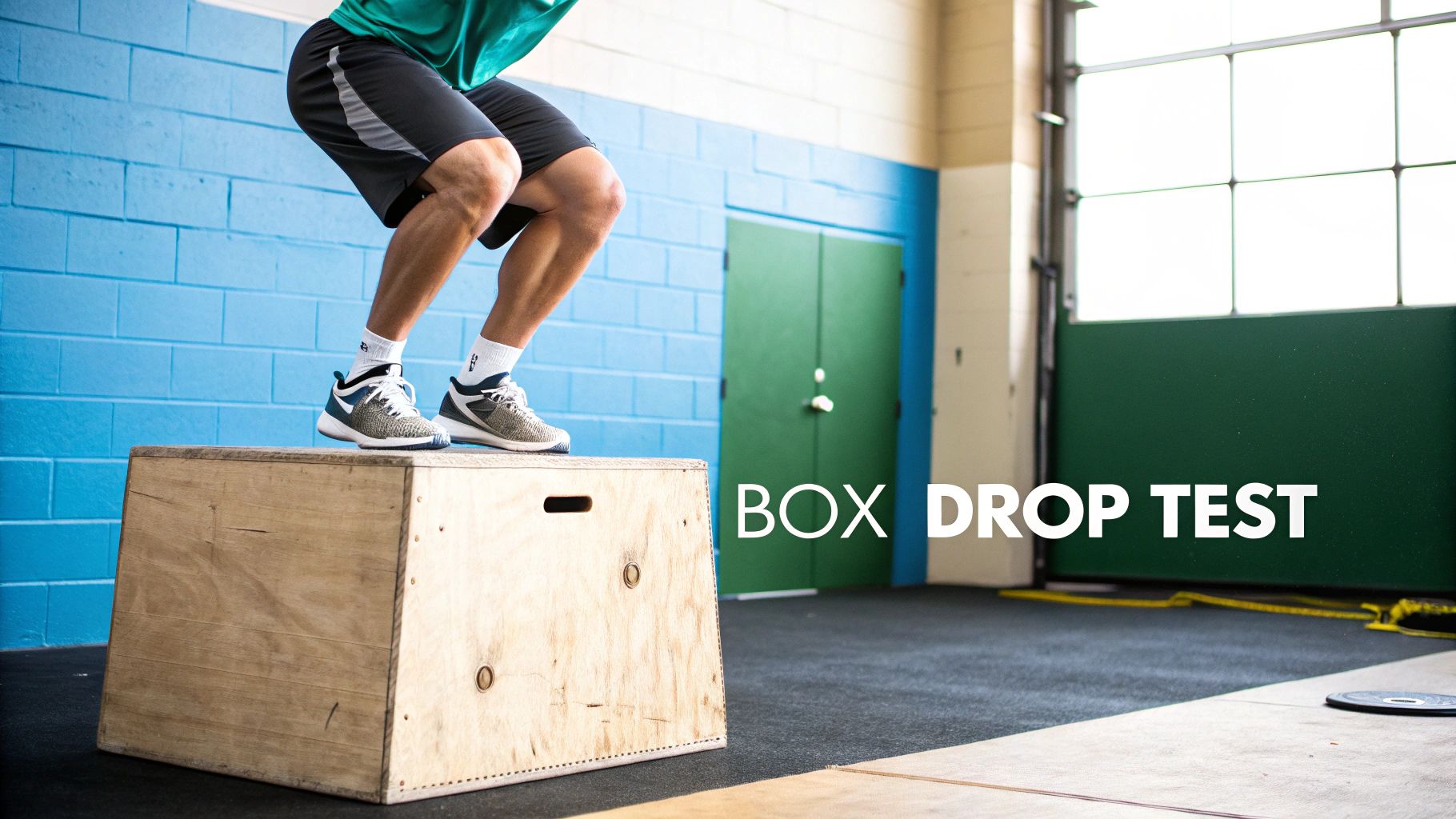
The box drop test, often referred to as a drop jump, provides a window into an athlete's neuromuscular efficiency. The focus is not solely on jump height but on the entire kinetic chain: the landing mechanics, the rapid absorption of impact, and the immediate, explosive redirection of energy. This process is governed by the stretch-shortening cycle (SSC).
An efficient SSC allows for a near-instantaneous release of stored elastic energy, propelling the athlete upwards with minimal ground contact time. Conversely, a delayed or inefficient response may indicate suboptimal neuromuscular control, which can limit athletic performance and potentially increase injury risk.
Why It’s a Clinical Cornerstone
In both performance enhancement and rehabilitation settings, the drop jump is a vital tool for assessing neuromuscular function. It is particularly valuable for evaluating landing mechanics, deceleration capabilities, and readiness for a return to sport following lower-limb injury. By requiring minimal ground contact time, the test specifically assesses the fast SSC, which is critical for most explosive athletic activities. For additional context, you can explore the role of drop jumps in athletic assessment in more detail.
For clinicians and sports scientists, the test is indispensable for objective, data-driven decision-making. Precise measurements can reveal:
- Underlying Deficits: Subtle insufficiencies in force absorption or production that are not apparent during slower, more controlled movements.
- Asymmetries: Significant performance differences between limbs, which are common following injuries such as an anterior cruciate ligament (ACL) tear and may persist if not measured and addressed.
- Neuromuscular Fatigue: A decline in performance over several repetitions can indicate poor conditioning or an over-taxed central nervous system.
The table below outlines the primary uses of the box drop test across different domains.
Primary Uses of the Box Drop Test
| Application Area | Main Objective | Key Performance Indicators |
|---|---|---|
| Sports Performance | To enhance explosive power and reactive strength for better athletic output. | Short ground contact times, high Reactive Strength Index (RSI), and consistent power output across repetitions. |
| Injury Rehabilitation | To safely reintroduce plyometrics and confirm readiness for return-to-play. | Limb symmetry in force absorption/production, stable landing mechanics, and progressive improvement in RSI without pain or compensation. |
| Injury Prevention | To screen for neuromuscular deficits that may increase injury risk. | Asymmetries between limbs (often a >10-15% difference is considered a point of concern), poor landing mechanics (e.g., knee valgus), or ineffective force absorption. |
By quantifying how an athlete handles impact, the box drop test moves us beyond subjective observation. It replaces guesswork with objective data, providing a clear and reliable picture of an athlete's functional capacity and readiness to return to the demands of their sport safely. This makes it a non-negotiable tool in modern sports rehabilitation and performance monitoring.
The Gear You Need for Reliable Testing
To transform a simple box drop test into a powerful diagnostic tool, appropriate equipment is necessary. While a basic version can be performed with just a box, true clinical value is derived from capturing precise, objective data that quantifies the landing and jumping phases.
The foundational equipment includes sturdy, certified plyometric boxes. These must be stable to ensure safety during repeated, explosive use. A standard set typically includes heights of 20, 30, and 40 cm, allowing for adjustments based on the athlete's specific rehabilitation stage or performance level. A means of measuring jump height, such as a Vertec or marked wall, is also required for basic analysis.
Taking Your Analysis to the Next Level
While basic equipment provides outcome measures (jump height), it fails to capture the crucial details of how the movement was performed. To gain these deeper insights, specialised technology is required.
The gold standard for a high-fidelity box drop test is a dual force plate system. Force plates are platforms that measure ground reaction forces with high precision. Using two plates, one under each foot, provides an unparalleled view of an athlete's neuromuscular strategy.
A single force plate can measure overall force, but it’s the dual system that uncovers the critical, often hidden, imbalances between limbs. This is the kind of granular data you need to spot compensatory patterns that could increase re-injury risk.
Building a Complete Picture with Key Technologies
Beyond the essentials, several technologies can be combined to create a comprehensive performance profile.
- Force Plates: As the cornerstone of objective jump testing, force plates quantify metrics such as ground contact time, peak landing forces, and the rate of force development. Critically, they reveal asymmetries between limbs. For those serious about data-driven decisions, exploring different types of force measurement equipment is recommended.
- High-Speed Cameras: While force plates provide quantitative data, high-speed video offers qualitative insights into movement quality. A camera can help assess landing mechanics, identifying issues such as dynamic knee valgus or poor trunk control that may indicate inefficient or risky movement patterns (1).
- Wearable Sensors: Technologies like accelerometers are becoming more common. While they may not offer the same level of kinetic detail as force plates, they can provide valid estimates of jump height, ground contact time, and reactive strength, making them a practical option for field-based testing or clinics with budget constraints (2).
Ultimately, incorporating these technologies provides the objective, actionable data required for confident clinical decision-making.
How to Run a Box Drop Test: The Standard Protocol
Reliable and repeatable data from a box drop test depends on a consistent, standardised protocol. This ensures that any observed changes reflect true physiological adaptations rather than variations in testing procedure.
The process begins with a thorough dynamic warm-up to prepare the neuromuscular system. It is also crucial to clearly explain and demonstrate the entire movement to the athlete.
Selecting the Right Box Height
Choosing the appropriate box height is a critical decision tailored to the individual. The aim is to select a height that challenges the stretch-shortening cycle without overwhelming the athlete, which could lead to poor technique and invalid data.
- For Rehabilitation: In later stages of recovery, a lower box height (e.g., 20 cm) is recommended. This manages landing forces while still providing a clear picture of reactive strength progression.
- For Performance: With healthy, trained athletes, heights of 30-40 cm are often used. This greater drop height increases the eccentric demand during landing, offering a more robust assessment of their ability to absorb and redirect significant force (1).
The selected height should allow the athlete to minimise ground contact time. If the drop is too high, they will spend excess time absorbing the impact, which negates the purpose of testing the fast stretch-shortening cycle.
This simple workflow shows the key data capture stages in a box drop test.
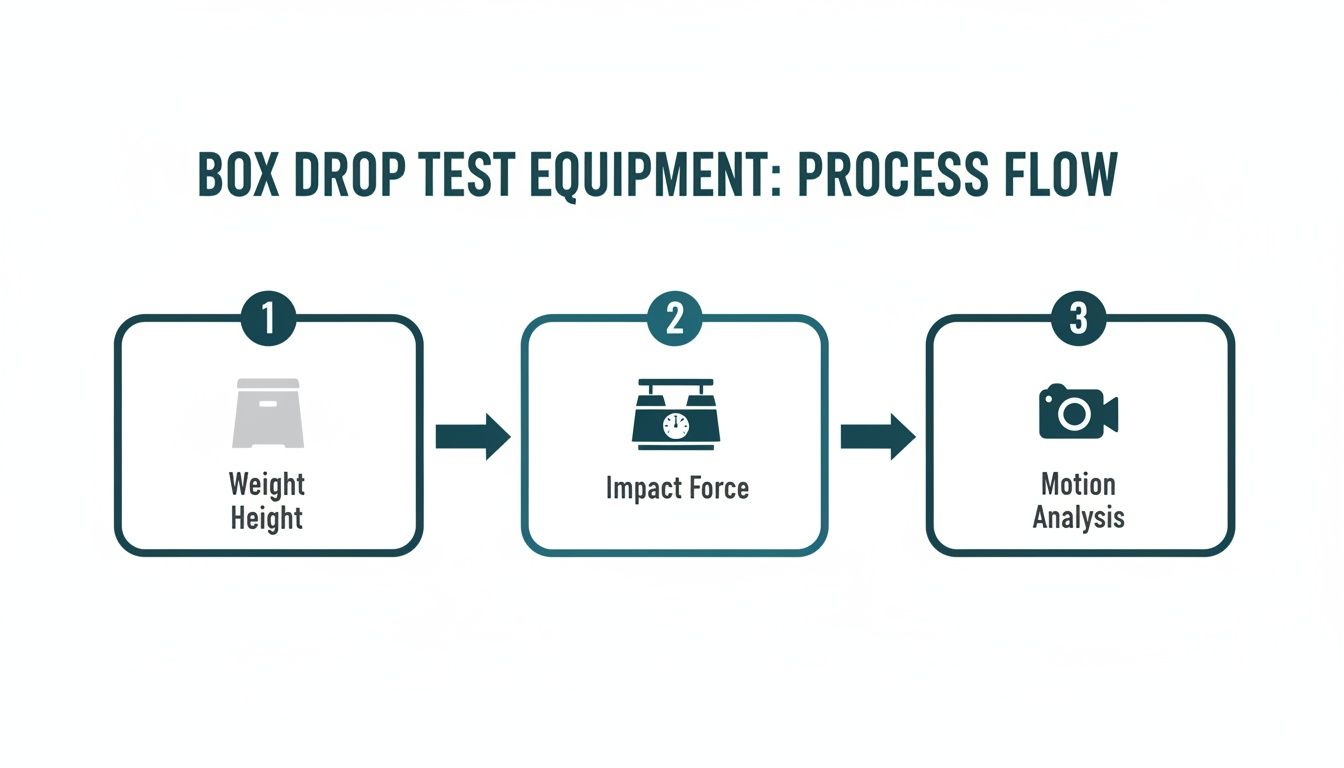
As shown, combining a plyometric box with force plates and video analysis creates a comprehensive environment for data capture.
Executing with Flawless Technique
Clear and consistent instructions are paramount. Using scripted cues helps eliminate ambiguity and ensures every athlete performs the test identically across all sessions.
Instructions should be simple and direct.
"Step off the box with one foot—do not jump down. The instant both feet contact the ground, jump straight up as high and as fast as possible. Aim to spend the least amount of time on the ground."
This command covers the three critical components: the step-off, the immediate ground reaction, and the maximal-effort jump.
Several other variables must be controlled to standardise the test:
- Arm Swing: Decide beforehand whether the athlete will perform the jump with hands on their hips (to isolate lower body contribution) or with a natural arm swing. Whichever method is chosen, it must remain consistent for that athlete across all future tests.
- Repetitions and Rest: A typical protocol involves 3-5 maximal effort jumps. It is crucial to provide adequate rest, generally 30-60 seconds, between repetitions to allow for neuromuscular recovery and prevent fatigue from confounding the results.
- Landing Target: The athlete should aim to land on the same spot for each repetition, ideally centred on the force plates, to ensure consistent measurement of ground reaction forces. For a deeper look at jump mechanics, our guide on the force plate vertical jump is a useful resource.
By controlling these factors, you can be confident that changes in data reflect genuine changes in the athlete's neuromuscular function, not inconsistencies in testing.
Translating Data Into Clinical Insights
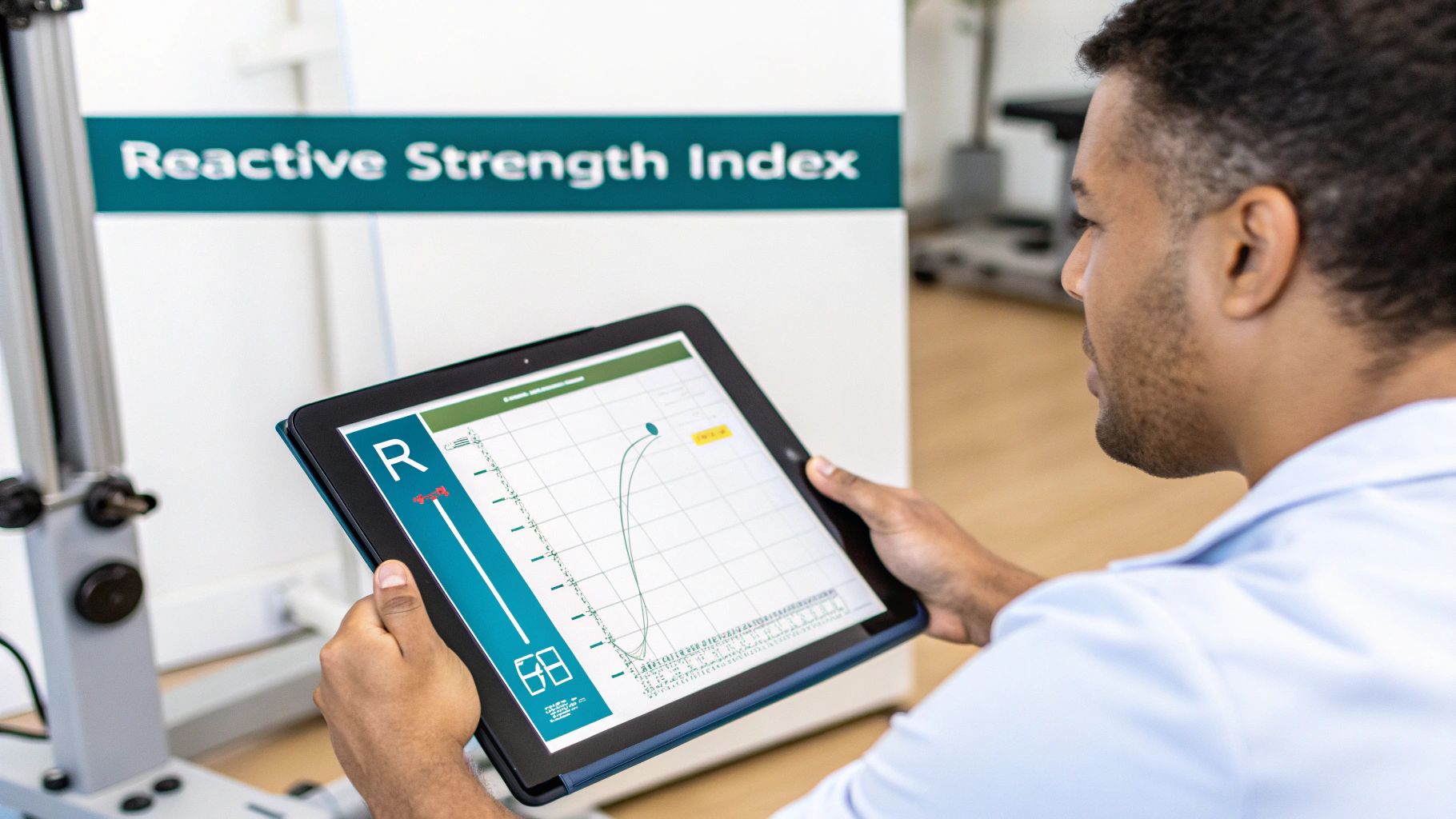
Executing a box drop test with a standardised protocol is only the first step. The true clinical value lies in interpreting the raw data to understand an athlete's neuromuscular function and readiness. This process transforms numerical outputs into a clear narrative about performance capabilities and potential risks.
Modern force plate systems often include software that automates the calculation of key metrics. This instant analysis allows clinicians to move directly from data collection to interpretation and program design.
Unpacking the Key Performance Metrics
The box drop test yields several critical data points, each providing a unique insight into an athlete's physical capabilities.
Reactive Strength Index (RSI) is a primary metric, calculated by dividing jump height by ground contact time. It is a composite measure of explosive efficiency.
A high RSI score indicates that an athlete can achieve significant jump height with minimal ground contact time—the hallmark of an efficient stretch-shortening cycle. A low RSI may suggest that they either spend too much time on the ground, dissipating energy, or lack the power to jump high.
Ground Contact Time (GCT) is the duration, measured in milliseconds, that an athlete's feet are in contact with the force plate between landing and take-off. It provides a direct measure of how quickly they transition from absorbing force (eccentric phase) to producing it (concentric phase). For highly reactive athletes, GCTs are often below 250 milliseconds (1). A prolonged GCT can signal poor eccentric strength or a delayed neuromuscular response.
Digging Deeper Into the Data
Beyond these primary metrics, other data points provide a more granular view of performance.
- Peak Ground Reaction Force (GRF): This is the maximum force the athlete applies to the ground during the jump. It reflects raw power potential but must be interpreted in context with other metrics like GCT.
- Rate of Force Development (RFD): This measures how quickly an athlete can generate peak force. High RFD is non-negotiable in sports requiring split-second reactions.
- Asymmetry Index: When using dual force plates, this metric is arguably the most critical for rehabilitation. It quantifies the performance difference between limbs. A limb symmetry index below 90% is often considered a significant finding, pointing to a potentially problematic imbalance (2).
This table provides a quick reference for interpreting key metrics in a clinical setting.
Key Box Drop Test Metrics Explained
| Metric | What It Reveals | Clinical Significance |
|---|---|---|
| Reactive Strength Index (RSI) | Overall explosive efficiency and SSC function. | A key indicator of athletic potential and readiness for high-demand sports. |
| Ground Contact Time (GCT) | Speed of the transition from eccentric to concentric contraction. | Short times indicate efficient energy transfer; long times suggest neuromuscular inefficiency. |
| Peak Ground Reaction Force (GRF) | Maximum force production capability. | Provides insight into an athlete's raw strength and power output. |
| Asymmetry Index | Imbalances in force/power between limbs. | Critical for identifying injury risk, especially post-surgery or injury. |
The Clinical Relevance of Deficits
Identifying these deficits has significant real-world implications, particularly in post-operative rehabilitation. For example, following an anterior cruciate ligament reconstruction (ACLR), athletes often exhibit persistent deficits in reactive strength.
Research has shown that a significant percentage of ACLR patients do not return to their pre-injury competitive sport level, and re-injury rates are a major concern. A recent meta-analysis on post-ACLR jump performance highlighted that these athletes demonstrated significantly lower drop jump heights compared to healthy controls, indicating persistent deficits in reactive strength that must be addressed prior to a safe return to sport.
Using the box drop test to quantify these metrics allows clinicians to confidently identify athletes who are not yet prepared for the demands of their sport, thereby protecting them from premature return and potential re-injury. You can learn more about how normative data aids this process by exploring our guide on the subject of definition and normative data.
Making Confident Return to Sport Decisions
Collecting precise data from a box drop test is a powerful step, but using it to guide an athlete's return-to-sport decision is where its true value lies. Objective measurement transforms complex data into a clear narrative of an athlete’s readiness, facilitating evidence-based conversations with all stakeholders.
Case Study: An ACL Reconstruction Journey
Consider a 19-year-old soccer player, nine months post-ACLR. She has met all strength and balance criteria and reports feeling mentally ready to return to play. Subjectively, she appears ready. However, a box drop test is conducted to objectively assess her ability to manage explosive forces.
The force plate data reveals two significant red flags:
-
Low Reactive Strength Index (RSI): Her RSI score is well below established benchmarks for her sport. This indicates that while she can produce force, she cannot do so rapidly. Her neuromuscular system is still inefficient at absorbing and redirecting energy—a critical skill for the dynamic movements required in soccer.
-
Significant Asymmetry: The data reveals a limb symmetry index of 82%. Her non-surgical leg is generating significantly more power and absorbing more force than her reconstructed leg. This is a classic compensatory pattern where the body unconsciously protects the involved limb, placing the uninvolved limb at an increased risk of injury.
Interpreting the Data for Decision Making
Armed with this objective data, the return-to-sport conversation is reframed. Instead of a subjective assessment, you can present specific numbers. You can explain that a limb symmetry index below 90% is associated with an increased risk of re-injury, and that her low RSI indicates a specific performance deficit that requires targeted intervention.
This evidence-based approach shifts the focus from a feeling of "readiness" to clear, measurable goals. The box drop test data not only identifies limitations but also provides a roadmap for the final phase of rehabilitation.
This approach transforms the clinician's role from a simple gatekeeper to a strategic partner. The data provides a shared language for what "ready" truly means, building trust and ensuring the athlete is an active participant in their own comeback story.
The rehabilitation program can then be modified to address these specific deficits, perhaps by incorporating drills designed to improve fast SSC function and targeted plyometrics to reduce the asymmetry. Subsequent testing will objectively track progress, allowing for program adjustments until all criteria for a safe return are met.
To better understand how this data fits into a larger clinical framework, you can explore the objective of measurement and its role in modern practice.
The Bigger Picture: A Comprehensive Testing Battery
It is essential to remember that the box drop test is one component of a comprehensive return-to-sport testing battery. It should be used alongside other assessments, such as isokinetic strength testing, various hop tests, and sport-specific movement screens. Together, these tests provide a multi-faceted profile of an athlete's functional capacity.
This thorough approach is critical given the high stakes. Some research suggests that only a minority of athletes pass comprehensive return-to-sport test batteries. However, athletes who do pass these test batteries have a significantly lower risk of re-injury, highlighting the predictive value of these objective assessments.
This is particularly relevant considering that a substantial number of athletes who undergo ACL reconstruction may suffer a second ACL injury, often within two years of returning to sport. By insisting on objective data and clear, evidence-based criteria, clinicians can play a pivotal role in mitigating these risks and ensuring athletes return to their sport safely and for the long term.
Common Questions About the Box Drop Test
As the box drop test becomes more integrated into clinical practice, several practical questions arise.
What Is a Good Reactive Strength Index Score?
There is no single "good" RSI score, as it is highly dependent on the individual's sport, age, and training level (1). Context is key.
However, as a general guideline, an RSI above 2.5 from a 30cm drop is often considered indicative of well-developed reactive strength for many athletic populations. The primary value of RSI lies not in achieving a specific number but in tracking an individual's progress over time and comparing them to normative data for their specific peer group.
When Is This Test Appropriate After an ACL Injury?
The box drop test is a high-level assessment and should be reserved for the final phases of return-to-sport testing. It is not an early-stage rehabilitation exercise.
Before an athlete attempts a drop jump, they must meet several prerequisite criteria, including full range of motion, satisfactory strength metrics (e.g., limb symmetry index >90% on strength tests), and the ability to perform lower-level plyometric activities without pain, swelling, or apprehension.
Can This Test Be Performed on a Single Leg?
Yes, the single-leg drop jump is an advanced variation that provides a more detailed assessment of unilateral power, landing control, and limb asymmetry.
Due to its increased demand, it should only be introduced after an athlete has demonstrated mastery of the bilateral version with excellent mechanics. This variation is particularly useful for identifying subtle deficits that may be masked during a two-footed jump (2).
A typical protocol is 3-5 maximal effort jumps, with ample rest of 30-60 seconds between repetitions. The focus should always be on the quality of movement. If an athlete's technique degrades due to fatigue, the test should be stopped to ensure data validity and minimise injury risk.
References
- Flanagan EP, Comyns TM. The use of contact time and the reactive strength index to optimize drop jump training. Strength & Conditioning Journal. 2008 Oct 1;30(5):32-8.
- Welling W, Benjaminse A, Lemmink K, Gokeler A. Passing return to sport tests after ACL reconstruction is associated with greater likelihood for return to sport but does not guarantee a safe return to sport. The Knee. 2020 Oct 1;27(5):1435-46.

Producto destacado
Dinamómetro digital EasyForce
Pruebas de fuerza muscular de mano con un 99 % de precisión. Utilizado en más de 40 estudios revisados por pares.
Más información